
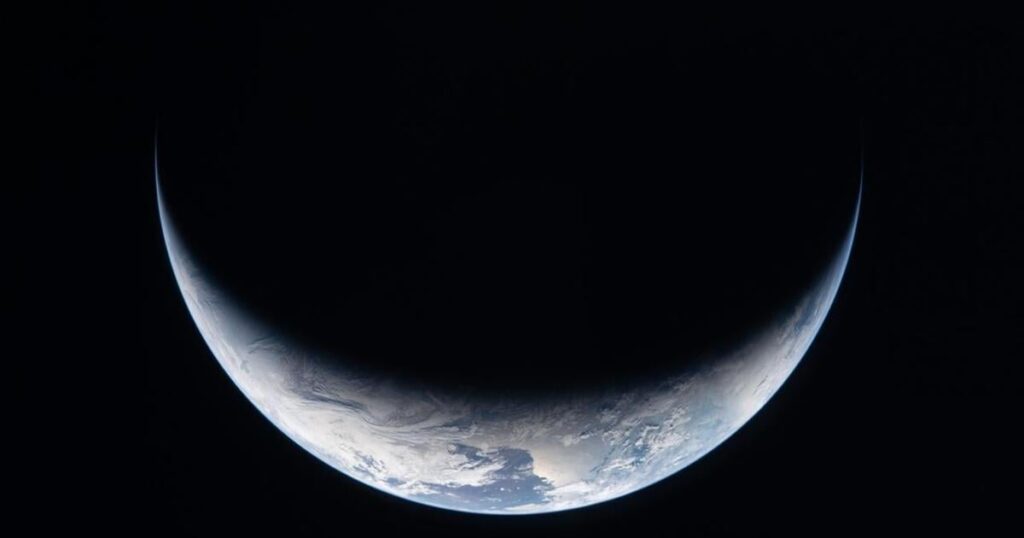
Amateur Kelowna astronomers, over the moon about the Artemis II space mission, are eager to once again share their passion for space with the wider public.
The Okanagan Observatory east of Kelowna will open soon for regular Friday viewings of the night sky.
Hopes for this year’s viewing season are high with expectations that public attendance will rise in the wake of Orion carrying humans farther than ever before into space.
“We are hoping to have the observatory open in the beginning of May,” said Penny Nile, of the Royal Astronomical Society of Canada – Okanagan Centre branch. “We just have to wait for the snow to melt and the ground to harden up.”
The four-person Orion crew, including Canadian astronaut Jeremy Hansen, on Monday went about 6,000 km further than the 400,171 km distance from Earth reached by the Apollo 13 mission in 1970.
Represented by Hansen, Canada is now only the second nation after the U.S. to send an astronaut that far into space.
“We will continue our journey even further into space before Mother Earth succeeds in pulling us back to everything that we hold dear, but we, most importantly, choose this moment to challenge this generation and the next to make sure this record is not long-lived,” said Hansen, who was chosen to speak on behalf of the astronauts on the momentous occasion.
Back on Earth, Colleen O’Hare, another member of the local astronomical society, said she was “so excited” for the Artemis II mission.
And longtime club member Jim Failes said: “It’s great to see a new generation getting inspired by the extraordinary experience of a human crew travelling to the moon, and beyond.
“The power of an enormous rocket lifting off, the precise calculation of a trajectory to meet the moon in its orbit, the prospect of living 10 days in a confined craft with three other people – these things are so far beyond our everyday experience, they captivate our imagination.
“As astronomy enthusiasts, perhaps we have a better appreciation than most of the huge distances, technological challenges, and unforgiving risks involved in space travel,” Failes said. “But anyone can feel the excitement and concern for the crew.”
The Orion was scheduled to splash down in the Pacific Ocean about 50 miles off the coast of San Diego on Friday afternoon.