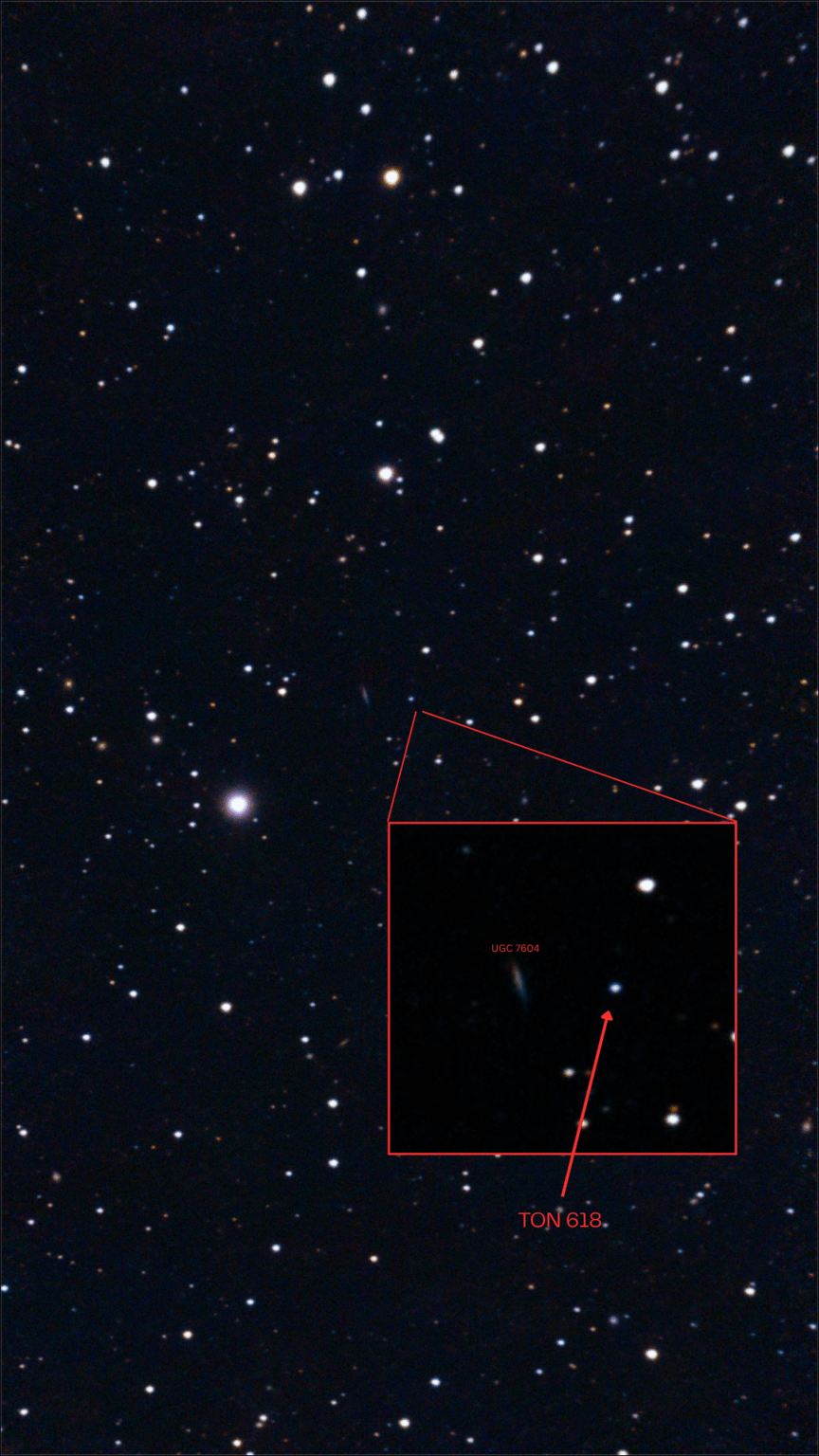
That’s nice. What’s the brightest object in view in the centre left? Are things that appear brighter larger = closer?
Seaniau on
Man, 10 billion light years is just an unfathomable distance, like what you’re observing was there 10 billion years ago and we have no idea what it looks like right now
And it took us what, 6 days travel to reach the Moon again and it’s right there in the sky.
I love space, but it scares me how insignificant we are 😂
Hopeful_Group7684 on
Gibts zu dem Bild, technische Details?
gimmeslack12 on
.
Tribolonutus on
The scale itself that is shown on this photograph is mind blowing…
Bobby_The_Kidd on
Wow! What did you use to photograph it? I assumed objects that far away wpuld require like telescopes as large as Hubble or something
MarsMaterial on
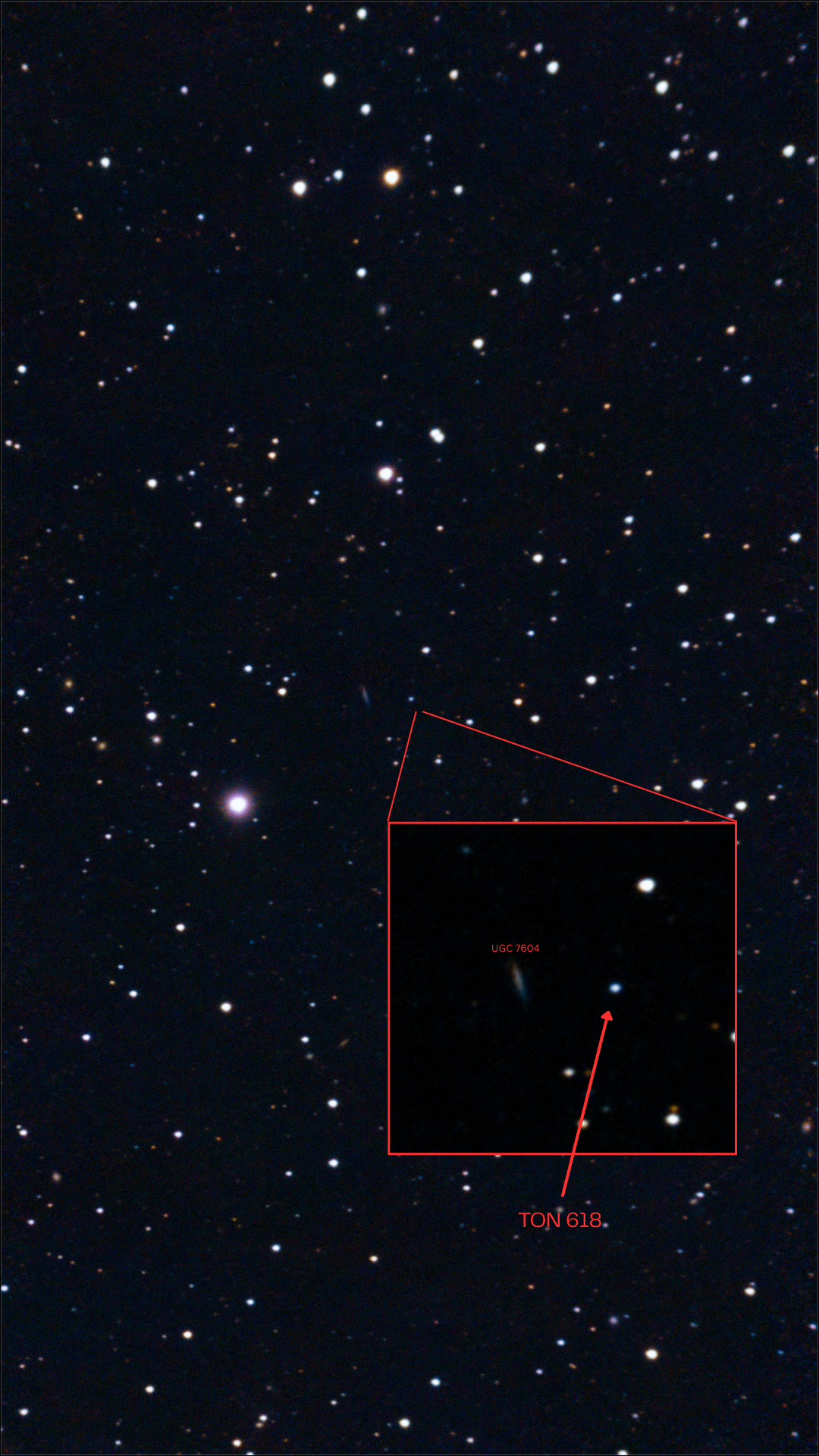
TON 618 is such an interesting object. A black hole so monstrous that you could theoretically see the event horizon with the naked eye from multiple light years away. So colossal that if you fell past the event horizon it would take over a week to reach the singularity. An event horizon that extends further than the distance from here to Voyager 1. And every 5 millimeters or so of that vast Schwarzschild radius represents the mass of the entire Earth.
And it’s real. So real that you just photographed it. And it’s so intense that you were able to do so from 10 billion light years away, a distance so absurd that this light is more than twice as old as the planet under your feet.
It blows my mind to think about it.
MsuProdigy69_ on
Shouldn’t we be able to see the pulses of light coming out of it at the poles due to it being a quasar?
HJVN on
I always find it fascinating, that they know, that bright dot in that picture with 100 other bright dots, is a black hole, and not a star.
jradio on
Is some of that gravitational lensing? Some of those stars look similar.
dekion101 on
Probably evaporated by now.
PeukkuBoi88 on
Would it be possible to even know what it is without knowing what it is?
It looks like a just a another star.
ivorybishop on
I am not very knowledgeable about astronomy, could someone explain how we know that dot is not another star?
In my mind, it seems like it’s so far away, how can we even begin to determine that it’s not an actual star.
Astronomy is wild.
JustAnotherMile on
Lies! Can’t be a black hole if it is bright! /s
OliOli1234 on
Well thank god it’s far, I guess.
NecessarySeaweed9409 on
How did you capture this image?
rosy_drunkenness on
That’s not actually TON 618 in the image, mate. That faint smudge is just the host galaxy, the black hole itself is invisible. You’re looking at billions of years of light travel time compressed into a tiny box.

20 Comments
That’s nice. What’s the brightest object in view in the centre left? Are things that appear brighter larger = closer?
Man, 10 billion light years is just an unfathomable distance, like what you’re observing was there 10 billion years ago and we have no idea what it looks like right now
And it took us what, 6 days travel to reach the Moon again and it’s right there in the sky.
I love space, but it scares me how insignificant we are 😂
Gibts zu dem Bild, technische Details?
.
The scale itself that is shown on this photograph is mind blowing…
Wow! What did you use to photograph it? I assumed objects that far away wpuld require like telescopes as large as Hubble or something
TON 618 is such an interesting object. A black hole so monstrous that you could theoretically see the event horizon with the naked eye from multiple light years away. So colossal that if you fell past the event horizon it would take over a week to reach the singularity. An event horizon that extends further than the distance from here to Voyager 1. And every 5 millimeters or so of that vast Schwarzschild radius represents the mass of the entire Earth.
And it’s real. So real that you just photographed it. And it’s so intense that you were able to do so from 10 billion light years away, a distance so absurd that this light is more than twice as old as the planet under your feet.
It blows my mind to think about it.
Shouldn’t we be able to see the pulses of light coming out of it at the poles due to it being a quasar?
I always find it fascinating, that they know, that bright dot in that picture with 100 other bright dots, is a black hole, and not a star.
Is some of that gravitational lensing? Some of those stars look similar.
Probably evaporated by now.
Would it be possible to even know what it is without knowing what it is?
It looks like a just a another star.
I am not very knowledgeable about astronomy, could someone explain how we know that dot is not another star?
In my mind, it seems like it’s so far away, how can we even begin to determine that it’s not an actual star.
Astronomy is wild.
Lies! Can’t be a black hole if it is bright! /s
Well thank god it’s far, I guess.
How did you capture this image?
That’s not actually TON 618 in the image, mate. That faint smudge is just the host galaxy, the black hole itself is invisible. You’re looking at billions of years of light travel time compressed into a tiny box.
this is just like that one geometry dash level
This is a neat read
[SLABs](https://en.wikipedia.org/wiki/Supermassive_black_hole#Description)
I wonder what the universe inside that black hole is like..