
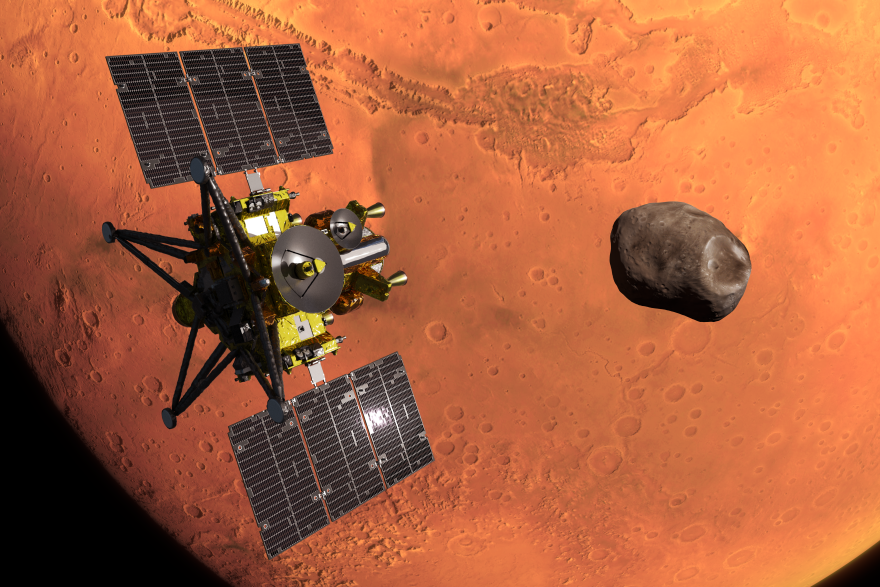
The Japan Aerospace Exploration Agency (JAXA) is preparing to launch the MMX (Martian Moons eXploration) interplanetary probe: the spacecraft was delivered to the Tanegashima Space Center on March 31, 2026. The launch is scheduled for November–December of this year. If the mission goes according to plan, in 2031 humanity will receive soil samples from Mars’ moon Phobos for the first time.
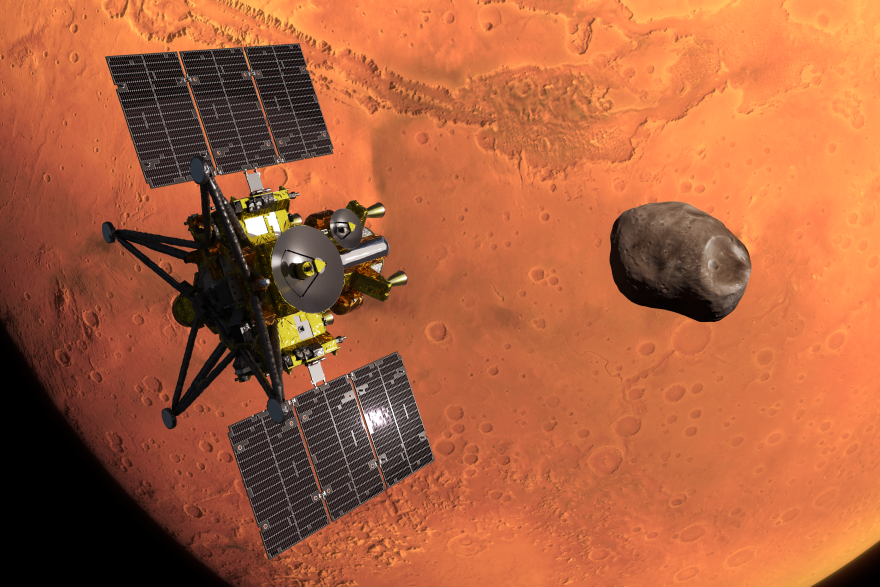 Illustration of the MMX (Martian Moons eXploration) interplanetary probe from the Japan Aerospace Exploration Agency (JAXA). Source: jda.jaxa.jp
The primary scientific objective of the MMX mission is to determine the origin of Mars’s two moons: Phobos and Deimos. Scientists are still debating whether these bodies are captured asteroids or fragments of Mars, flung into orbit by an ancient collision—much like how Earth’s Moon was formed about 4.5 billion years ago. The soil samples should provide the answer. In addition, the mission will investigate how Mars and the other inner planets of the Solar System formed.
Mission route and European rover
The launch is scheduled for November–December 2026 on an H3 rocket—during a brief launch window that opens once every 26 months. According to the plan, the probe will enter Mars’ orbit in 2027 and begin mapping both moons in search of a landing site. In 2029, MMX will land on Phobos and collect about 10 grams of soil. The samples are expected to arrive on Earth in 2031.
On board the MMX will be the 25-kilogram four-wheeled autonomous rover IDEFIX, developed jointly by the DLR (German Aerospace Center) and the French space agency CNES (Centre National d’Etudes Spatiales — National Center for Space Studies). IDEFIX will land on Phobos ahead of the main probe to gather data for a safe landing in conditions of extremely low gravity.
Delays left behind
The mission was originally scheduled to launch during the 2024 launch window, but was postponed due to issues with the H3 rocket. After the second launch vehicle failure in December 2025, doubts about the mission’s ability to stay on schedule arose again. However, the engineers quickly identified the cause and confirmed the mission.
MMX continues the series of Japanese sample-return missions: JAXA has already brought back to Earth soil samples from the asteroids Itokawa (Hayabusa mission) and Ryugu (Hayabusa2 mission).
According to space.com