
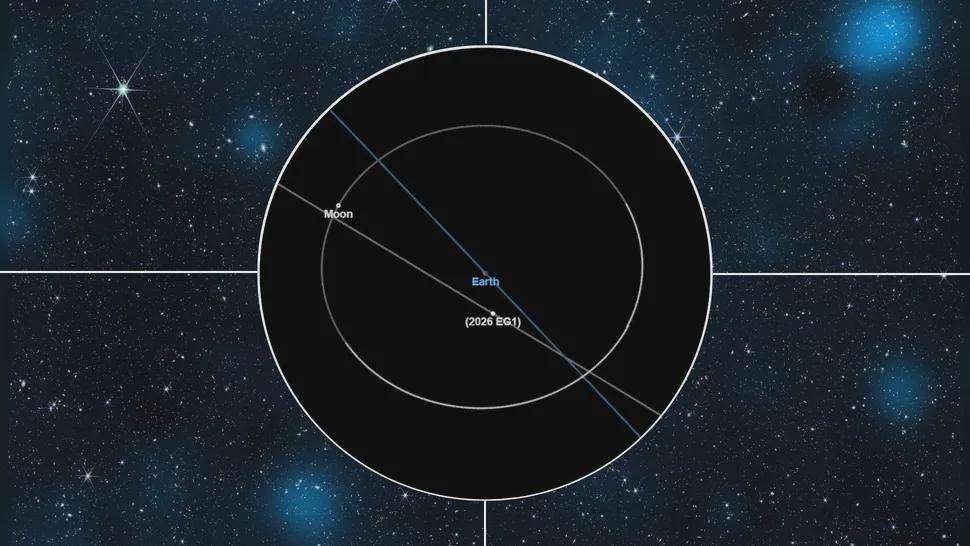
Asteroid will make its closest approach to Earth at 11:27 p.m. EDT on March 12 (0327 GMT on March 13), when will pass 317,791 km from S hemisphere.
At the point of closest approach NASA estimates 32-72 foot-wide (10-22 meters) asteroid — designated 2026 EG1 — will be travelling blistering km) relative to Earth and will swiftly pass us by, after performing a distant flyby of the moon.
2026 EG1's next closest planetary approach won't take place until Sept. 13, 2186, when it will pass approximately 7.5 million miles (12.1 million km) from the surface of Mars.
The wandering asteroid is just one of over 41,000 near-Earth asteroids currently being tracked by NASA and its partners — a figure that will likely rise significantly thanks to the efforts of the Vera Rubin Observatory, which has already discovered 2,000 hitherto unknown solar system bodies with its initial dataset.
https://ssd.jpl.nasa.gov/tools/sbdb_lookup.html#/?sstr=2026%20EG1&view=VOPC
by Neaterntal
13 Comments
Image
Asteroid 2026 EG1 will pass within 1 lunar distance of Earth (Image credit: NASA JPL, NASA/STScI/J. DePasquale/A. Pagan)
Why is the trajectory of the asteroid so straight? Shouldn’t it be curved by Earth’s gravity?
> Bus-sized …
r/anythingbutmetric
Can the bus pick me up please? I want to leave this planet
Why is the text of the post so garbled?

I thought it said bruh sized asteroid
Haha, you missed

I arrived a little late and this bus didn’t pick me up, damn it.
It’s crazy they can detect these
this is why I fully beleive it is possible to be hit by an asteroid that we never see coming like the one in russia a few years ago.
We’ve had a good run. May the next one hit us so earth can start over without humans.