
I wanna share an experiment I imagined. I haven't done it, but I am sure it could work.
Take a stick and put a small ball at the extreme of it. Then place it steadily on the ground.
using a camera or the naked eye place yourself in a position where the ball covers the Moon exactly. It is advisable to use a fairly small object, like a coin or a ping-pong ball. If the object is too small, you will need to stay closer, if it is too large, you'll never get it to match up.
at this point, you or someone else can measure the distance between the point of view and the ball.
now you have: the diameter of the ball, the POV distance and (search it on google) the moon's diameter.
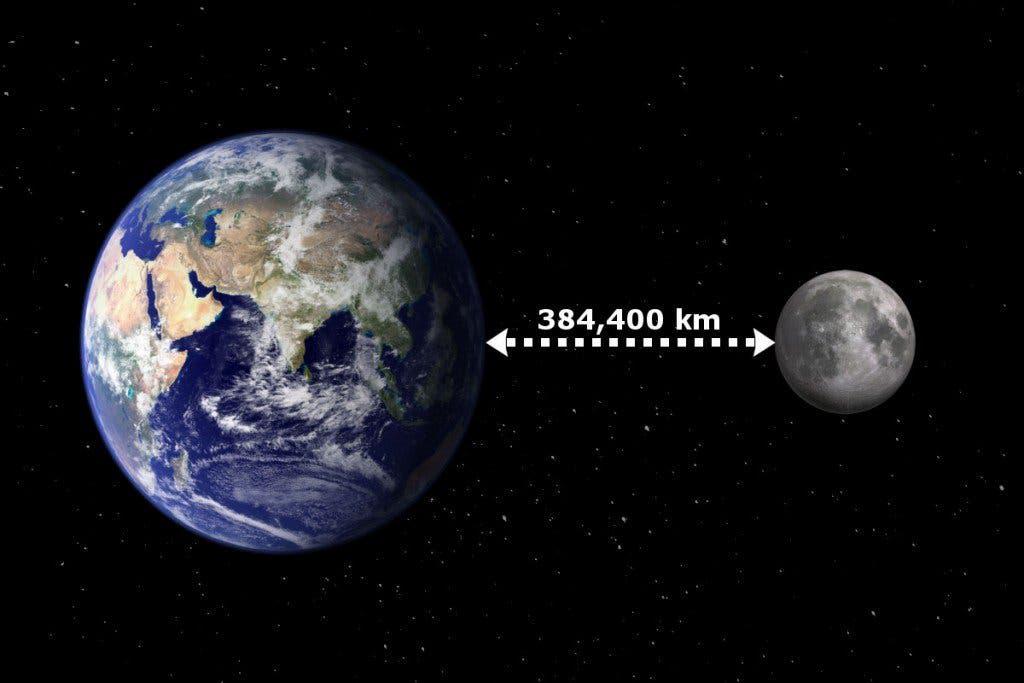
Knowing all this you can imagine a isoscele triangle: base B is the moon's diameter, and height H is the Earth Moon distance.
a smaller but similar triangle has base B' your ball's diameter and height H' your eye-ball distance.
You can therefore calculate the Moon's distance from Earth
I find it pretty cool
by MammothComposer7176
5 Comments
You can also use a similar approach to calculate Earth-Sun distance. Knowing that the Sun and the Moon appear to have the same size during an eclipse, you can use the moon as your “ball” and the Earth-Moon distance as your POV
3blue1brown made videos with the mathematician Terence Tao about this very topic and much more, how we discovered and the methods we used to measuring the diameter of the Earth, to the distance to the Sun and other planets to galactic and universal distances.
You can fit every single planet including Pluto between the Earth and Moon
Roughly 48 Earth diameters
I would just use a tape measure. 😏