
Comet 3I/ATLAS passed through the inner solar system on a one-time trajectory, entering a brief but consequential observational gap. During this interval, the object moved behind the Sun from Earth’s perspective, placing it beyond the reach of ground-based observatories and space telescopes in Earth orbit.
At the same time, NASA’s Europa Clipper spacecraft occupied a vantage point that allowed it to observe what no Earth-based instrument could. Although designed to investigate Jupiter’s icy moon Europa, Europa Clipper used its ultraviolet spectrograph to collect rare compositional data from the interstellar comet while it remained hidden from view.
In a recent SETI Live discussion, SETI Institute Communications Specialist Beth Johnson and Dr. Cynthia Phillips, Europa Clipper Project Staff Scientist and Science Communications Lead, from NASA’s Jet Propulsion Laboratory, discussed how an instrument built for a very different target was rapidly repurposed to study one of the rarest objects ever detected in the solar system.
What Europa Clipper Found That No One Else Could
Europa Clipper began observing 3I/ATLAS in early November, while most observatories remained effectively blind. The spacecraft’s contribution depended on three factors: its location in the solar system, access to a highly sensitive ultraviolet instrument, and the ability of mission engineers and scientists to repurpose planned calibration observations rapidly.
At the time of the observations, Europa Clipper was positioned at a distance of approximately one astronomical unit — about 100 million miles — from the comet. Despite this separation, the spacecraft’s ultraviolet spectrograph was sensitive enough to resolve the structure of the comet’s coma (the cloud of gas surrounding the nucleus) and detect key atomic species within it.
Europa Clipper could not use its visible-light cameras, which will remain covered until later in the mission. Instead, the ultraviolet spectrograph, designed to study Europa’s tenuous atmosphere, became the primary tool for comet science.
New Compositional Confirmation from Ultraviolet Data
The ultraviolet observations revealed clear signatures of hydrogen and oxygen in the comet’s coma. Together, these elements indicate the presence of water ice. While water is common in comets formed around the Sun, this detection is particularly significant for an interstellar object.
As Dr. Phillips emphasized, this observation provides some of the first direct compositional confirmation that comets formed in other planetary systems can contain the same fundamental volatile materials as those in our own. Before this observation, it was not certain that 3I/ATLAS would exhibit familiar outgassing behavior or release detectable water-derived species.
Equally important, the comet’s activity appeared stable. The data show no evidence of fragmentation or unexpected behavior during its closest approach, reinforcing the idea that cometary physics may be broadly consistent across planetary systems.
New Insight into Comet Structure and Viewing Geometry
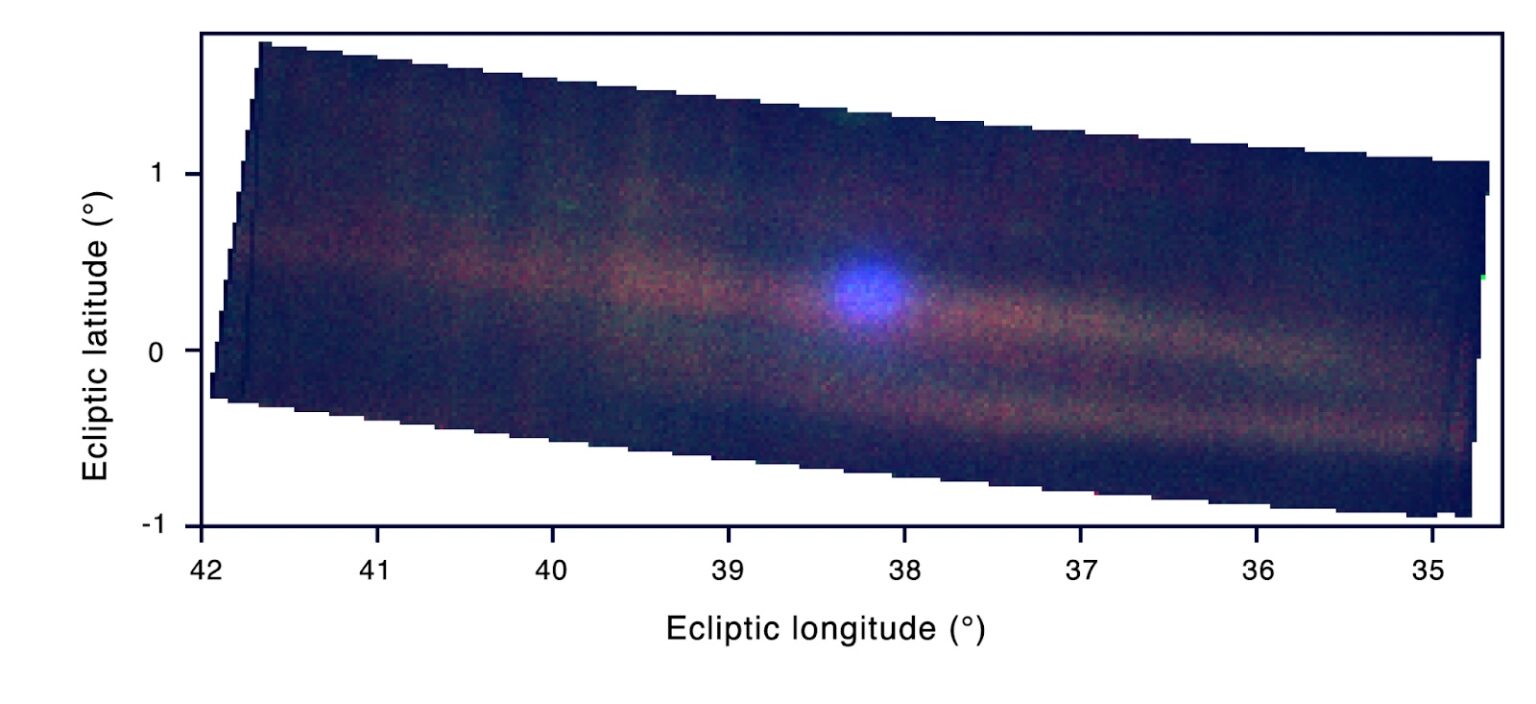
Beyond composition, Europa Clipper’s observations offered a distinct perspective on the comet’s structure. Because the spacecraft was positioned “downstream” of the comet — effectively looking toward the Sun — it observed the tail before the central coma. This geometry differs from most Earth-based observations and affects how features appear in projection.
The ultraviolet data show faint, wispy structures extending away from the coma, interpreted as dust released from the nucleus. These features are consistent with later observations after the comet re-emerged from behind the Sun, confirming that Europa Clipper captured real, persistent structures rather than transient artifacts.
Comets can exhibit both a dust tail, which follows the comet’s trajectory, and an ion tail, shaped by the solar wind and oriented away from the Sun. The Europa Clipper observations hint at this complexity, though detailed compositional and plasma analysis is still underway.
Opportunistic Science Across the Solar System
A central theme of the conversation was how this observation exemplifies a changing model of planetary science. Europa Clipper was not alone in observing 3I/ATLAS. Other spacecraft, including Mars missions and ESA’s JUICE spacecraft, also attempted to collect complementary data and succeeded.
This coordinated but largely opportunistic effort reflects a growing capability: a distributed network of spacecraft acting as mobile observatories. When transient events occur, such as the arrival of an interstellar object, scientists can now evaluate which spacecraft are best positioned to respond — even if those missions were built for entirely different purposes.
Dr. Phillips noted that this approach echoes earlier moments in space science, such as spacecraft observations of Comet Shoemaker–Levy 9’s impact with Jupiter, but on a much larger and more flexible scale.
Looking Ahead
Analysis of Europa Clipper’s ultraviolet data is ongoing. Scientists are working to refine estimates of dust composition and to determine whether plasma instruments and magnetometers detected signatures associated with an ion tail. Parallel datasets from other missions, including JUICE, will help place Europa Clipper’s observations in a broader context once additional data are downlinked.
Europa Clipper’s primary mission, to investigate Europa’s subsurface ocean and assess its potential habitability, remains unchanged. Yet this unexpected encounter with 3I/ATLAS demonstrates how preparedness and geometry can transform a brief observational gap into a source of new scientific insight.
Explore these findings in depth on the SETI Live episode. Read the press release here.