
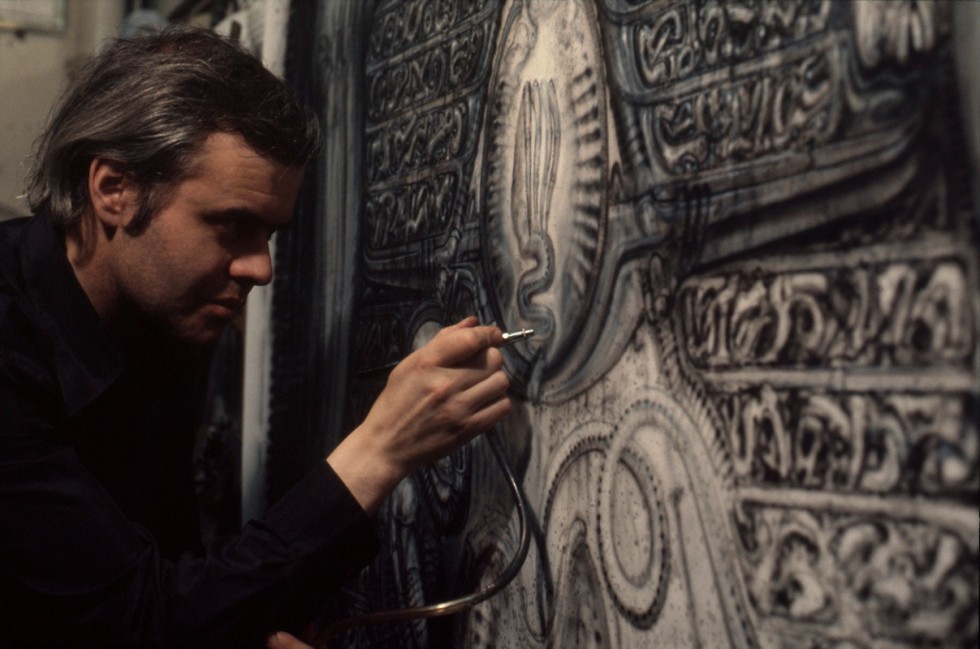

H.R. Giger
Writer Dan O’Bannon introduced Ridley Scott to H.R. Giger’s artwork; both of them felt that his painting Necronom IV was exactly the type of creature they wanted for the Xenomorph. At first, 20th Century Fox thought his art was too disturbing and too sexual for audiences, but they managed to convince the studio.
Ridley Scott flew to Zürich, Switzerland, to meet Giger and hired him to work on all designs of the different stages of the Xenomorph as well as the LV-426 surface environment, Derelict Spacecraft and Space Jockey. The surrealist travelled to England in February 1978, where he worked until 1979 at Shepperton Studios outside London, completing the sets and creatures for Ridley Scott’s Alien.
I own several Giger books and have always found his biomechanical art mesmerising – that fusion of organic, biological matter with mechanical, industrial components. I don’t think Alien would have had such a monumental impact on people had it not been for Giger’s contributions. When you first see the Derelict Spacecraft and the Space Jockey creature fused into the chair, it creates so much mystery that it still holds up decades later.
Alien: Diaries was first released back in 2013 to mark the 15th anniversary of the Giger Museum in Gruyères, Switzerland, which first opened in June 1998. It was also the last book Giger released before his death on May 12, 2014, although his estate continues to release new entries showcasing his work. Alien: Diaries primarily includes a facsimile of two of H.R. Giger’s diaries that he wrote while he was working on Alien.
Alien: Diaries is a hardcover book with a black cover featuring a picture of the Xenomorph from Alien crouching. On the side of the book, there is text “Alien” in big white lettering. It comprises 660 pages with 59 colour images and 48 black and white images. The dimensions are 23.5 x 13 cm and there is a bookmark string. At the time of writing, there have been five editions of Alien: Diaries, which I believe contain all the same material. I wanted this book for many years, but it did come with a substantial price tag (110 euros). It’s no longer sold in the UK and has to be imported. I managed to find a second edition of the book.
There have been many H.R. Giger books released over the years, republishing various artwork he has made in his time. The publisher of Alien Diaries, Edition Patrick Frey, says that most of the material in the book is completely new and hasn’t been published before. I would attest to that. The handwritten diaries haven’t been published verbatim before, but much of what was in Giger’s Alien was derived from these diaries. The Polaroids are brand new and many of the professional production stills from the set of Alien, I have not seen before. Although some of his sketches and stills were previously printed in Giger’s Alien.
Giger’s handwritten diaries are in his native German language, but after each diary, there are German textual transcriptions with the English translation on the opposite page. Some parts of the diaries have been redacted, particularly the names of people whom Giger criticised. Littered throughout the diary are lots of sketches and his own colour photographs that he took with his Polaroid SX70.
The diaries are printed on very high-quality, thick paper. It’s extremely accurate. The pencil and ink colour, the smudges, the blemishes, the fading, the colour of the paper. It looks like the real thing. The transcription/translation pages are noticeably thinner. In between those pages are some stunning production stills. The first diary contains black and white stills, while in the second diary’s transcription pages, you’ll find colour stills. There are some lovely shots of the Xenomorph and Derelict in here. Other than quick sketches, you won’t find any of Giger’s iconic Alien paintings in this book that have been printed in numerous other behind-the-scenes books.

Alien: Diaries – Black and white production stills.
The Diaries
Throughout the diaries, the Swiss artist recounts what design aspects he was working on throughout the days on set, the mechanical complications of things not working and not looking right. He vents his frustrations frequently. He often feels he was underpaid for the work he was doing and that the studio assigned him incompetent, slow collaborators who never really understood his vision. The diary also includes entries relating to his personal life and what he did in London and Switzerland during production.
So we start off with Diary 7, which was written from February 23rd, 1978, to June 28th, 1978. Giger mentions he had issues with his apartment in London. There are continuing issues between Giger and 20th Century Fox over his contract and the amount of money he would receive. Ridley Scott and Gordon Carroll say they have a new idea and that is to move the Space Jockey from the spaceship into the landscape so it blends in with the environment. They eventually changed their mind and moved it back to the spacecraft.

Alien: Diaries
Giger recounts his making of the Derelict spacecraft. He says the people who built it “have no clue about his architecture”. He told them to get bones and build a model out of plasticine. Giger took over and did it himself. Giger becomes frustrated at one redacted person – Roger Dicken. Dicken was a special effects artist on Alien who was responsible for the technical build of the Facehugger and Chestburster. Giger criticised his Facehugger for looking too much like a spider.
He says the Chestburster design is a catastrophe and says Dicken is a bad artist who can’t follow Giger’s designs accurately. Giger says Dicken has been working for three months and hasn’t produced anything usable. Roger Dicken created a prop based on Giger’s initial Chestburster design, which was faithful to Giger’s design, but it resembled a “degenerate plucked turkey”, and it was too big to fit in somebody’s ribcage. Scott and Dicken then went back to the drawing board and created the long, snake-like creature that would be in the final film.
There are further frustrations from Giger in his diary. Giger’s wife, Mia Bonzanigo, told him that Gordon Carroll and Ivor Powell think Giger should pay for his flights to Switzerland himself, as they deemed his trips not related to the production. Giger writes, “They don’t give a damn about my contractual agreements!” Speaking of his wife, she is mentioned frequently and does help him quite a lot in the designs of the Facehugger, Chestburster and adult Xenomorph.
The Alien: Diaries also reveal the deep personal troubles that the production took on him. Giger was a man still thinking about his past and very homesick while in England. On May 19th, 1978, Giger recounts that he visited the grave of Li Tobler and brought 100 pale red roses with him. Li Tobler was a model for Giger who tragically took her own life after battling severe depression in 1975. Separated from everything he knew in Switzerland, Giger frequently thought of home, writing about his longing to return to Zurich and how much he simply missed his cats, Müggi and Nömeli.
Moving on to Diary 8, which was written from August 1, 1978, to February 1979. Giger continues to talk about what he is working on. At this point in production, his work is very much focused on getting the Xenomorph costume ready for Bolaji Badejo, a 26-year old Nigerian design student who stood at 6ft 10. A member of the casting team randomly found him in a bar in Soho. Again, Giger is further frustrated with the crew. He feels like just going home, but since he started the film, he feels he must finish it. In August 1978, Carlo Rambaldi joined the crew with his mechanical head, which Giger deems to look too much like an ape.

Alien: Diaries
Giger mentions that two versions of lettering that were framed had been deliberately cut out with a knife and stolen. The surrealist only mentions actress Sigourney Weaver once or twice throughout the book. He notes that Sigourney Weaver gave Giger and his wife Mia a hard time and the Managing Director of 20th Century, Peter Beale, once sent Mia away from the set at the behest of Weaver.
By October 1978, Giger is homesick and says, “We are both rather fed up with this place, although most people here are very likeable. I miss my familiar surroundings, my cats, my pictures, my books and my old friends.” Giger finishes at Shepperton Studios, returns to Switzerland and wonders how successful Alien will be when it is released. He is looking forward to designing the book Giger’s Alien. A month later, he returns to the UK for a few days, to Bray Studios to supervise the landscape and derelict.
Complaints
One of the biggest issues I have with many of the Giger books is that they are overly small. Giger has done some impressive work and it is a shame they continue to put out such small books. Alien: Diaries continues that trend and is 23.5cm x 13cm. However, I think the small dimensions are justified here as this is not an art book. I believe the facsimiles of Giger’s diaries are actually 1:1 scale. Due to the thickness, though, it’s hard to lay the book out completely flat and it makes me wonder how the strength of the book’s binding will hold up long term.

Alien: Diaries
Another minor inconvenience I have with the book is that the English translations are after each diary, so you have to go back and forth between the diary and the translations to follow the diary. I don’t think the publisher could have handled this any other way, though. There are also no printed page numbers in the diary. Instead, Giger has actually written the page numbers on there, but he hasn’t written the numbers on every page and has left some out, so you have extra pages in between. I’m not sure why the publisher just didn’t print the page numbers on the black border surrounding the diary.
Overall
I would describe Alien: Diaries as a time capsule – a collectable memento that gives you a glimpse into Giger’s personal thoughts and frustrations as he worked on Alien. There aren’t any major brand new revelations in the book. A lot of the conflict between Giger and 20th Century Fox over his contract is really common knowledge and it’s no secret that Giger was a perfectionist. Giger was a surrealist painter first and foremost. In the art world, he had total control over every brushstroke. It was a huge change for him, moving into the film industry where lots of people are touching his work, trying to ‘correct’ his sculptures, and him having to worry about budgets.
I think casual Alien fans would be better off with something like Giger’s Alien if you just want to read about his work on Alien. It is larger, showcases his iconic paintings, is far better organised and textually, contains much of what is in these diaries and is entirely in English. But the Alien: Diaries are the ultimate uncut form of Giger’s thoughts, direct from the artist himself. The Alien: Diaries is the story of how H.R. Giger brought his vision to life.