
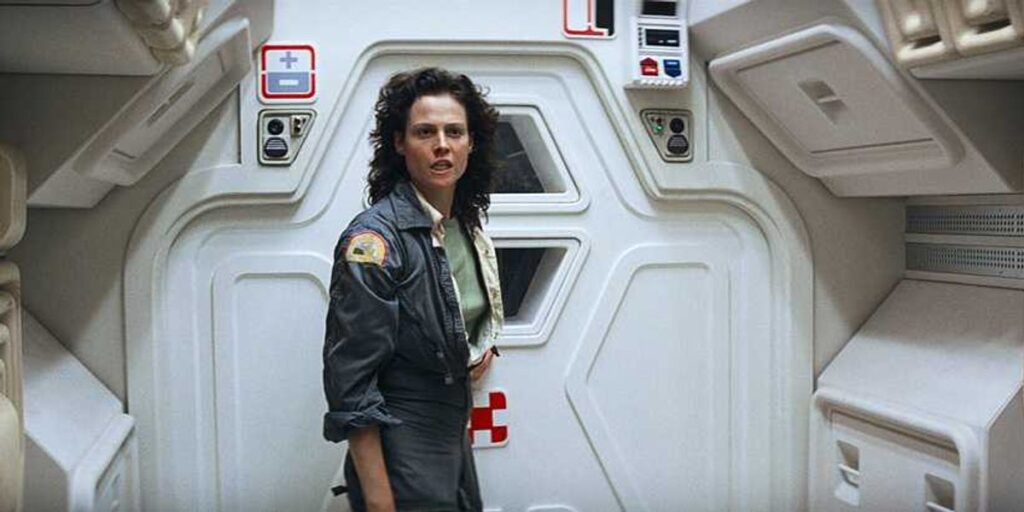
One of the greatest movie characters of all time is Sigourney Weaver’s Ripley. She’s the survivor of many an alien attack across several decades in one of the most beloved science fiction franchises of all time.
Now, I could wax on about how much I love these movies all day, but I wanted to actually focus on Ripley and all the things writers can glean from watching the Alien movies she’s in and by following what she does on screen.
Let’s dive in.
Screenwriting Lessons From Ripley
I tried to break this down to the three main lessons you can get from Ripley. These are things I think you should apply to your own writing and think about as you work on your own screenplays.
1. Write the Person, Not the Trope
The character of Ripley was originally written as a man – or so the legend goes. But then Ridley Scott read it and had other ideas. When Sigourney Weaver was cast, the team didn’t suddenly flip the script. They just kept the traits on the page, which led to her competence, her insistence on protocol, her sheer resourcefulness, and a character that felt full.
The lesson here is legitimately not to be sexist. Which shouldn’t feel revolutionary now, but it remains to be said.
Write a fully fleshed-out human being defined by their intelligence, their drive, and their flaws. Don’t focus on gender, focus on goals, wants, and desires.
Ripley works because she’s a competent warrant officer who follows the book, not because she’s trying to be a stereotypical action hero or any other cliche we’ve seen people try to write.
2. Make the Hero Earn Their Authority
Ripley isn’t the Captain right out of the gate. She’s below Dallas, Kane, and the android Ash in the pecking order. That’s a good way to meet her, because it allows us to root for her right off the bat.
Her early scenes are all about being the one who gets ignored and dismissed when she tries to follow correct protocol (like refusing to let Kane back onto the ship without a quarantine).
Again, we’re on her side, and we have a clearly defined position for her to arc into over the course of the movie.
Ripley’s eventual rise to sole survivor and protector is so satisfying because she earns it by being the only one to stick to the rules and accurately judge the threat at hand and how to navigate it.
3. Character is Built Through the Small Actions
Ripley’s moral core isn’t established with some huge, expository monologue. Screenwriter Dan O’Bannon (with a crucial rewrite by Walter Hill and David Giler) uses quick, telling actions to reveal who she is and what makes her tick.
This is such an age-old screenwriting trope, but you should know it by now. Don’t tell us what your character is—show us!
The character of Ripley defines this perfectly. One example I love using is Ripley risking her life at the end of the film to go back and get Jones, the cat.
It’s a literal Save The Cat moment that endears us to her all the more.
The action defines her as fundamentally decent, a principle that solidifies her as the ultimate survivor and becomes her central drive in the sequel, Aliens.
Summing It All Up
These are just a couple of takeaways from the Alien movies, which I think probably have dozens of lessons embedded inside them.
The most important lesson of all is just to keep writing and figuring it out as you go because all writing is rewriting.
Let me know what you think in the comments.