
https://www.chinadaily.com.cn/a/202403/25/WS66016937a31082fc043be8f7.html
BEIJING – China’s Queqiao-2 relay satellite has successfully performed a near-moon braking procedure and entered its circumlunar orbit, the China National Space Administration (CNSA) said on Monday.
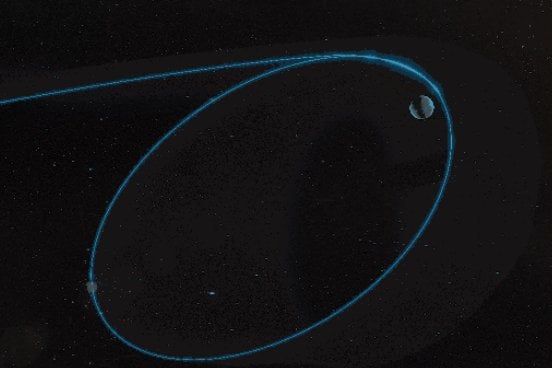
At 12:46 am (Beijing Time) on Monday, after approximately 112 flight hours, the satellite began near-moon braking at a distance of about 440 kilometers from the lunar surface and entered its circumlunar orbit smoothly 19 minutes later, the CNSA said.
By adjusting the altitude and inclination of its circumlunar orbit, Queqiao-2 will enter its target elliptical orbit around the moon and carry out a communication test with the Chang’e-4 and Chang’e-6 lunar probes as planned.
Near-moon braking is the most critical orbital control action during lunar satellite flight. A satellite must begin braking when approaching the moon to maintain a speed lower than the moon’s escape velocity so that it can be captured by the moon’s gravitational force and realize circumlunar flight.
Two communication and navigation technology test satellites, Tiandu-1 and Tiandu-2, were sent into space together with Queqiao-2. They also completed near-moon brakes on the same day and entered their circumlunar orbits. The separation of the two satellites will be carried out as planned, the CNSA said.
Queqiao-2, which translates to “magpie bridge 2”, was launched on March 20 to provide Earth-Moon communication services. It will undertake lunar exploration missions such as sample retrieval on the far side of the moon and an exploration of the lunar south pole region.
by iantsai1974
1 Comment
The codename of “Queqiao” (“Magpie Bridge” comes from ancient Chinese mythology. Legend has it that the Weavergirl, granddaughter of the God of Heaven, fell in love with the Cowherdboy, a mortal, and married him. The God of Heaven was angry for her decision and separated the two and placed them on both sides of the Milky Way, becoming two stars in the sky, the α Lyrae and the α Altair.
Then every year on July 7th, in the night of “七夕”, numberous of magpies will fly into the sky and build a magpie bridge across the Milky Way, so that the two lovers might meet each other on the magpie bridge for one night.
Queqiao-1 was launched into a halo orbit around the earth–moon L2 Lagrangian point in 2018 and is still working.
Queqiao-2 is the second moon-earth relay satellite launched by China. The initial mission of Queqiao-2 is to provide relay communication support for Chang’e-6 mission, which will be launched in May 2024 and make a sample-and-rerurn from the south pole of the moon.
After Chang’e-6 mission completes, Queqiao-2 will adjust its orbit to provide services for Chang’e-7, Chang’e-8 and subsequent lunar exploration missions.