
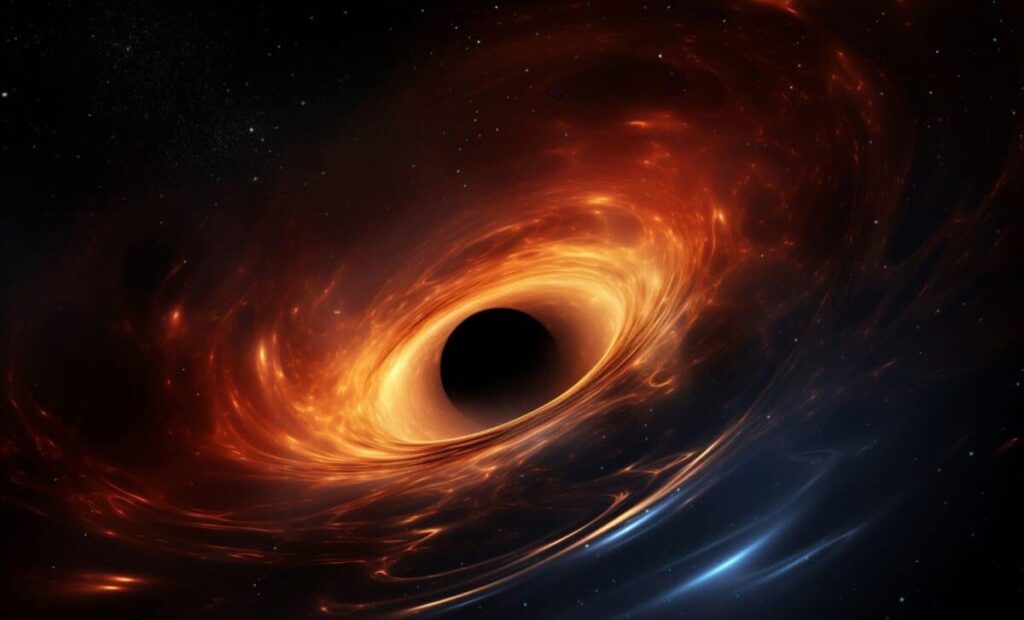
A new study suggests that decaying dark matter may have helped create the universe’s first supermassive black holes much earlier than expected. The idea could explain why these massive objects show up so soon in observations. The early universe is still puzzling, especially when it comes to how black holes got so big so fast after the Big Bang.
Data from the James Webb Space Telescope has revealed massive black holes appearing very early on, which does not quite match the usual, slower growth models. Researchers from University of California, Riverside and their collaborators suggest that dark matter might not be completely stable.
A Tiny Burst Of Energy That Set Off A Chain Reaction
Yash Aggarwal explains that each decaying dark matter particle releases a very small amount of energy, about “a billion trillionth” of what you would get from a AA battery. It sounds negligible, but in the early universe, it was enough to matter.
“Our study suggests that decaying dark matter could profoundly reshape the evolution of the first stars and galaxies, with widespread effects across the Universe,” he stated.
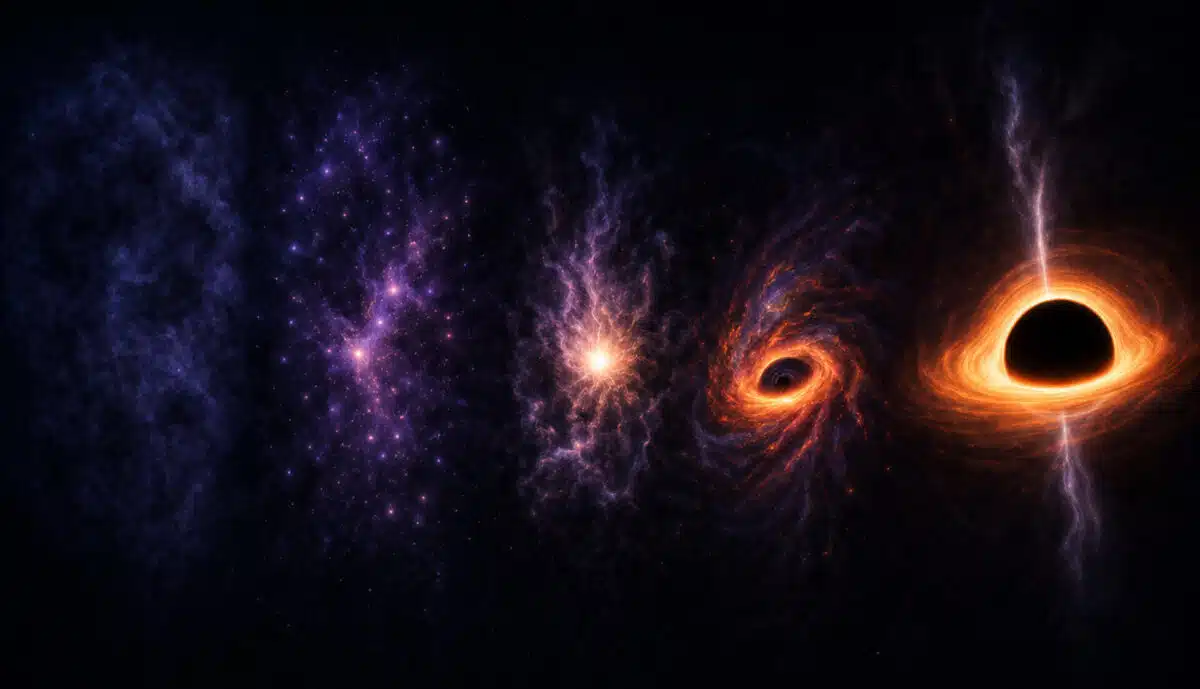 A step-by-step view of how the first black holes may have emerged from early cosmic clouds. Credit: Journal of Cosmology and Astroparticle Physics
Back then, galaxies were basically clouds of pure hydrogen gas. These clouds were very sensitive, so even a slight energy input could disturb them and push them to collapse faster under gravity.
Early Galaxies Reacting to Dark Matter
For University of California, Riverside’s Dr. Flip Tanedo, these first galaxies acted like natural detectors. Their sensitivity made them react to even the smallest energy inputs, including those from dark matter decay.
“The first galaxies are essentially balls of pristine hydrogen gas whose chemistry is incredibly sensitive to atomic-scale energy injection,” he explained. “These are the properties that we want for a dark matter detector — the signature of these ‘detectors’ might be the supermassive black holes that we see today.”
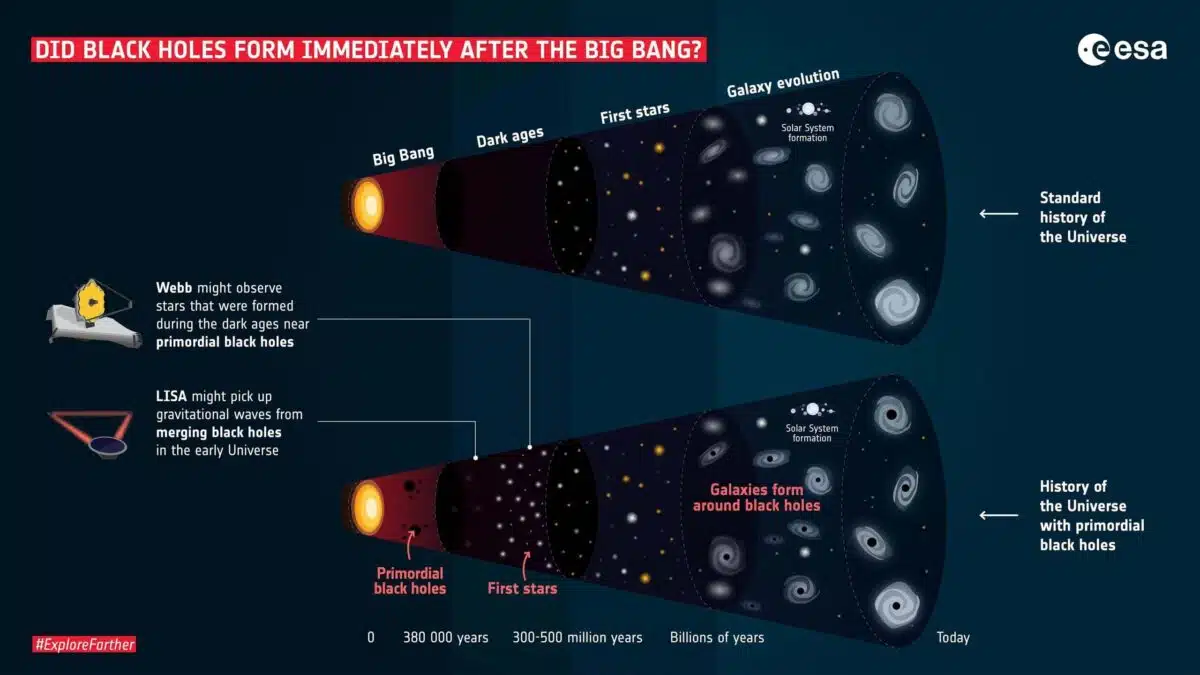 Cosmic evolution with or without early black holes. Credit: Credit: ESA
In that sense, the supermassive black holes we see today may carry traces of those early interactions. Scientists are not detecting dark matter directly here, but rather its possible effects on how cosmic structures formed.
A Narrow Range That Makes It Work
The team modeled how gas behaves when exposed to decaying particles, including candidates like axions. Their results point to a specific mass range, between 24 and 27 electronvolts, where conditions favor rapid collapse.
“We showed that the right dark matter environment can help make the ‘coincidence’ of direct collapse black holes much more likely.” said Dr. Tanedo.
The study indicates that this range makes it easier to form direct collapse black holes, which skip slower growth stages. Published on April 14, 2026, in the Journal of Cosmology and Astroparticle Physics, the work reflects collaboration between astrophysics, cosmology, and particle physics.
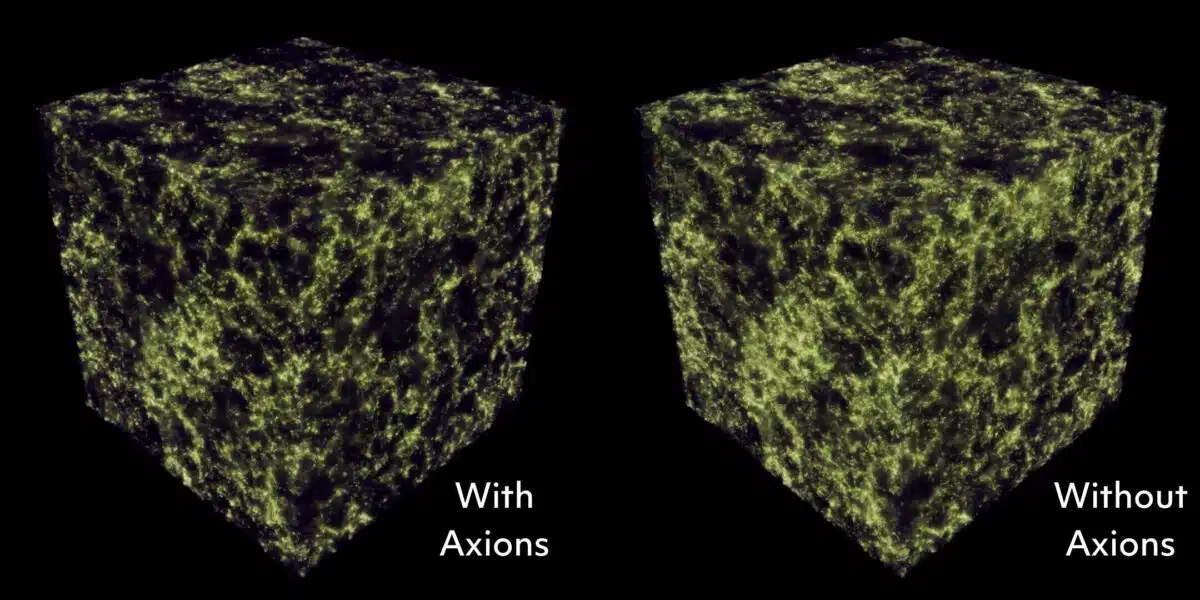 Simulation comparing early universe structures with (left) and without axions (right), showing their impact on gas collapse. Credit: Alexander Spencer London/Alex Laguë.
“The work stemmed from a series of coincidences that brought the right people together at the right time, including a series of workshops that connected particle physicists, cosmologists, and astrophysicists to discuss the big questions in their field,” hed added. “In the same way, the support for interdisciplinary work helped make the ‘coincidence’ leading to this work possible.”