
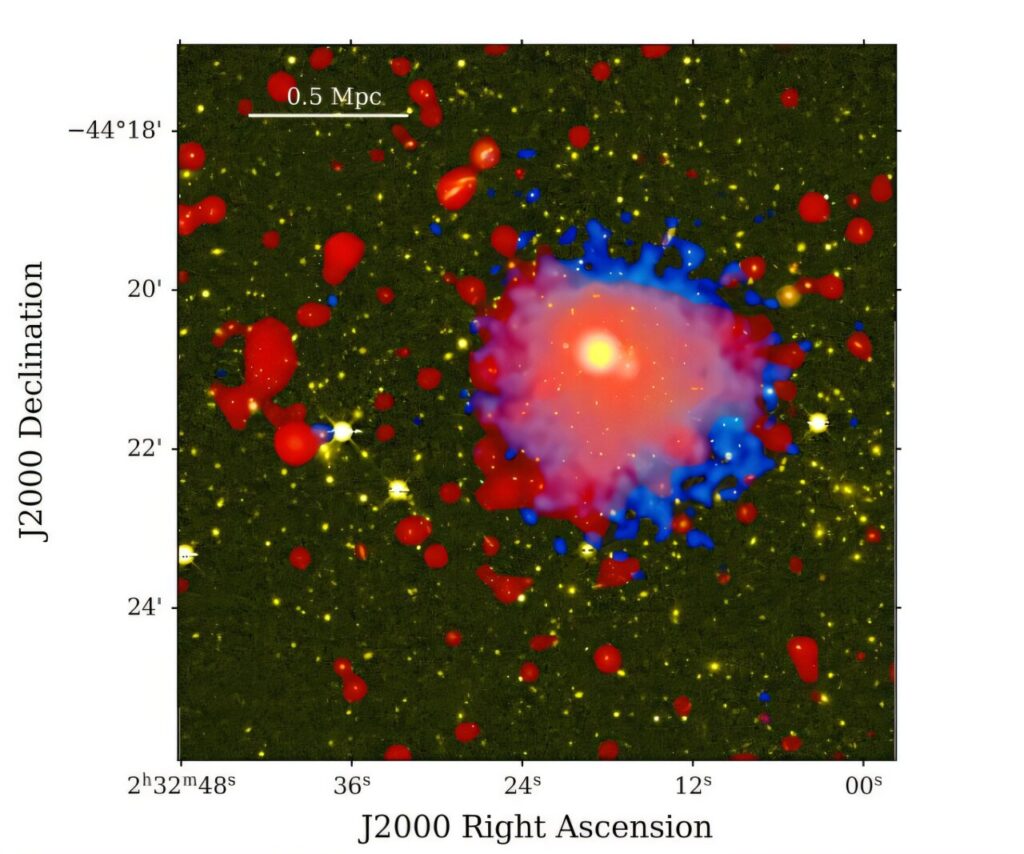
RXCJ0232–4420 is a massive galaxy cluster with two bright star systems at its center. New research conducted using the uGMRT and MeerKAT radio telescopes has revealed that a gigantic halo, spanning 3.6 million light-years, surrounds them.
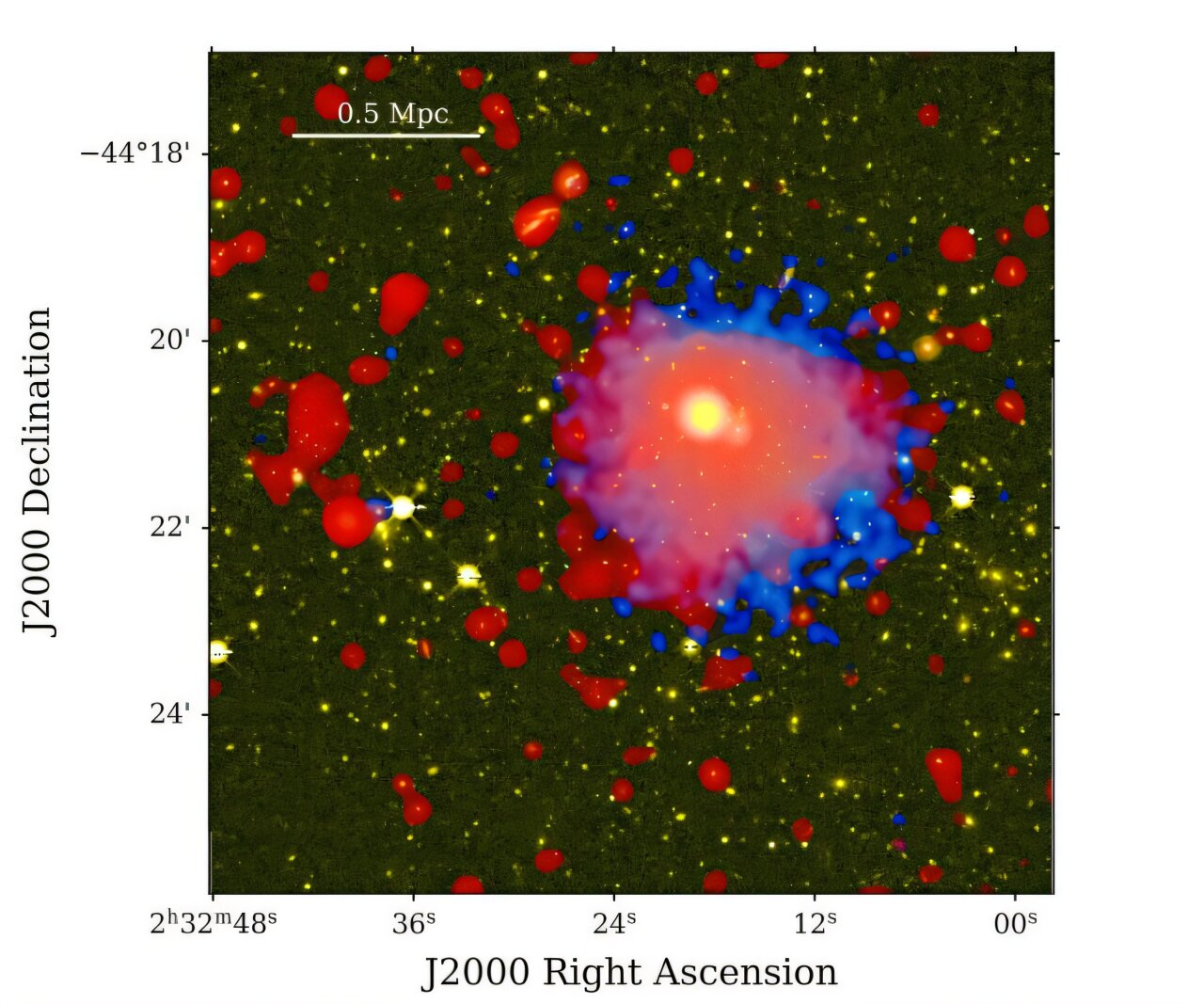 Halo in the galaxy cluster RXCJ0232-4420. Source: phys.org
Cluster RXCJ0232–4420
A halo is the outer, diffuse envelope of a galaxy, which is usually nearly spherical in shape. Scientists are still studying them, but it is already clear that they are complex structures composed of gas and sparsely distributed stars. Typically, a halo surrounds only one galaxy.
However, Indian researchers working with the upgraded Giant Metre Radio Telescope (uGMRT) and the MeerKAT radio telescope recently published a study describing an incredibly massive radio-luminous halo spanning 3.6 million light-years.
We are talking about the galaxy cluster RXCJ0232–4420. Since 2002, the year of its discovery, it has repeatedly attracted the attention of researchers. In total, the cluster contains about 1,000 galaxies, and at its center are two particularly large and bright ones—BCG-A and BCG-B. The distance between them is only 330,000 light-years, which is roughly three times the diameter of the Milky Way.
Radio emission from the halo
The scientists studying RXCJ0232–4420 had previously been interested in how the halos of the galaxies within the cluster appear in the radio spectrum. Clusters are known to have large halos composed of highly magnetized plasma.
At the time, researchers were unable to reach a consensus on what they looked like in the case of RXCJ0232–4420; some studies suggested more traditional, small radio relics, while others pointed to much more extended structures.
And now there is confirmation that the central halo is indeed about 3.6 million light years in size—which is greater than the distance from the Milky Way to the Andromeda Galaxy—and encompasses several star systems at once.
What’s more, two other relics active in the radio band have been detected nearby. One of them, located east of the central halo, is also enormous—about 980,000 light-years across. Scientists say these structures reveal how the galaxies in the cluster are actually connected to one another.
According to phys.org