
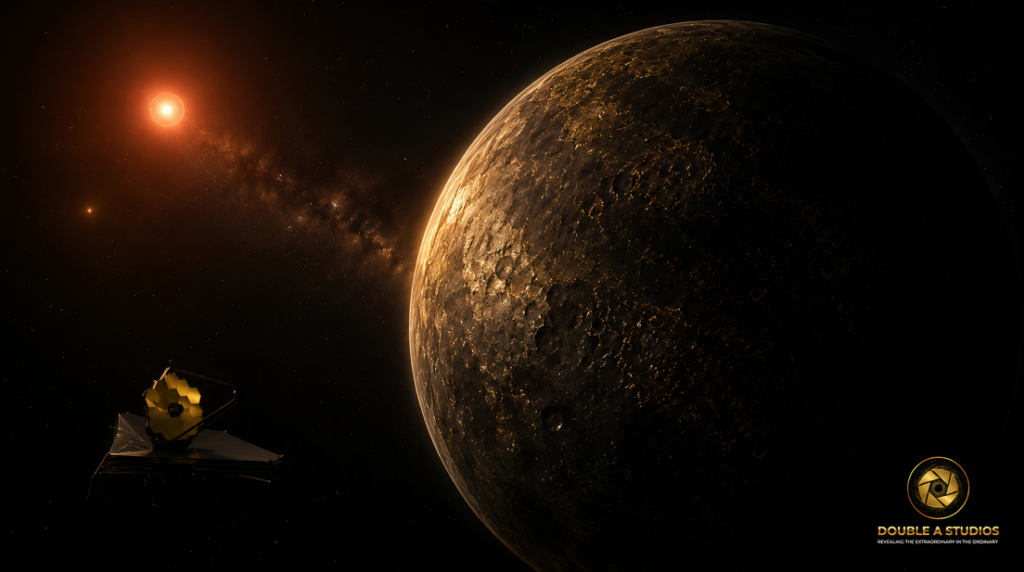
Astronomers have used the James Webb Space Telescope (JWST) to study the surface of a rocky exoplanet, opening a new chapter in the search for worlds beyond our Solar System. Webb did not photograph mountains or craters directly.
Instead, it measured the planet’s infrared glow, the heat coming from its surface.
For years, headlines about distant planets have often followed the same pattern: astronomers find a world similar in size to Earth, and the imagination immediately does the rest. We picture oceans, clouds, landscapes, perhaps even life.
But in reality, a planet can be rocky and close in size to Earth and still be nothing like our world.
That is the case of LHS 3844 b, also known by its official name Kua’kua, a rocky exoplanet about 49 light-years from Earth and roughly 30% larger in radius than Earth – one of the so-called “super-Earths”.
Kua’kua appears to be a dark, airless, scorched world, with a surface more reminiscent of Mercury or the Moon than of our own blue planet. It orbits a small, cool red dwarf star in less than eleven hours and is likely tidally locked, meaning one side permanently faces the star while the other remains in darkness.
According to the study, the planet’s surface may be rich in basaltic rock or olivine-rich material, dark minerals and rocks associated with volcanic or mantle-like compositions. Similar materials are found on worlds such as the Moon, Mars,and Mercury, as well as across much of Earth’s ocean floor.
But one of the most important parts of the discovery is what Webb did not find.
The data in fact show no convincing sign of a substantial atmosphere as the planet appears to have an enormous temperature contrast. Webb also found no clear trace of gases such as carbon dioxide or sulphur dioxide.
These gases would be important because they could point to an atmosphere or recent volcanic outgassing. Their absence supports the idea of a world exposed directly to space.
That makes Kua’kua uninhabitable by any human standard. There is also no evidence for liquid water on the surface. No protective atmosphere. No familiar climate. No gentle cycle of clouds, rain, and seasons.
Yet, the result highlights something exciting. When a rocky planet has little or no atmosphere, the surface may become accessible to study. And it’s a remarkable shift.
For favourable nearby rocky planets, astronomers can now begin to investigate whether a surface is volcanic, dusty, rich in certain minerals, young and active, or old and weathered. Questions that were once mostly theoretical can now begin to be answered.
The search for life beyond Earth remains one of the greatest scientific adventures of our time. But that search depends just as much on understanding the lifeless worlds as the potentially habitable ones.
We need to know how planets lose their atmospheres. How radiation from red dwarf stars affects nearby worlds. How surfaces change when exposed to space for billions of years. How geology behaves on planets larger than Earth but very different from it.
Kua’kua may not be another Earth, but certainly helps answer those questions.
As we enter the era of exoplanet geology, these distant worlds are revealing how planets form and evolve, and why our own remains so unique. Earth is not simply a rocky planet of the right size.
It is a rare balance of atmosphere, water, geology, magnetic protection, distance from the Sun and long-term stability. Finding worlds that lack such balance is not disappointing; instead, it helps us understand what the balance really means.
Sometimes, we need a planet 49 light-years away to remind us how lucky we are.