
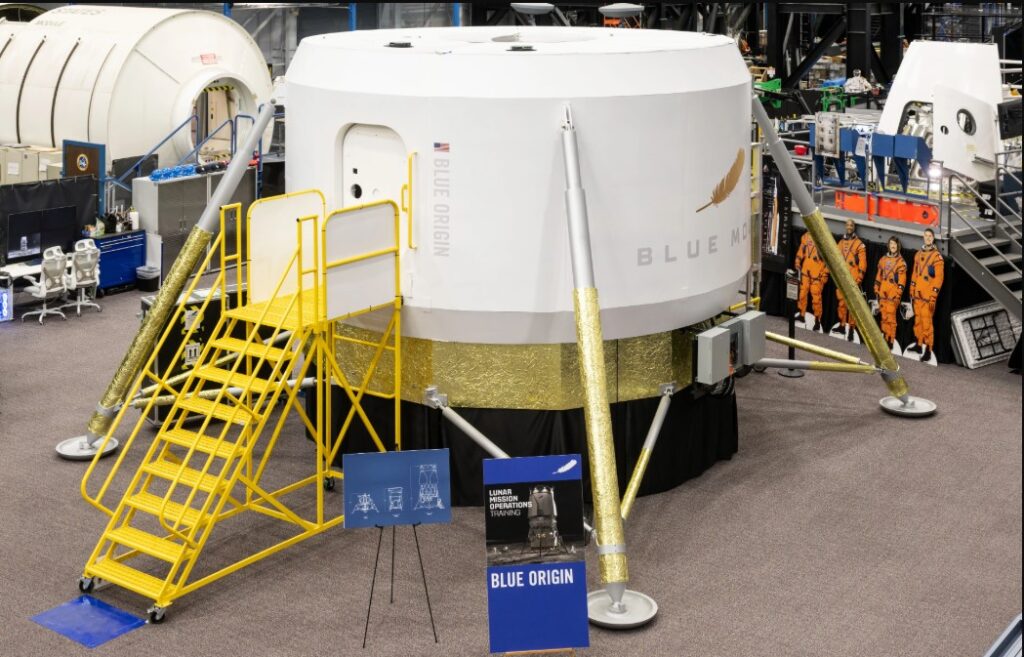
On May 7, 2026, NASA announced that a full-scale replica of a commercial lunar lander is now in operation at the Johnson Space Center. This mockup supports training and testing as NASA and industry partners prepare for future crewed missions under the Artemis program. The training simulator comes from Blue Origin and will be used in preparation for docking with landers in Earth orbit in 2027 and sending astronauts to the Moon by 2028.
NASA has teamed up with two American companies to develop the systems that will move astronauts from lunar orbit to the Moon’s surface and back. Blue Origin’s lander, launched without astronauts aboard on top of its New Glenn rocket, will meet astronauts aboard NASA’s Orion spacecraft in lunar orbit. Two crew members will ride the Blue Moon lander down to the surface and then return to the rest of the crew aboard Orion after their surface stay.
The Blue Moon crew lander will stand about 52 feet tall. The cabin at the base will serve as the living and working area where the two astronauts eat, sleep, conduct science, and observe the lunar environment during their stay.
The prototype at NASA’s Johnson Space Center is a full-size model that includes the exterior ladder astronauts will use on the Moon. As NASA and industry teams plan future crewed lunar missions, this model will develop to support more advanced training and mission needs. Over time, it will become an integrated simulator with interactive systems to help astronauts practice with ground flight controllers.
Both NASA and Blue Origin will be able to access the cabin trainer’s interior and exterior for human-in-the-loop tests. These tests will cover mission scenarios, mission control communications, spacesuit checks, and preparations for simulated moonwalks. The cabin also allows for design feedback to Blue Origin as the lander evolves and mission planning advances.
Looking ahead, Artemis III is planned for next year to test key Earth-orbit systems, including rendezvous and docking with one or both commercial landers from Blue Origin and SpaceX. Integrated checks of life support, communications, propulsion, and possibly new spacesuits will occur. These steps set the stage for Artemis IV and V in 2028, which aim to return NASA astronauts to the Moon using these commercial landers.
 Published by James Hydzik
James Hydzik is a technology geek focused on the junction of engineering, writing, and coffee. He joined Orbital Today in 2020 to help make sense of the Johnson government’s decision to buy OneWeb. Since then, he has taken on interviewing and editor-in-chief roles. James learned the ropes of editing and writing with Financial Times magazines, The World Bank, PwC, and Ericsson. Thus far, interviewing New Space movers has put the biggest smile on his workaday face. The son of an Electrical Engineer, James understands the value of putting complex topics into clear language for those with a lay person’s understanding of the subject. James is a European transplant from the United States, and as ex-KA3LLL, he now holds European amateur radio licenses. His next radio project is a portable 10GHz EME (moonbounce) station, as it combines his childhood interests in antennas and space.