
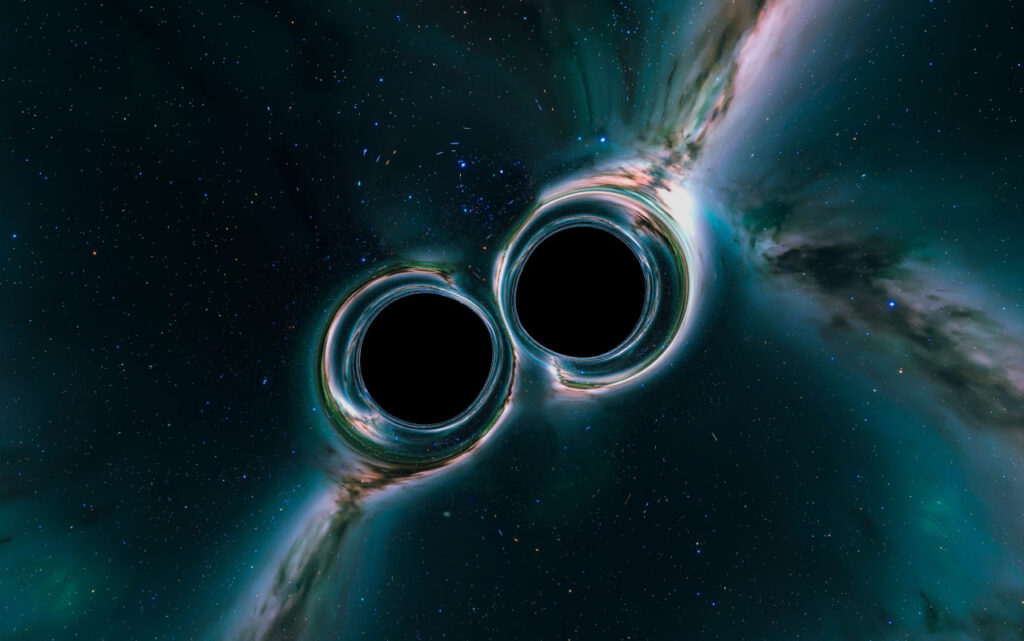
Some of the Universe’s biggest black holes may be cosmic “Frankensteins,” stitched together from many earlier collisions instead of being born huge in one go. That is the picture emerging from a new analysis of dozens of black hole mergers, led by researchers at Cardiff University and published in Nature Astronomy.
Listening to Black Holes Grow
When two black holes collide, they shake space‑time and send out ripples called gravitational waves. You can imagine them like waves on a pond after throwing in two heavy stones. Except here, the “pond” is the fabric of the Universe itself. Detectors such as LIGO, Virgo and KAGRA record these tiny ripples and turn them into data about the colliding black holes: their masses, how fast they spin, and how they are oriented.
The team looked at 153 confirmed black hole mergers from the latest gravitational‑wave catalogue. Instead of just counting events, they asked a deeper question: are the heaviest black holes in this list different from the lighter ones, and if so, why?
Two Families
The analysis revealed two clear groups. The smaller black holes look like we expect if they come from “ordinary” dead stars: massive stars collapse at the end of their lives and leave behind a single black hole. These systems tended to spin slowly and in more orderly ways.
The heavyweights, though, told another story. They spin faster, and their spins point in random directions. That’s exactly what theory predicts if black holes live in extremely crowded star clusters, where stars are packed far more tightly than in our part of the Milky Way. In those cosmic “cities,” black holes can repeatedly bump into each other, merge, and then merge again. Each smash‑up makes a bigger, rapidly spinning black hole with a jumbled spin direction.
A “Forbidden Zone” in Mass
The study also puts a new spotlight on a long‑suspected “mass gap”. According to models of how very massive stars explode, there should be a range of masses where no black holes are born directly from stars. The explosions are so violent that the star blows itself apart instead of collapsing.
The team finds signs of this transition around 45 times the mass of the Sun. Heavier black holes above this line are hard to explain with simple star collapse alone, but fit naturally if they are built up through repeated mergers in dense clusters.
From Star Cores to Nuclear Physics
Surprisingly, these distant collisions could help scientists study what happens deep inside massive stars. The exact location of the mass gap depends on nuclear reactions that control how stars burn elements like helium in their cores. As gravitational‑wave catalogues grow, astronomers hope to use black hole masses as indirect probes of nuclear physics, turning the Universe’s most extreme objects into laboratories for processes we can’t reproduce on Earth.
For now, the message from the data is that some of the largest black holes we’ve heard about are not born giants. They are the result of long, violent family trees playing out in the most crowded corners of the cosmos.