
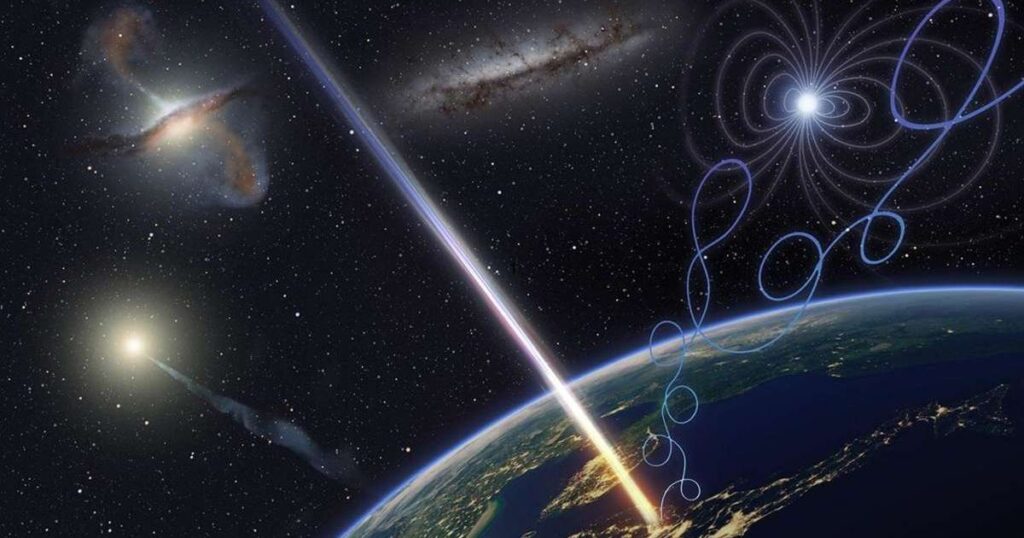
A new study, published in the journal Physical Review Letters, suggests that some of the highest-energy cosmic rays could contain atomic nuclei heavier than iron.
As some of the most powerful particles in the universe, ultrahigh-energy cosmic rays travel long distances in space before raining down on Earth. They carry energies much higher than those formed in human-made particle accelerators. But their true nature has been shrouded in mystery. Now, a study led by Penn State scientists suggests that some of the highest-energy cosmic rays may consist of atomic nuclei heavier than iron.
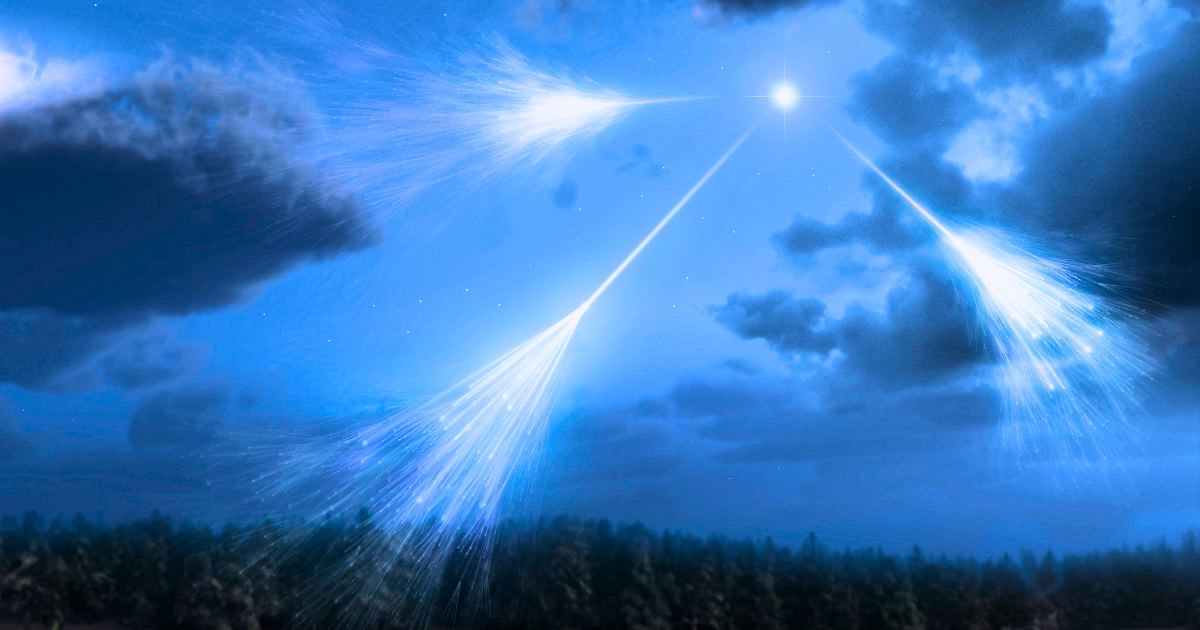
Artwork of high-energy particles and radiation from a star in deep space (cosmic rays) impacting molecules and atoms in the Earth’s atmosphere. (Representative Cover Image Source: Getty Images | MARK GARLICK/SCIENCE PHOTO LIBRARY)
The researchers have reported their findings in a paper published in the journal Physical Review Letters. Atomic nuclei, which form the core of atoms, are made of protons and neutrons. Although the cores contain nearly all of an atom’s mass, they occupy an extremely small fraction of its volume. The team’s analysis reveals that the ultraheavy nuclei lose energy more slowly than protons or other lighter nuclei during their journey through intergalactic space. This allows them to reach Earth at extreme energies.

A 3D illustration of a High-energy particle explosion (Photo by Pitris / Getty Images)
“Ultrahigh-energy cosmic rays can only be accelerated by some of the most powerful sources in the universe,” said Kohta Murase, professor of physics and of astronomy and astrophysics in the Penn State Eberly College of Science and the leader of the research team, in a statement. “When we detect individual cosmic-ray particles such as the Amaterasu particle here on Earth, we can often use their energies, arrival directions and expected magnetic deflections to infer their possible cosmic sources.” The “Amaterasu particle” was detected by the Telescope Array in Utah in 2021, and it stands as one of the highest-energy cosmic-ray events ever, with energy comparable to the “Oh-My-God particle” detected back in 1991.
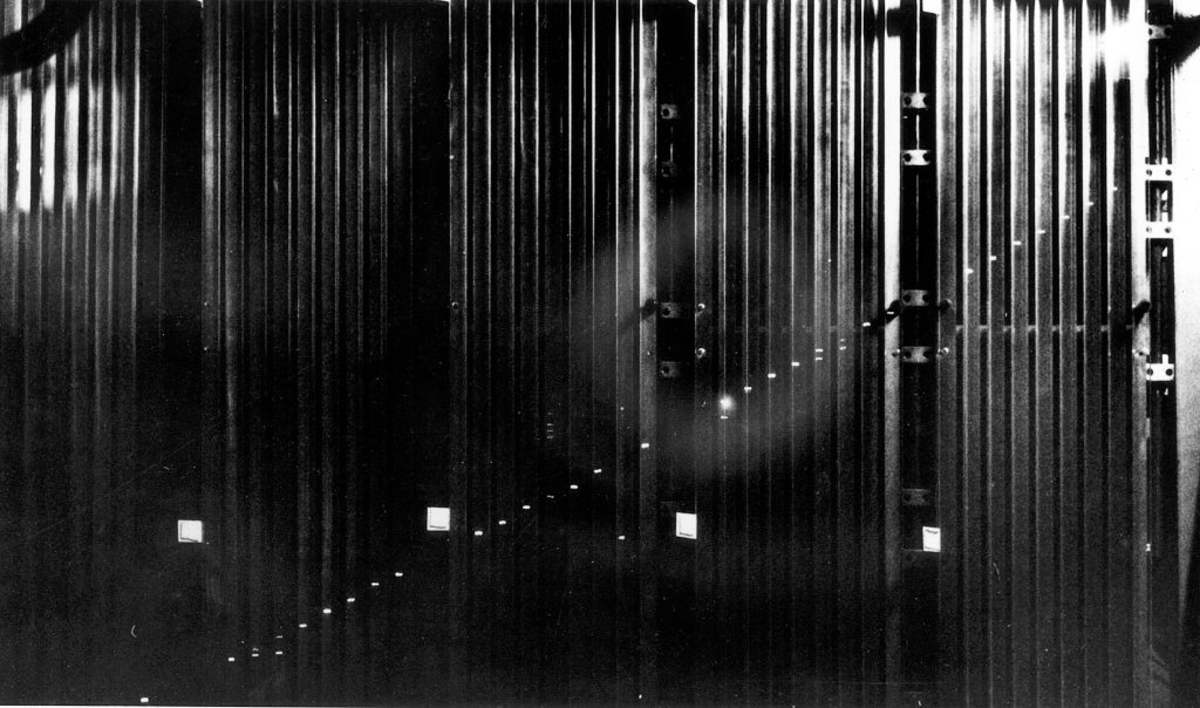
Track of a high-energy cosmic ray (m meson) in the spark chamber at the Alternating Gradient Synchrotron at Columbia University, New York, 1965. Image courtesy US Department of Energy. (Image Source: Smith Collection/Gado/Getty Images)
Scientists tried to trace the Amaterasu particle back to its origins, but they ended up detecting a cosmic void with no source of ultrahigh-energy cosmic rays. “The origins and acceleration mechanisms of ultrahigh-energy cosmic rays have been among the biggest mysteries in the field for more than 60 years, since the first example was reported,” Murase said. Cosmic rays consist of particles that have 10 million times more energy than the particles accelerated in the Large Hadron Collider, the world’s largest and most powerful particle accelerator. The cosmic particles have energies above 100 exa-electron volts (100 quintillion electron volts).
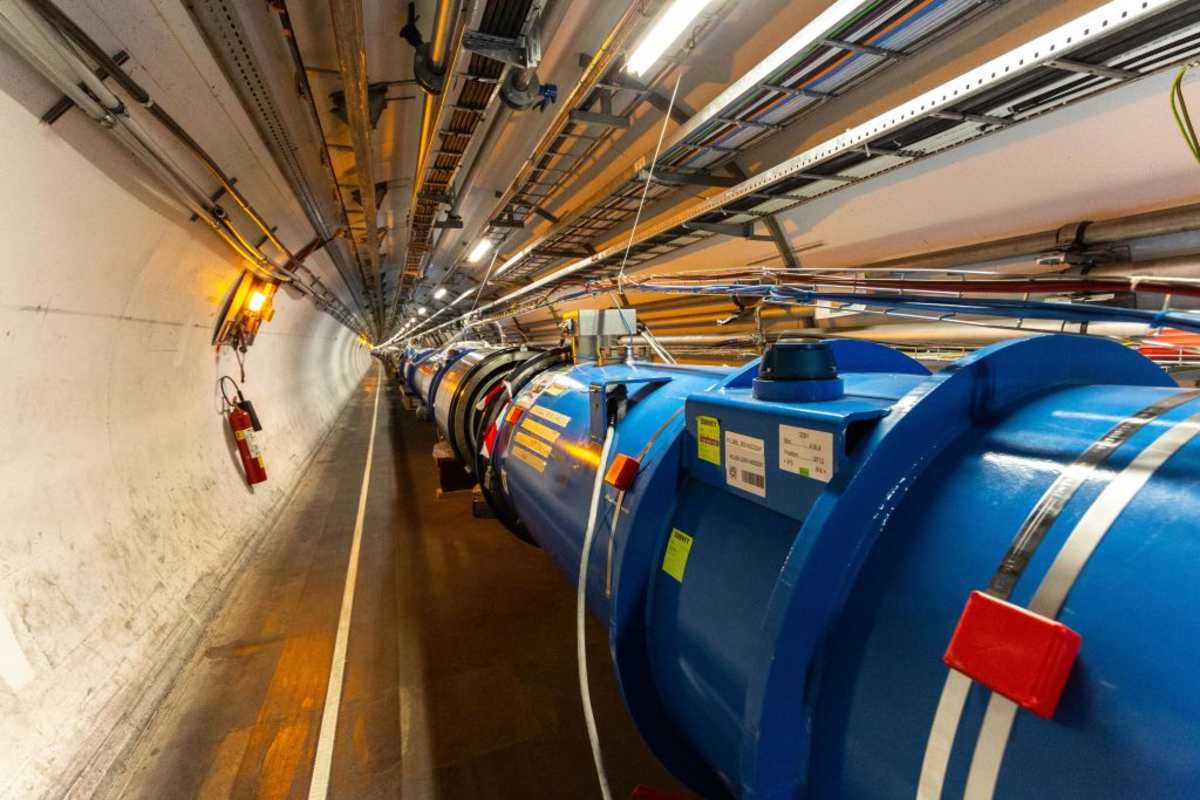
A part of the LHC tunnel is seen during the Open Days at the CERN particle physics research facility on September 14, 2019, in Meyrin, Switzerland. (Image Source: Ronald Patrick/Getty Images)
The Amaterasu particle’s energy was about 240 exa-electron volts. That is roughly the kinetic energy of a fast-moving tennis ball, but all carried within a single cosmic ray particle. Keeping such an energy range in mind, the team did computational simulations of how the energies of different-sized particles would change as they travel through intergalactic space. Their simulations also placed new constraints on how such ultraheavy nuclei contribute to the overall population of observed ultrahigh-energy cosmic rays. The study, conducted in collaboration with researchers at the Yukawa Institute for Theoretical Physics in Japan, Virginia Tech, and other institutions, could help home in on the cosmic sources capable of accelerating these particles.

Artwork of a black hole surrounded by an accretion disc of material, the light from which is warped by the strong gravity. (Representative Photo by MARK GARLICK / SCIENCE PHOTO LIBRARY / Getty Images)
“The most promising sites for producing and accelerating such ultraheavy nuclei are massive star deaths involving explosive collapse into black holes or strongly magnetized neutron stars, as well as binary neutron-star mergers known to be powerful gravitational-wave emitters,” Murase explained. “These violent cosmic phenomena can also power gamma-ray bursts that are among the most energetic explosions in the universe. A contribution from these sources could also help explain a possible difference seen between the northern and southern skies in the ultrahigh-energy cosmic-ray spectrum. If ultraheavy nuclei contribute significantly at the highest energies, future data should indicate a composition heavier than iron.”
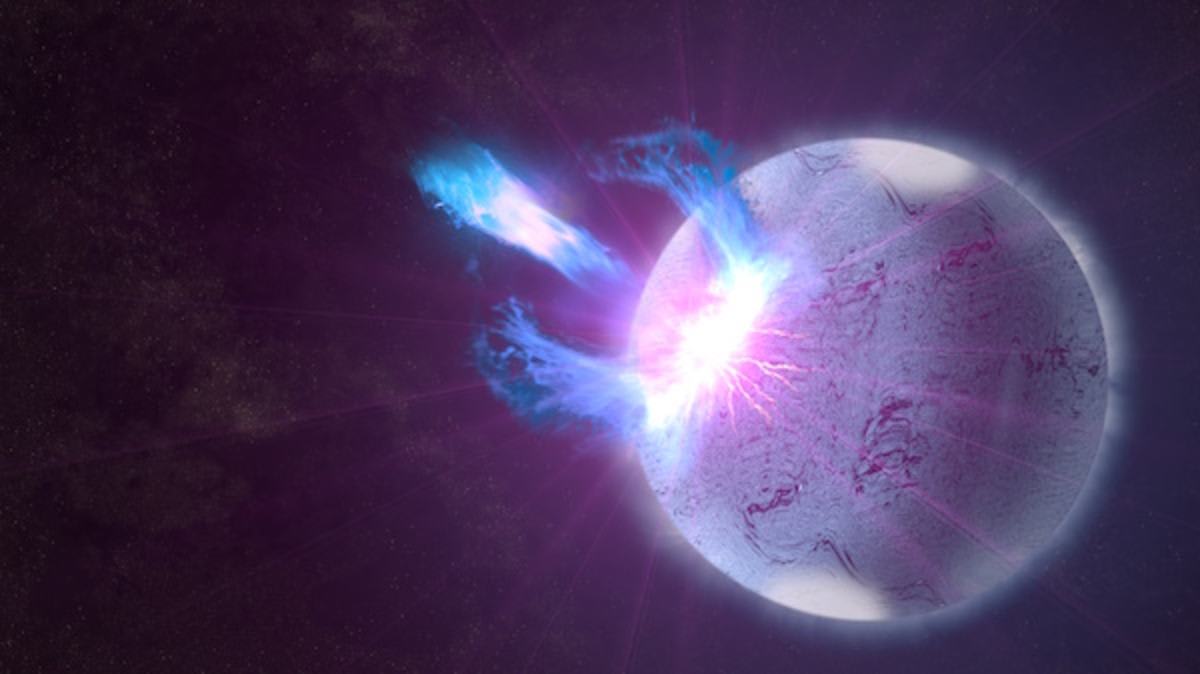
A rupture in the crust of a highly magnetized neutron star, shown here in an artist’s rendering, can trigger high-energy eruptions. (Representative Image Source: NASA’s Goddard Space Flight Center/S. Wiessinger)
The researchers think that next-generation observatories, such as the proposed AugerPrime in Argentina and the proposed Global Cosmic Ray Observatory, could test the cosmic ray signatures. Murase also noted that theoretical studies of cosmic explosions involving black holes and highly magnetized neutron stars could help trace when these rays come from.
More on Starlust
Scientists trace the most energetic neutrino ever detected on Earth to blazars
Massive water tank located 600 meters below ground can help deepen understanding of ghost particles