
Here’s what you’ll learn when reading this story:
Scientists are unsure what drives wave function collapse in the quantum world, but according to some radical theories, gravity may play a role.
Scientists determined that if those theories are true, there must be a limit to how accurately time can be measured.
This limit would be imperceptible to us and to our hyper-accurate atomic clocks, but it would tell us more about the nature of gravity in the subatomic world.
Quantum mechanics is known in popular culture primarily for its weirdness. While, in classical physics, objects have a definite position and state at any given time, when you enter the world of subatomic particles, this is no longer the case. One of the core principles of quantum weirdness is the principle of superposition, according to which a particle can exist in multiple states simultaneously, such as being in more than one location at once. The range of possible states (each with a calculable probability) is represented by a mathematical entity known as a wave function. Once a measurement is made, however, the wave function collapses into a single outcome.
The fundamental cause of this wave function collapse, however, is unknown. Some scientists—including those who support the Ghirardi–Rimini–Weber (GRW) model, the continuous spontaneous localization (CSL) model, and the Diósi–Penrose (DP) model—think it’s actually an objective physical collapse. The last of those models, introduced in the late 1980s by Nobel Prize-winning physicist Roger Penrose and Lajos Diósi of Eötvös Loránd University in Budapest, relies on gravity to explain the physical collapse of the wave function.
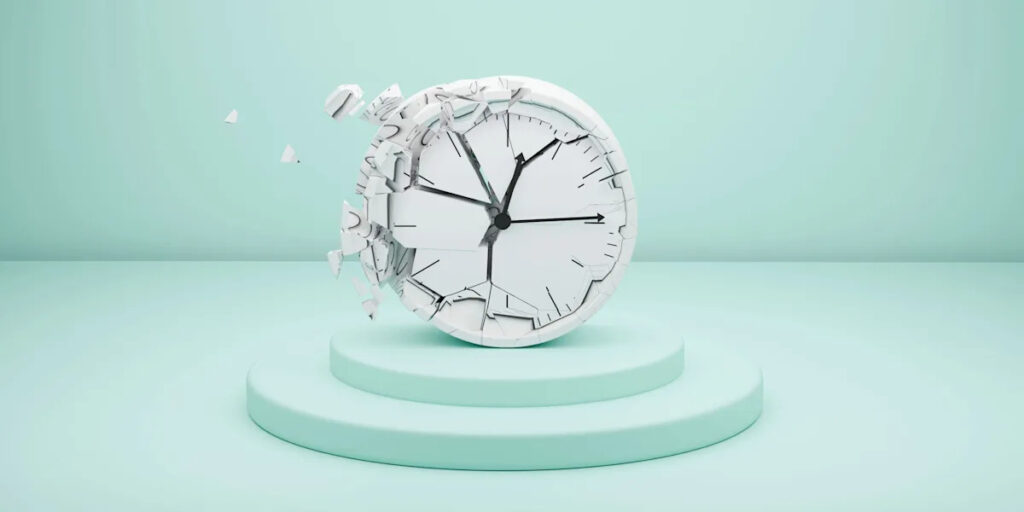
Now, in a new study published in the journal Physical Review Research, scientists have analyzed these theories and explored what their impacts would be on the measurement of time. They found that if these collapse models are accurate, time itself is not exact—in other words, there’s a fundamental limit on how accurate a clock can be. This is due to the fact that fluctuations in the gravitational field “induce an intrinsic uncertainty in the flow of time,” according to the study.
“What we did was to take seriously the idea that collapse models may be linked to gravity,” Nicola Bortolotti, a Ph.D. student at the Enrico Fermi Museum and Research Centre (CREF) and lead author of the study, said in a press statement. “And then we asked a very concrete question: What does this imply for time itself?”
These uncertainties don’t impact our everyday lives. In fact, even the most hyper-accurate atomic clock—which can measure time down to the 19th decimal place—isn’t even close to being impacted by this fluctuation. But the results do suggest that there’s a theoretical limit where time itself becomes fuzzy.
“Our work shows that even radical ideas about quantum mechanics can be tested against precise physical measurements, and that, reassuringly, timekeeping remains one of the most stable pillars of modern physics,” said Catalina Curceanu, a co-author of the study.
Of course, there’s still uncertainty as to whether or not wave function collapse is caused by gravity in the first place, but this is far from the only weird time-related quirk that pops up when exploring quantum mechanics. A study published last month, for example, explored the idea of the “quantum twin paradox,” in which time itself could also experience a superposition that would result in its passage being both fast and slow. Hopefully, scientists will one day be able to observe these effects using ultra-precise atomic clocks that are manipulated into a “squeezed state,” inducing new behaviors of time in the quantum world.
The quantum weirdness just keeps getting weirder.
You Might Also Like