
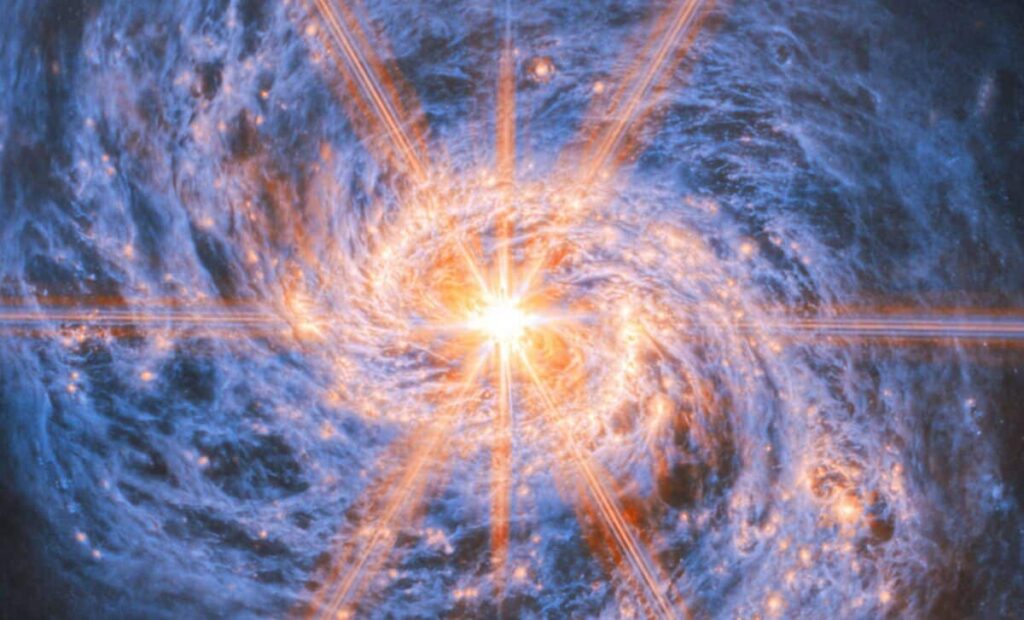
NASA’s James Webb Space Telescope has captured a stunning new image of Messier 77, a spiral galaxy whose brilliant core outshines nearly everything in its vicinity. Located 45 million light-years away in the constellation Cetus, the galaxy’s active nucleus reveals the dramatic power of a supermassive black hole consuming material at an extraordinary rate.
The image, according to reports from this week, demonstrates why the James Webb Space Telescope has become such a transformative tool for astronomy since its launch in 2021. While astronomers have long known about active galactic nuclei, the level of detail now visible through Webb’s infrared instruments offers an unprecedented window into how these cosmic monsters interact with their surroundings.
The Supermassive Engine at Messier 77’s Core
According to NASA’s reporting, the extraordinary brightness emanating from the spiral galaxy’s nucleus is powered by a supermassive black hole that weighs approximately 8 million times more than our sun. This is no dormant relic but rather an actively feeding black hole that pulls surrounding material into its gravitational embrace. The gas and other matter in the vicinity of this cosmic monster are funneled into an increasingly tight orbit as they spiral inward toward the event horizon.
What makes this process so bright is the physics of material falling into the black hole. As gas and dust speed up toward it, the particles rub against each other, creating friction that heats them up to insanely high temperatures.
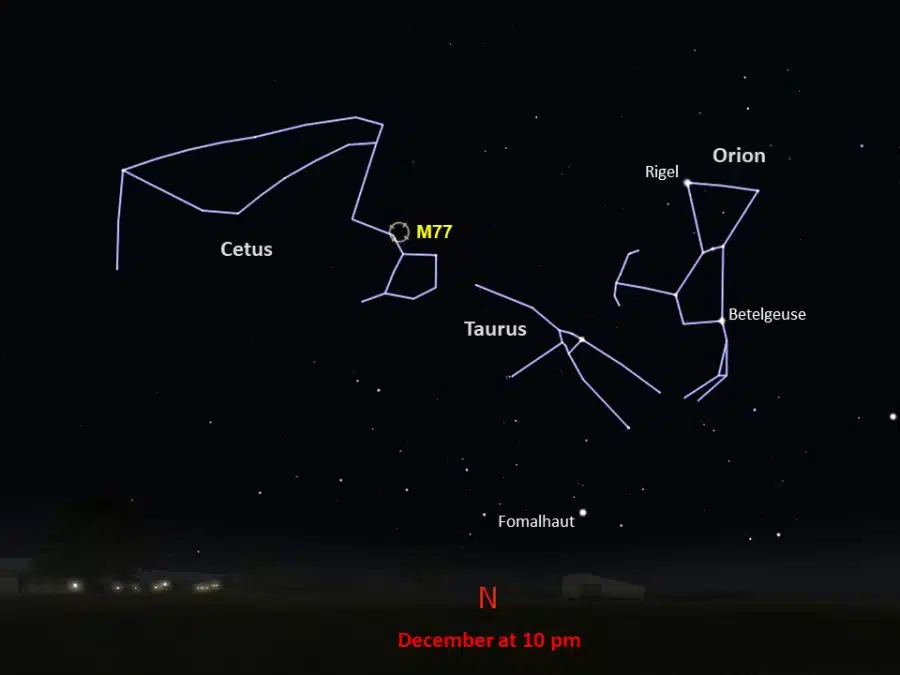 This M77 star chart shows the view from mid-southern latitudes at the specified time. Credit: Stellarium
These temperatures get so extreme that the material starts to glow across a wide range of wavelengths, from radio waves to visible light and beyond. The result is a super bright region that makes the galaxy shine.
Webb’s Infrared Vision Penetrates the Cosmic Veil
The remarkable clarity visible in this new image owes everything to the James Webb Space Telescope’s mid-infrared instruments, which proved particularly adept at capturing the details around Messier 77’s active nucleus. Infrared observation provides a distinct advantage when studying active galactic regions: dust that blocks visible light becomes largely transparent to infrared radiation.
According to Phys.org‘s coverage of the image, the technology represents a leap forward from earlier space telescopes, which often struggled to penetrate the dust surrounding these violent regions.
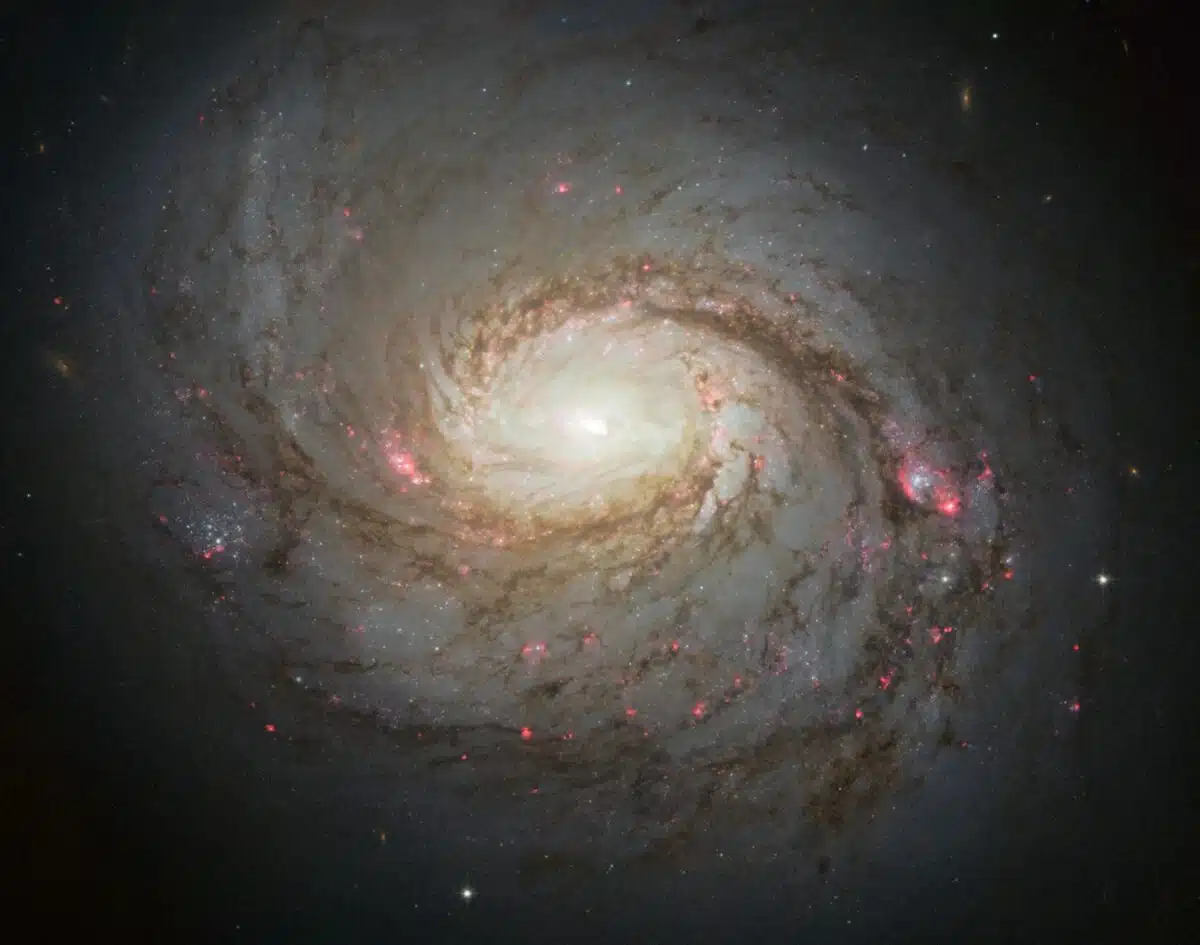 M77 captured by Hubble in 2013. Credit: NASA, ESA & A. van der Hoeven
A Transformative Era for Cosmic Observation
The world’s largest and most powerful space telescope has been photographing the galaxy since its launch in 2021, and images like the Messier 77 observation demonstrate why the investment in this technology has proven worthwhile.
The steady stream of discoveries flowing from Webb’s instruments suggests that we’re only beginning to appreciate what this observatory can reveal about the distant cosmos. This particular image will likely join a growing gallery of Webb observations that have fundamentally altered how astronomers think about the universe.