
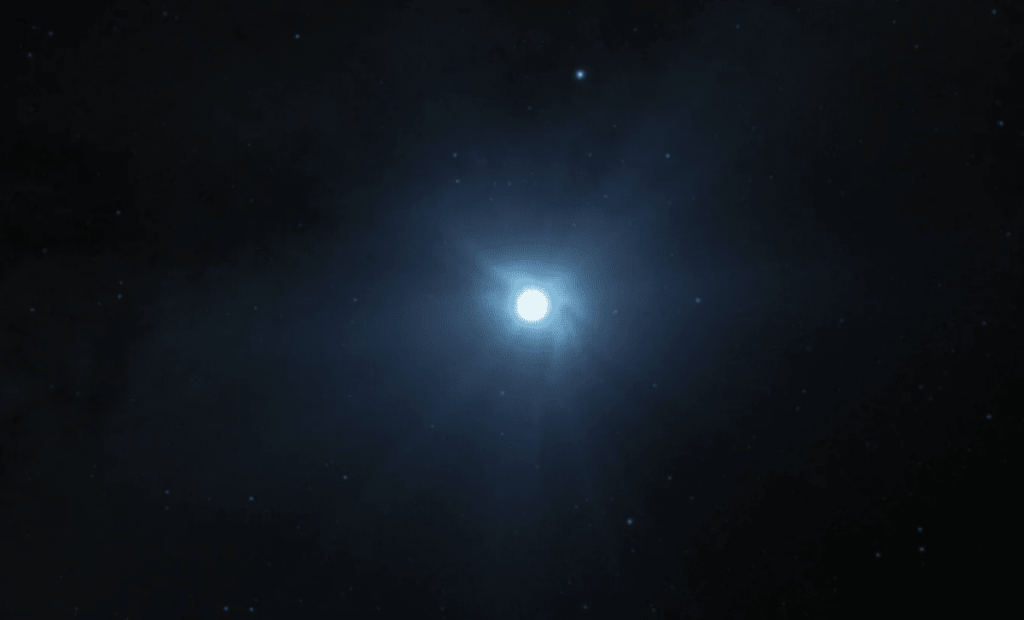
Astronomers are on the brink of a groundbreaking discovery that could reshape our understanding of the universe. A new study shows that NASA’s upcoming Nancy Grace Roman Space Telescope may be able to detect elusive neutron stars, hidden remnants of massive stars that have exploded. These cosmic objects, which are typically invisible to most telescopes, could be revealed using the power of gravitational microlensing, a phenomenon that Roman is uniquely equipped to study.
The Power of Gravitational Microlensing
Neutron stars are incredibly dense remnants of stars that have undergone supernova explosions. They pack more mass than the Sun into a sphere no larger than a city, yet remain largely undetectable due to their dimness and isolation in the vastness of space. “Most neutron stars are relatively dim and on their own,” explained Zofia Kaczmarek, a researcher at Heidelberg University in Germany, who led the study. “They are incredibly hard to spot without some sort of help.”
However, the study, published in Astronomy and Astrophysics, proposes that NASA’s Nancy Grace Roman Space Telescope could change that. Roman’s innovative approach, known as gravitational microlensing, allows it to detect these faint objects by measuring how their intense gravity bends and brightens the light from distant stars behind them.
Gravitational microlensing occurs when a massive object, like a neutron star, moves between Earth and a distant star, warping the star’s light. This brief brightening allows astronomers to spot objects that would otherwise remain hidden. Roman’s advanced capabilities enable it to measure both the increase in brightness (photometry) and the subtle shift in the background star’s position (astrometry). The combination of these measurements provides a more precise way to identify and study neutron stars.
New Insights Into Stellar Remnants
The Roman Space Telescope’s ability to observe microlensing with unparalleled precision has the potential to not only detect neutron stars but also provide important data about their mass. “What’s really cool about using microlensing is that you can get direct mass measurements,” said Peter McGill, a co-author of the study from Lawrence Livermore National Laboratory. “Photometry tells us that something passed in front of the star, but it’s the amount the star’s position shifts that tells us how massive that object is.”
According to NASA, this new method of mass measurement could help solve several long-standing mysteries in astrophysics. For example, scientists currently don’t know the mass distribution of neutron stars and black holes, nor where the boundary between the two objects lies. Roman’s findings may be a breakthrough in determining how these stellar remnants differ in size and weight, and how fast neutron stars move across the galaxy after receiving powerful “kicks” during their formation.
McGill emphasized the importance of these measurements:
“We don’t know the mass distribution of neutron stars, black holes, or where one ends and the other begins with any certainty. Roman will really be a breakthrough in that.”
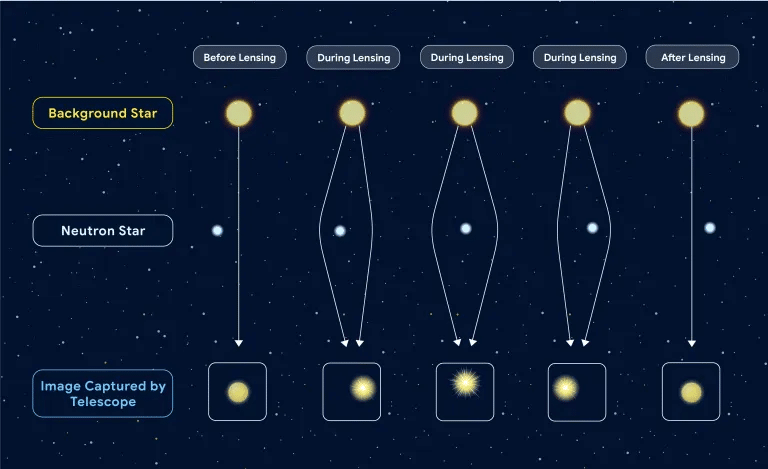 Astrometric microlensing occurs when a foreground object, like a neutron star, passes in front of a more distant background star. The neutron star’s gravity bends the distant star’s light, splitting it into multiple paths that reach the telescope. Although these distorted images can’t be resolved, their combined light appears brighter and slightly shifted from the distant star’s true position. As the alignment between the two objects changes over time, this apparent shift traces a small elliptical pattern on the sky. The size of that ellipse depends on how strongly the light is bent, meaning more massive objects produce larger shifts, allowing astronomers to directly measure the mass of the otherwise invisible neutron star.
NASA, STScI, Joyce Kang (STScI)
Vast Survey for a Hidden Population
The research team will take advantage of Roman’s Galactic Bulge Time Domain Survey, a massive observational project that will scan millions of stars across wide areas of the sky at high frequencies. The survey is primarily aimed at identifying exoplanets using photometric microlensing, but the newfound ability to measure astrometric microlensing opens up an entirely new frontier in astrophysical research.
The telescope’s capability to observe such a vast region of the sky makes it possible to detect isolated neutron stars that may be scattered across the Milky Way, a population that has been nearly impossible to study until now. “We’re seeing a small sample that’s not representative of the big picture,” said Kaczmarek. “Even a single mass measurement would be very powerful. If we found just one isolated neutron star, it would already be incredibly stimulating to our research.”
Roman’s ability to identify these objects could provide astronomers with the first large sample of isolated neutron stars, helping to shed light on a population that has remained hidden from previous surveys.
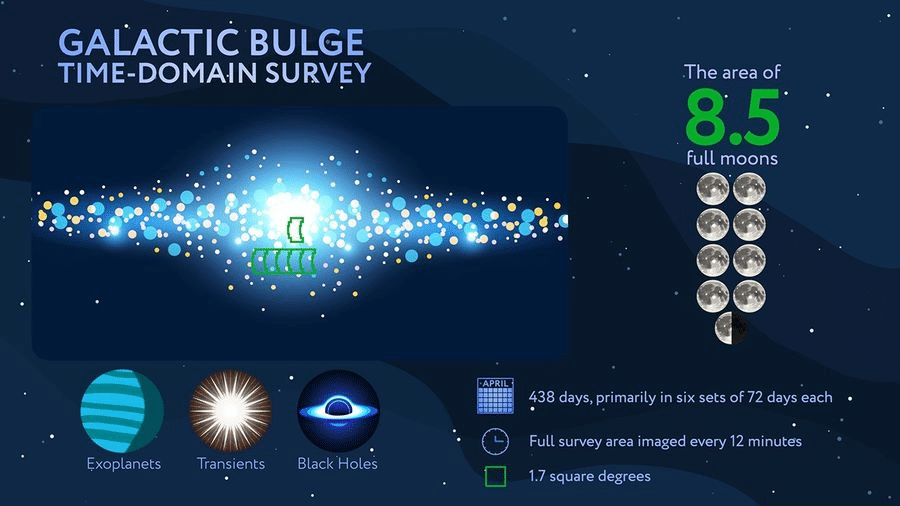 This infographic describes the Galactic Bulge Time-Domain Survey that will be conducted by NASA’s Nancy Grace Roman Space Telescope. The smallest of Roman’s core surveys, this observation program consists of repeat visits to six fields covering 1.7 square degrees total. One field pierces the very center of the galaxy, and the others are nearby — all in a region of the sky that will be visible to Roman for two 72-day stretches each spring and fall. The survey mainly consists of six seasons (three early on, and three toward the end of Roman’s primary mission), during which Roman views each field every 12 minutes. Roman also views the six fields with less intensity at other times throughout the mission, allowing astronomers to detect microlensing events that can last for years, signaling the presence of isolated, stellar-mass black holes.
NASA’s Goddard Space Flight Center
A New Chapter in Microlensing and Cosmic Discovery
Roman’s unique blend of photometric and astrometric capabilities allows it to pursue not just one scientific goal, but many. McGill noted that the ability to detect neutron stars and black holes through microlensing wasn’t originally part of Roman’s design but has turned out to be one of its most exciting applications. “This wasn’t part of the original plan,” he said. “But it turns out Roman’s astrometric capability is really good at detecting neutron stars and black holes, so we can add a whole new kind of science to Roman’s surveys.”
The anticipated discoveries could transform our understanding of the universe. By revealing previously hidden neutron stars, Roman will open a new chapter in the study of stellar remnants and the dynamics of our galaxy. With this technology, NASA is poised to uncover a long-lost population of objects that has eluded scientists for decades.