
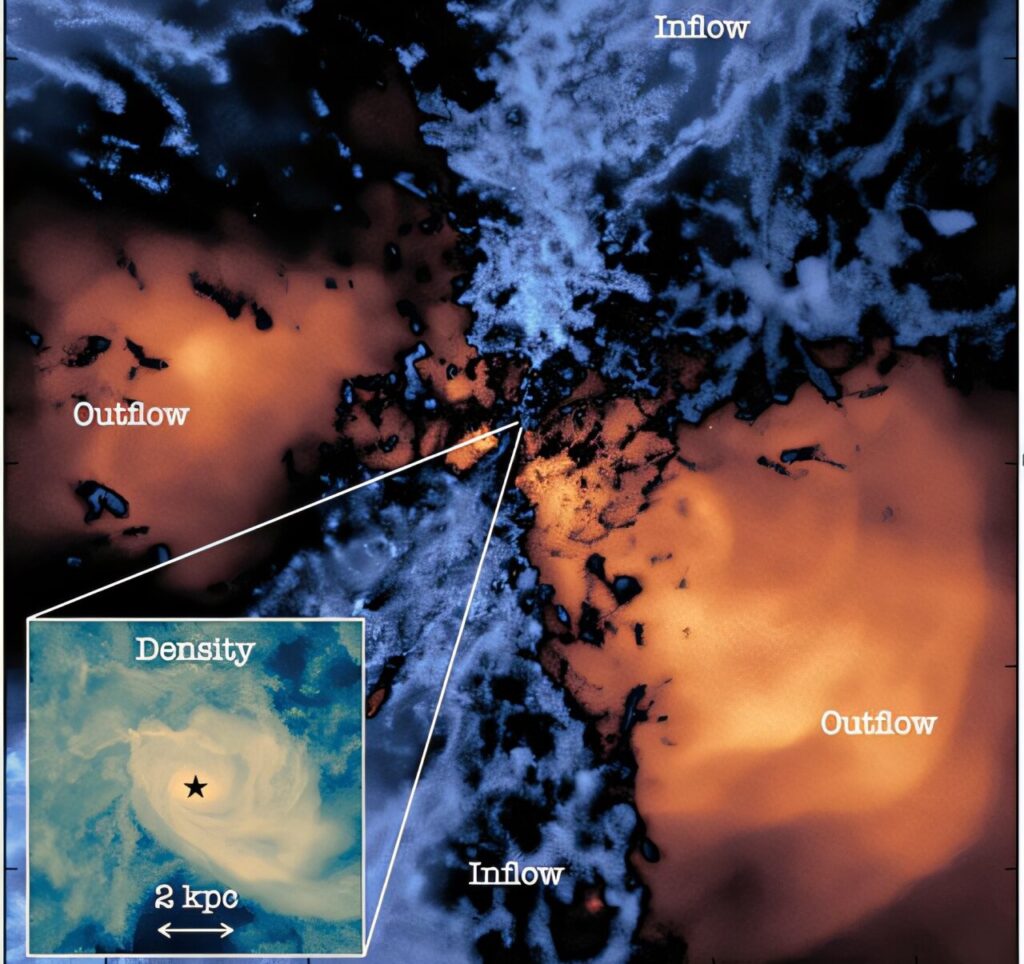
Quasars are supermassive black holes into which matter is constantly falling, causing them to emit an incredible amount of energy. As it turns out, this process hinders star formation and may even lead to the galaxy’s premature “aging.”
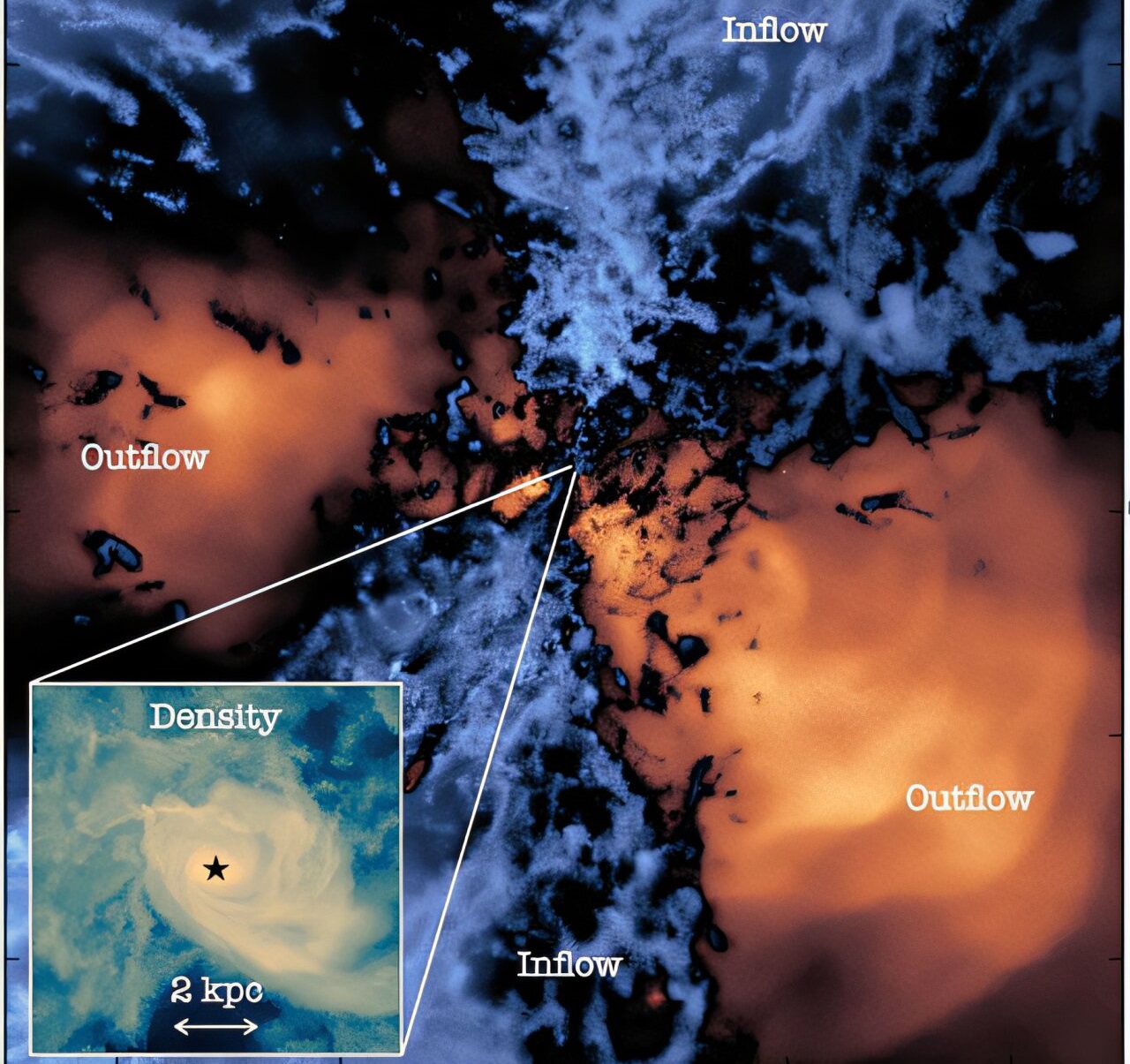 How quasars inhibit star formation. Source: phys.org
Quasars and star formation
At the center of nearly every large galaxy lies a supermassive black hole. When a large amount of matter falls onto it, an extremely powerful burst of radiation is emitted—comparable to the combined light of all the stars in that system—which is visible across the entire Universe. We call this a quasar.
Recently, scientists working with the James Webb Space Telescope discovered that quasars had a profound impact on the evolution of their host galaxies at a time when the Universe was only 5% of its current age. An article on this topic has been published in the journal Nature.
This refers to the effect of gas and dust being blown out of the galaxy by radiation from the quasar. As a result, there is less material left in it for new generations of stars, and star formation there comes to a halt. This phenomenon has been known for a long time, but its true scale has only recently been fully appreciated.
Stellar wind from quasars
In fact, not every supermassive black hole at the center of a galaxy becomes a quasar. One would expect even fewer of them during the first one or two billion years, when these objects would still be relatively small. However, there turned out to be an extremely large number of quasars visible during this period.
And this is precisely what led scientists to suggest that their radiation could significantly reduce the rate of star formation. It should be noted, however, that most of the quasar’s radiation is emitted in the form of jets from its poles. The others are usually overlooked, but it is precisely this one that can be powerful enough to generate galactic-scale “stellar winds,” which blow away the gas and dust.
Scientists examined 27 quasars in the early Universe and confirmed the existence of such winds in their galaxies. What’s more, they turned out to be even more powerful than those found in structures dating from later periods. The speed at which matter moves in them can reach 8,400 km/s.
All of this means that in just 100 million years, the galaxy could run out of material to form new stars. And all of this is consistent with data showing that a large number of galaxies have aged unexpectedly quickly—in other words, no new stars are forming in them anymore.
According to phys.org