
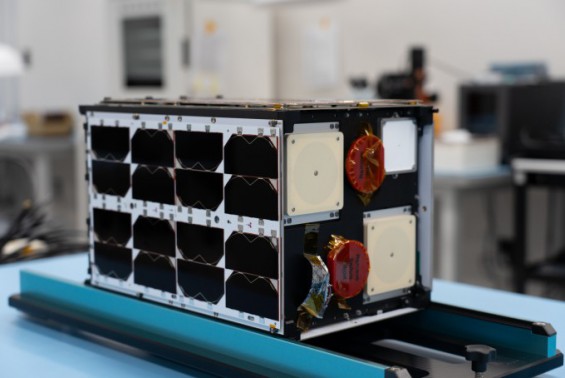
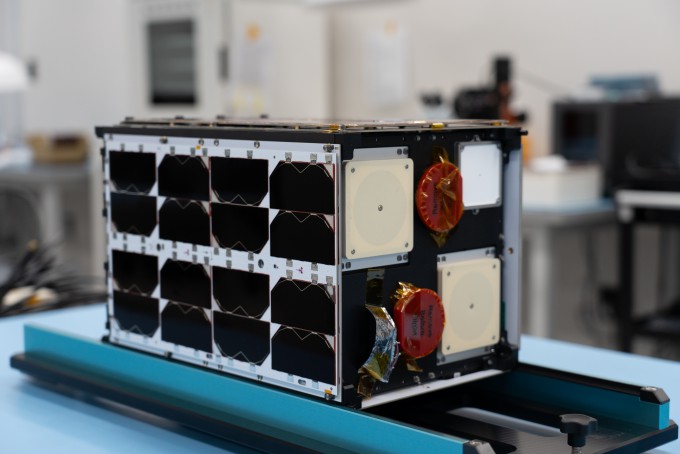
Nara Space has successfully launched ‘BusanSat,’ the first municipal ocean observation satellite in Korea. It will observe marine fine dust around the Busan port and the West Sea coast and be used for global climate research. Photo by Nara Space
After approximately seven years of planning and development, ‘BusanSat,’ South Korea’s first municipal microsatellite for ocean observation, has been launched into space. It completed its space debut by successfully reaching orbit and establishing two-way communication. BusanSat, which will monitor marine fine dust and the atmospheric environment around Busan Port, the West Sea coast, and the Pacific Ocean, is set to begin full-scale observations next month, with the collected data to be used for global climate research.
Nara Space Technology (Nara Space) announced on the 7th that it successfully launched the Busan Metropolitan City’s microsatellite, BusanSat, on the 3rd at 16:00 from Vandenberg Space Force Base in California, USA, aboard a SpaceX Falcon 9 rocket. The satellite successfully separated from the rocket about 139 minutes after launch, completed two-way communication, and has stably entered its initial operational phase.
Nara Space was responsible for the satellite system integration and bus manufacturing for this mission. By completing the entire process from launch to orbit insertion and successful two-way communication, the company has once again demonstrated its technological prowess as a specialist in microsatellites.
BusanSat is a 12U (20cm×20cm×30cm) satellite weighing about 12kg, equipped with a polarization camera as its primary payload. The data it collects will be widely used in public and industrial sectors, including marine environment analysis, fine dust policy formulation, and industries based on marine data.
Nara Space applied its proprietary Highly Adaptive Platform to BusanSat. This microsatellite bus system is designed to respond flexibly to various payloads and mission environments. The successful communication has demonstrated its potential for expansion to specialized missions like ocean and atmospheric observation. This is significant as it confirms the platform’s capability to perform missions ranging from commercial applications to international academic and scientific tasks.
Busan Metropolitan City and the Korea Astronomy and Space Science Institute (KASI) signed a joint utilization agreement in March 2024 and have detailed plans for data use with the NASA Langley Research Center. BusanSat’s data will be utilized not only for managing Korea’s marine environment but also for analyzing global climate change.
Lee Jeong-gyu, Head of Business at Nara Space, said, “BusanSat is significant as it is the first specialized ocean observation microsatellite to apply the Highly Adaptive Platform and the first ocean observation satellite operated by a local government in Korea. It also has high business value as it introduces a satellite model to the market that can commercially utilize public data, such as marine fine dust observations.”
Park Jae-pil, CEO of Nara Space, stated, “I am very pleased that the satellite, which has been in preparation for about seven years from planning to development and launch, has been successfully launched. It is an incredibly meaningful achievement that BusanSat will contribute to the marine environment management of Busan City and to international climate research with the NASA Langley Research Center.”
Copyright ⓒ DongA Science. All rights reserved.