
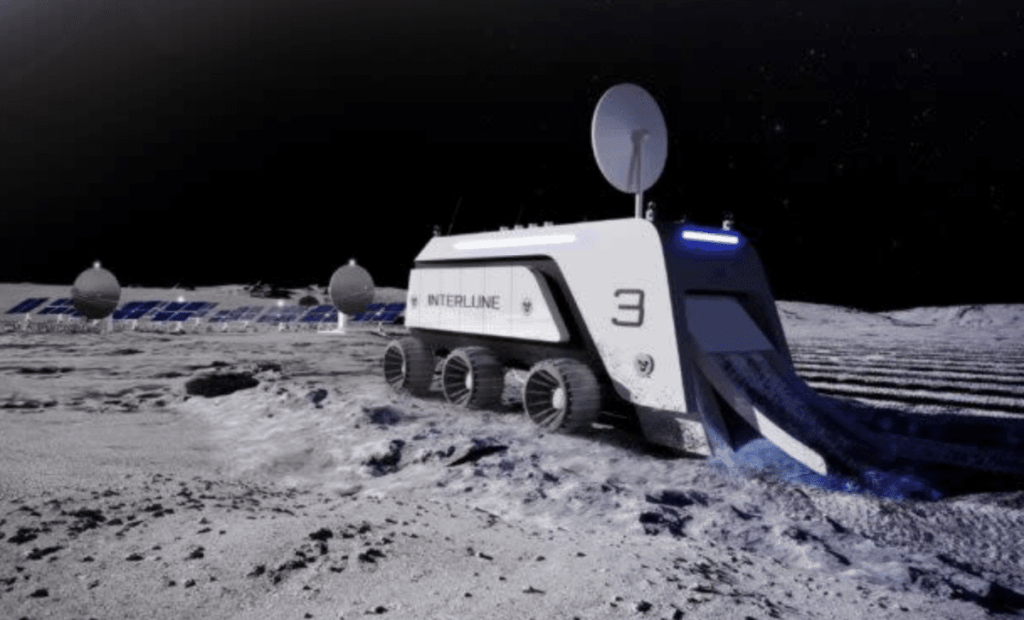
NASA has awarded a $6.9 million contract to Interlune to develop a payload capable of extracting helium-3 directly from lunar regolith, signaling a pivotal shift toward real-world resource utilization on the Moon and accelerating ambitions tied to the agency’s broader exploration strategy.
NASA’s Investment Signals A New Phase In Lunar Resource Exploration
The contract, issued under NASA’s Space Technology Mission Directorate as part of its Game Changing Development Program, supports the creation of a flight-ready payload designed to test extraction of solar wind volatiles on the Moon. This initiative reflects a growing focus on transforming experimental technologies into operational systems that industry can deploy at scale.
“A major goal of NASA is to mature transformative technologies so they can be confidently adopted by industry,” said Michael Johansen, Deputy Program Manager for NASA’s Game Changing Development Program. “The evolution of MSOLO into a robust, flight-ready instrument is a perfect example of that success. We are thrilled to see this proven technology leveraged by an industry effort, marking a significant step forward in commercial resource prospecting.”
The payload, known as Prospect Moon, will integrate advanced instrumentation with a robotic sampling system. Its mission is to validate whether valuable gases implanted in lunar soil by the solar wind can be efficiently extracted under real lunar conditions. This marks a transition from theoretical modeling and laboratory simulations to in situ experimentation, a critical milestone for any future mining operation beyond Earth.
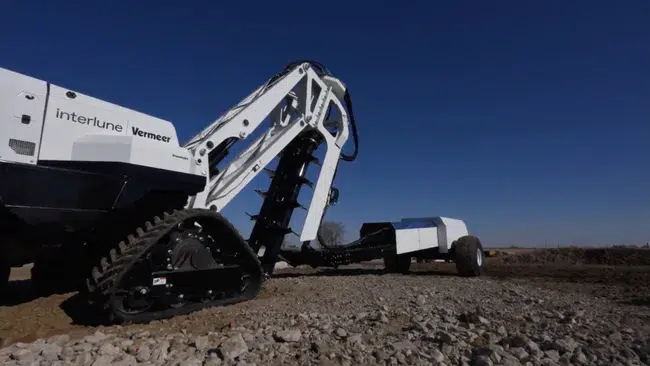 A full-scale prototype of the Interlune excavator, which was developed in partnership with Vermeer. The excavator will harvest helium-3 on the moon, if all goes according to plan.
Image credit: Interlune
How Prospect Moon Will Test Extraction On The Lunar Surface
At the core of the Prospect Moon system is a robotic arm capable of collecting regolith and delivering it into a processing unit. Once inside, samples will undergo controlled heating to release embedded gases such as helium-3 and hydrogen. Additional processing methods—including sorting, agitation, and crushing, will assess how physical manipulation impacts extraction efficiency.
“This is going to be the first time that solar wind volatiles have been extracted from lunar regolith in situ on the moon,” said Rob Meyerson, chief executive of Interlune.
The mission is designed not only to confirm the presence of extractable resources but to quantify how efficiently they can be harvested. Engineers will use the resulting data to refine future systems intended for continuous, industrial-scale operations on the Moon.
“We’ll calibrate the processes that we eventually want to use on the moon for a full-scale resource extraction operation,” Meyerson said. “It will measure the efficiency of our process so that we can use that to go build larger-scale hardware.”
The payload is expected to be ready for integration by fall 2027, targeting a launch window in 2028 aboard a commercial lunar lander. Interlune is currently evaluating multiple mission opportunities, with a preference for equatorial landing sites where regolith composition may favor extraction efforts.
Today, we’re announcing the award of our $6.9 million contract with NASA for lunar resource development.
The Prospect Moon payload will be ready for lander integration in Fall of 2027.
Chief Scientist Dr. Elizabeth Frank is quoted in the announcement – “For the first time ever,… pic.twitter.com/Z0z0ZeyMs9
— Interlune (@InterluneSpace) May 4, 2026
Rising Demand For Helium-3 Drives Commercial Momentum
The push to extract helium-3 is fueled by its potential applications in advanced energy systems and quantum computing. The isotope is extremely rare on Earth but believed to be more abundant in lunar soil due to billions of years of solar wind exposure.
Interlune has already secured agreements worth approximately $500 million with organizations including the U.S. Department of Energy and private companies such as Maybell Quantum and Bluefors. These deals point to a rapidly emerging market, even as the technical challenges of lunar extraction remain significant.
To bridge the gap before lunar operations begin, the company is also exploring terrestrial methods to extract trace amounts of helium-3 from commercially available helium supplies. This dual-track approach highlights both the urgency of demand and the long-term vision tied to lunar resources.
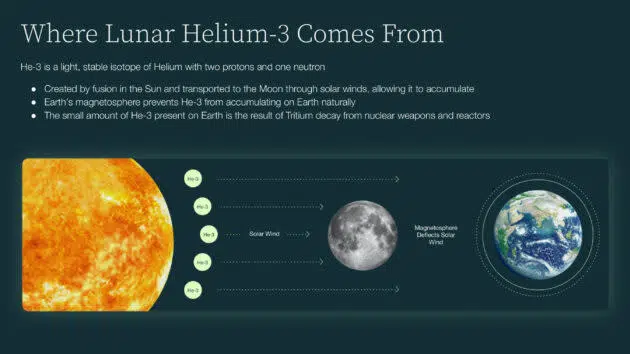 Credi: Interlune
The Role Of Lunar Infrastructure In Future Mining Operations
Although NASA’s Artemis program is focused on establishing a base near the Moon’s south pole, Interlune is prioritizing equatorial regions for its extraction activities. This geographic divergence reflects differing operational goals, yet the two efforts remain interconnected.
Infrastructure developed for a sustained human presence, such as power systems, transportation networks, and surface operations, could indirectly support commercial ventures like helium-3 mining. At the same time, private-sector initiatives offer practical use cases that strengthen the economic justification for lunar infrastructure.
Interlune has already taken steps toward lunar deployment beyond Prospect Moon. Its Crescent Moon camera system, designed to identify ilmenite concentrations as indicators of helium-3, is set to fly aboard Astrolab’s FLIP rover on Astrobotic’s Griffin-1 mission.