
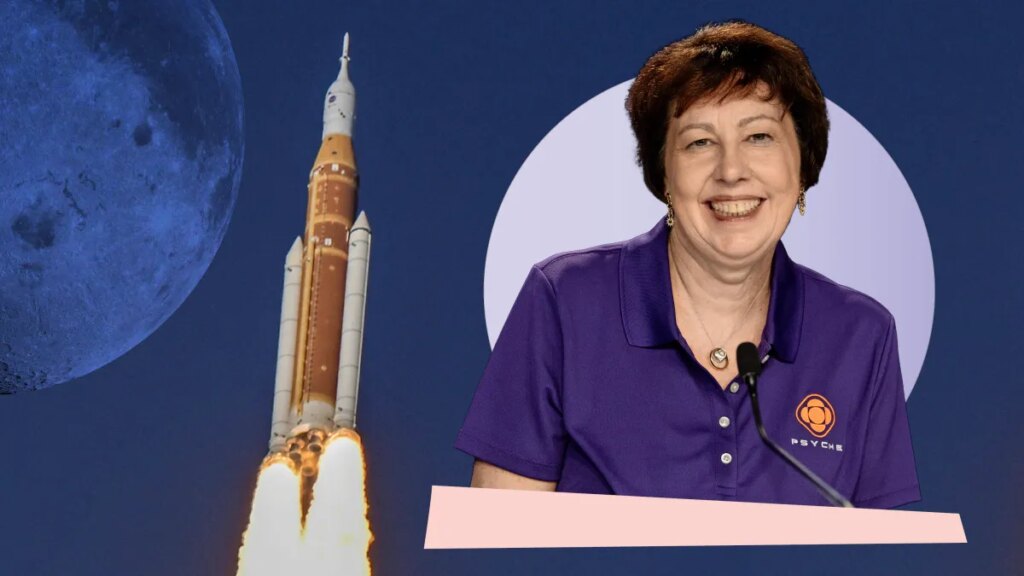
Fox, 58, was born in Hitchin, Hertfordshire. She read physics at Imperial College London, then earned a master’s in telematics and satellite engineering at the University of Surrey, before returning to Imperial College to complete a PhD in space and atmospheric physics. She worked at the Johns Hopkins University Applied Physics Laboratory in Maryland and in 2023 was appointed associate administrator for Nasa’s Science Mission Directorate. She lives with her husband near Washington with her children from her first marriage, James and Darcy.
I’m not sure I slept that well the night before Artemis II launched — April 1 was a very special day on my calendar. It was the first time I’d seen a crew lift off for outer space, so I felt the historic nature of what Nasa was doing. To think we were sending humans around the moon for the first time in over 50 years was amazing.
I was at Kennedy Space Centre in Florida to wave the four astronauts off as they were driven to the capsule. The people around me had given their heart and soul to the mission — there wasn’t a dry eye anywhere. Later, after I saw the rocket start to move upwards, I felt a boom of sound hit my chest. Everyone went crazy.
I’m usually based in Washington and like to be at work by 7am. I skip breakfast and spend most of the day in meetings. I try to eat healthily for lunch, something like a chicken salad. My guilty pleasure is jelly babies. They don’t taste the same here, so I bring them over from the UK.
I don’t get the chance to wear a white coat in the Nasa laboratories much these days but I’m very excited about how Artemis will help to progress science. My team talked directly to the astronauts as they passed around the moon, chatting about the size of the craters and what the surface looks like. The far side is constantly peppered by micrometeorites, so it’s different from what we see through a telescope here.
We are now studying the tissue chips, each the size of a USB drive and grown from the astronauts’ blood cells to mimic their organs. This will help us to understand how deep-space radiation and microgravity affect human tissue — vital if we’re going to establish missions to the moon and beyond.
I flew up to Mission Control in Houston for the moment the astronauts passed around the dark side of the moon. In the science evaluation room there was great tension when the module went out of contact for about 40 minutes, then tremendous relief when we heard voices again. A visit to the moon’s surface is now set for 2028 with Artemis IV, the first crewed landing mission since Apollo 17 in 1972.
In 1969 I was just months old when Dad lifted me out of my cot in the middle of the night to watch Neil Armstrong take his “giant step” on the moon. I don’t remember, of course, but later my father would read me space stories in bed and, naturally, Dad would go on to take all the credit for my future career!
I met my first husband, John Sigwarth, while studying the aurora borealis in Sweden in the Noughties. At first I was more interested in his camera aperture but we were a pair of nerds and fell in love. When he died suddenly in 2010 from an aortic aneurysm, my life fell apart. I had just joined the team for the Parker Solar Probe, which went on to make the closest approach to the sun. When it launched in 2018, John’s name was put on the side and I told our children, “Daddy is going to orbit the sun for ever.”
Read more about Artemis II
Managing a budget of $7.3 billion is demanding, so TV has to be light-hearted in the evening. My second husband is a project manager for Nasa and a great cook. He’ll make supper; something like chicken and broccoli pasta. If I cooked, nobody would eat. I might sneak off to bed with a few jelly babies if I need to read notes.
My Nasa team does amazing science. We are unlocking the secrets of the universe. We are scientists but that doesn’t mean we don’t have feelings. When Artemis II splashed down it was very emotional. I definitely didn’t have problems sleeping that night.
Words of wisdom
Best advice I was given
If you want to lead a team, work harder than anyone else and know more about everything
Advice I’d give
If you don’t understand something, ask the question. It doesn’t mean you are stupid
What I wish I’d known
That it’s all right not to know the answer