
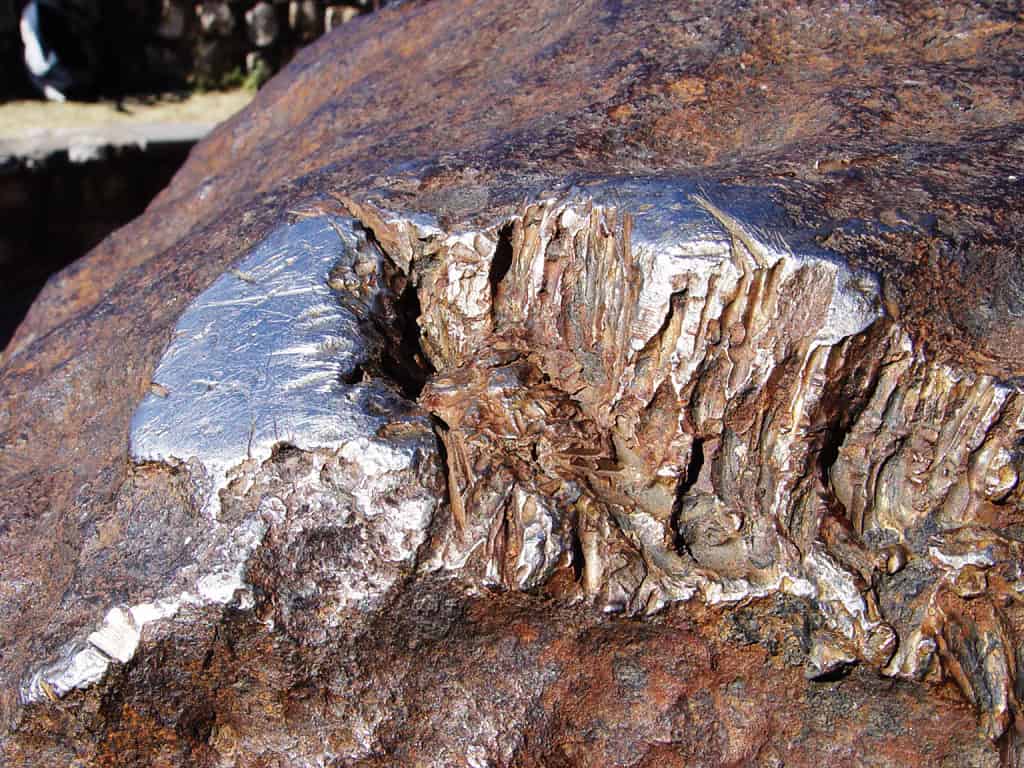
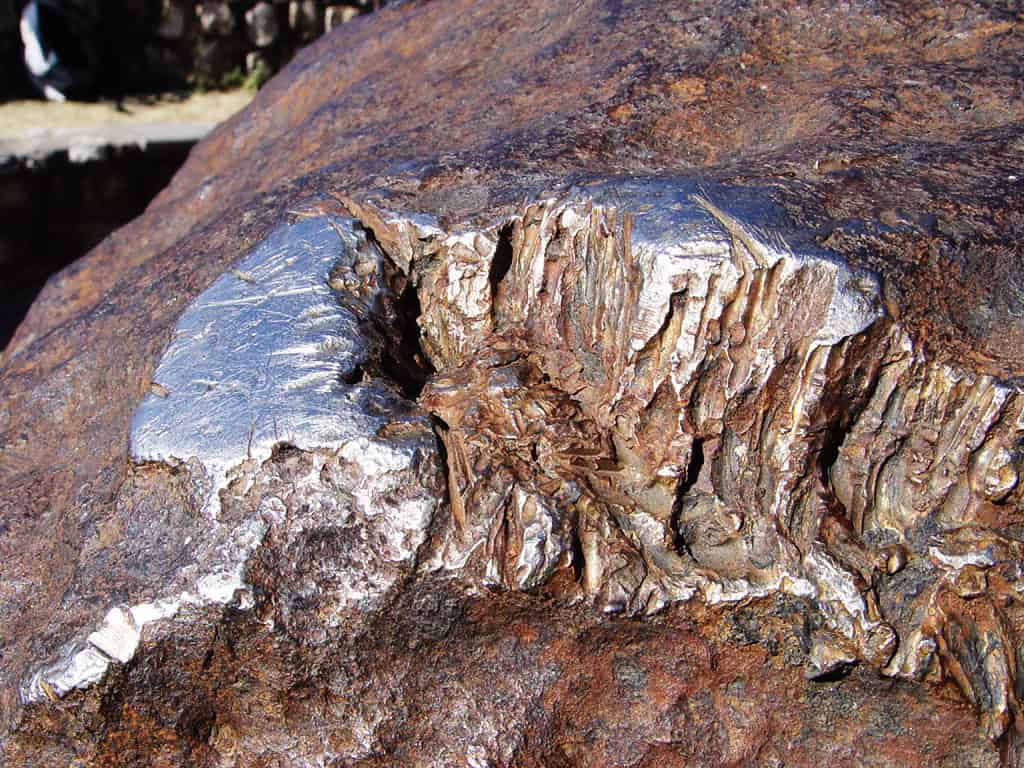
 The Hoba Meteorite. Image via Wiki Commons.
The Hoba meteorite in Namibia is the largest known natural piece of iron on Earth, weighing about 60 metric tons today. By simple logic and physics, a metal object that massive should have smashed into the planet with catastrophic force and left a crater.
Some 80,000 years ago, it smashed into the Earth, but look around it, and you won’t see any crater. It appears to have slowed down dramatically in the atmosphere due to a combination of factors. Its secret was a rare mix of nickel-rich strength, slab-like shape, shallow entry angle, atmospheric braking, and geological erasure.
Big and Massive
The meteorite still lies on a farm outside Grootfontein, Namibia. It was too massive to move, although bits and pieces appear to have been chipped from it.
The meteorite was discovered in 1920 by Jacobus Hermanus Brits, the owner of the land. It was a chance event. Brits was plowing a field with an ox when his plough came to an abrupt halt after striking a metal mass.
At the time of discovery, only a small portion of the meteorite was above ground. Subsequent excavation revealed the massive rectangular slab buried just beneath a shallow layer of soil.
 Hoba meteorite in 1952. Ora Scheel (right), who acquired the site and helped have the meteorite declared a national monument, with an unknown visitor (left). Image via Wiki Commons.
After analyzing it, scientists found that it belongs to a rare class of iron meteorites called ataxites. Ataxites are meteorites that contain a large amount of nickel but lack the internal crystal structure seen in many other meteorites.
The meteorite itself is massive. Its current mass is usually given as more than 60 metric tons, though it likely weighed closer to 66 tons before decades of sampling, vandalism, and weathering took their toll. Which already starts to explain why this meteorite didn’t leave a crater behind.
A Slab Built to Survive
Most meteorites do not reach the ground as the objects that entered the atmosphere. Friction with the atmosphere heats them up, often melting away chunks from the outer layers. Then, this friction can break meteorites apart. In fact, the atmosphere is the reason why our planet isn’t clobbered my meteorites and asteroids more often.
×
Thank you! One more thing…
Please check your inbox and confirm your subscription.
Hoba survived that wall because it had three rare advantages: it was strong, it was flat, and it probably entered at a shallow angle.
Start with the metal. Hoba is an iron meteorite, but its internal structure is different from most. This structure changes how the meteorites respond to stress and friction. Many iron meteorites show the famous Widmanstätten pattern, the interlocking metallic bands revealed when cut and etched. Hoba largely lacks that macroscopic pattern because its nickel content is high enough to suppress the growth of such structures. That dense, tough metal helped Hoba resist catastrophic breakup, whereas most other meteorites would have broken up.
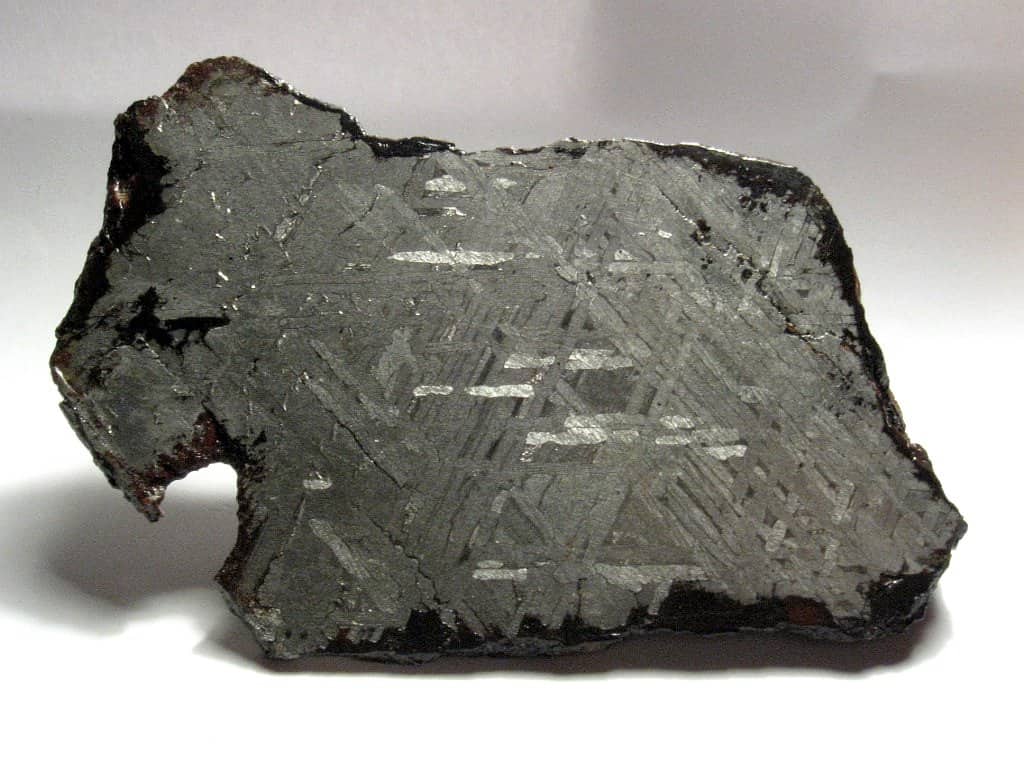 Widmanstätten pattern on a different meteorite. Image via Wiki Commons.
Models of Hoba-like atmospheric entry suggest the original body may have weighed about 500 metric tons before it reached Earth’s air. If so, the atmosphere removed nearly 90 percent of its mass, but a part of it still remained.
Then came the shape.
Special Shape and Special Landing
You’d think all meteorites are round, but that’s not the case. Most are spherical-ish, but Hoba came in as basically a slab. It’s not exactly a cube, as it measures around 2.95 by 2.84 meters, with a thickness ranging from roughly 0.75 to 1.22 meters; but it’s closer to a cube cut in half than a sphere.

This shape increased the amount of friction and drag experienced by the meteorite. A spherical object would have gone faster, but the Hoba slab slowed down a lot. Drag grows with the square of speed. Double the speed, and the resisting force quadruples. At cosmic velocities, that force becomes enormous. For an object entering Earth’s atmosphere at more than 10 kilometers per second, the air ahead of it compresses, heats, and fights back with staggering force.
But drag needs time to work. This is where the last crucial factor comes in: entry angle.
 Depiction of various entry angles for meteorites.
Meteorites don’t always come in hurtling straight down. Sometimes, they do come like that; other times, they come at a different angle, skimming the sky before being pulled down by gravity.
Researchers modeling Hoba’s fall have argued that the most plausible scenario involves a shallow entry angle, relatively low initial cosmic velocity, and a stable orientation that kept the broad face exposed to the oncoming air. In that configuration, the atmosphere had time to act like a brake pad.
Erosion Also Exists
Yet, even so, you’d expect some kind of small crater to be left behind.
The fact that the meteorite was found buried, but not at a great depth, confirms that it landed relatively slowly. A fast meteorite of this size would have either vaporized or buried itself deep within the bedrock. Hoba’s position suggests it simply pushed into the surface soil, coming to rest at the interface between the topsoil and the underlying carbonate layer.
 Chart of the largest recovered meteorites on Earth.
Scientists have estimated Hoba’s terrestrial age at less than 80,000 years using radioactive nickel-59. In that time, wind-blown sand and dust likely covered the depression created by the meteorite crater. Seasonal water and carbonate-rich soils could then have helped cement those sediments into calcrete, a hard natural crust common in dry regions. Even if regional erosion removed only a modest amount of rock, crater filling can happen much faster. What may have begun as a small impact scar was gradually buried, hardened over, and blended back into plain.
So, while it’s true that Hoba doesn’t have a visible crater today, it almost definitely had one that was covered and eroded away.
The Atmosphere Keeps Chipping Away (and Humans Do Too)

Hoba’s story isn’t exactly over.
The meteorite has been chemically weathering for tens of thousands of years. Iron hydroxides (rust minerals) form especially where the metal contacted soil, limestone, and calcrete. The burial protected it from erosion and oxidation, but now that it’s out in the air, that protection is gone.
Humans are also chipping away at it. In 1920, the mass was close to 66 tons; now, it’s closer to 60 tons. Scientists took some samples from it, but weathering and vandalism are the bigger problems.
For decades, visitors hacked pieces from it as souvenirs. One illegally harvested 2.8-kilogram piece from 1968 later sold for nearly $60,000, with the auction site noting:
“The present specimen was obtained in 1968 by the father of the present owner when he visited the main mass of Hoba together with some friends. Using a hand saw, they cut a large block of the meteorite from the main mass ‘as a souvenir’, an activity which took them between three and four hours.” And smaller bits often pop up on various markets.
Legal protection finally arrived when Hoba was declared a national monument on March 15, 1955. In 1987, the farm owner donated the meteorite and surrounding land to the state, enabling the construction of a visitor center and protective site layout. But enforcing protection has proven more challenging.
Lessons From Hoba
Hoba forces us to rethink how we imagine impacts.
Sure, it’s not the biggest meteorite to ever hit the Earth (though it is the largest we’ve ever found intact). But the popular idea that meteorites are all blazing rocks that hurtle straight down to the Earth isn’t always true.
Hoba was huge, but a combination of factors made it behave differently and hit the ground at a lower speed. A chunk of it survived the atmospheric heat, and all this is important beyond just astrophysical theory.
Planetary defense depends on understanding not just asteroid size, but entry behavior. Composition matters, as do shape and angle. So does fragmentation. A smaller object that reaches the ground at hypervelocity can be more destructive locally than a larger object that the atmosphere slows into terminal descent. A fragile asteroid can explode in the air, as happened over Chelyabinsk in 2013. A strong iron mass can survive, but if it arrives shallow and broadside, it may give up most of its energy before touchdown.