
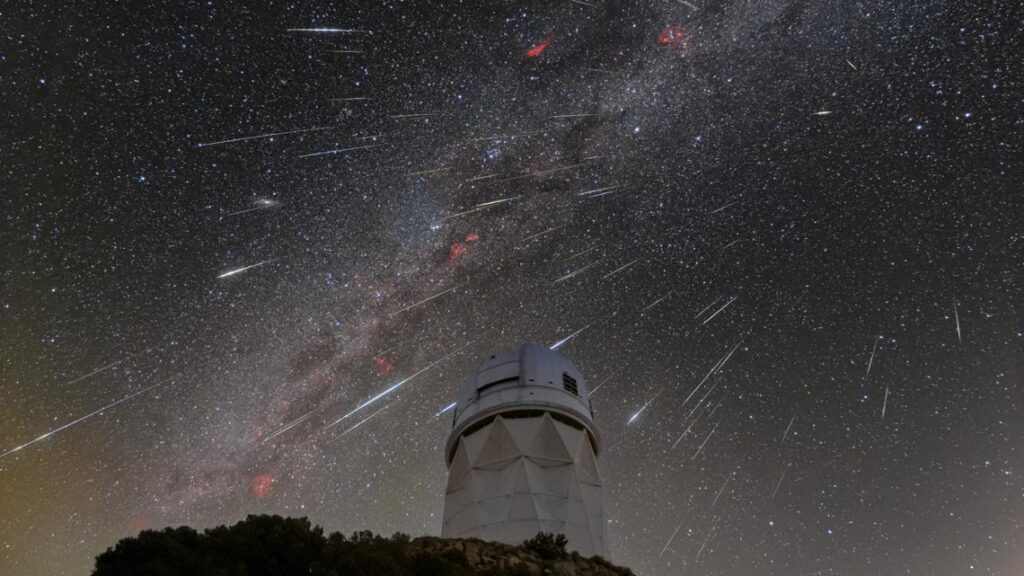
This year’s Eta Aquarid meteor shower is competing with a bright moon during its peak.
WASHINGTON — A meteor shower from Halley’s Comet will light up the night skies with glowing trails overnight.
The annual Eta Aquarid meteor shower peaks on Tuesday May 5 into Wednesday May 6. The meteors from the Eta Aquarids are known for their speed, producing long glow trains that last for several seconds, NASA says.
The Eta Aquarids will be visible through mid-May. Stargazers can expect to see up to 50 meteors an hour, though they may be washed out by a bright moon on Tuesday night. The meteors travel fast at speeds of roughly 40.7 miles per second when entering the Earth’s atmosphere.
The meteor shower comes on the heels of the Lyrids, which peaked in mid-April. But you won’t want to miss the Eta Aquarids as there will be a lull in meteor showers until July.
Here’s what to know about the annual meteor shower.
When do the Eta Aquarids peak?
The Eta Aquarids will peak at night on Tuesday, May 5, and into the morning of May 6.
How to watch the Eta Aquarid meteor shower
Find a spot away from city lights and head outside after midnight. Lie flat on your back and look up. Allow yourself at least 30 minutes for your eyes to adjust to the darkness.
NASA says the meteor shower is best viewed during the pre-dawn hours. The meteor shower’s peak coincides with a waxing gibbous moon that will set around 3 a.m. local time, providing optimal viewing conditions.
According to the space agency, the meteors from the Eta Aquarids are often seen as long meteors that appear to skim the surface of the Earth at the horizon, also known as “Earthgazers.”
What are the Eta Aquarids?
The meteor shower peaks each year in early May as the Earth passes through remnants of Halley’s Comet.
NASA says the Earth passes through the comet’s debris trail twice each year, leading to two different yearly meteor showers. The showers happen in May, the Eta Aquarids, and again in October, as the Orionids.
Each pass Halley’s Comet makes through the inner solar system leaves behind trails of ice and dust—perfect fuel for meteor showers. The comet takes about 76 years to orbit the sun and the last time it was seen on Earth was in 1986, according to NASA.
The comet will not enter the inner solar system again until 2061, the space agency says.
What are meteor showers?
Meteor showers occur annually as the Earth passes through debris trails left by comets, NASA says.
They usually are named after a star or constellation that is close to where they appear in the sky. About 48.5 tons of “meteroritic material” falls on Earth each day, NASA says. Most of the material vaporizes while traveling through Earth’s atmosphere, producing a bright trail known to us as shooting stars.
NASA says that several meteors can be seen on any given night, but the number dramatically increases during meteor showers.