
Agency
05/05/2026
14 views
0 likes
Student teams from Queen Mary University of London and AGH University of Kraków have been selected for the July 2026 test window of the Fly Your Satellite! Test Opportunities programme following a call for proposals opened in January 2026. The proposal evaluation and selection were carried out by the Fly Your Satellite! team and CubeSat Support Facility (CSF) operators. The teams are now eager to start learning about environmental testing and eventually test their device at ESA facilities.
ESA invited university student teams from ESA Member States, Canada, Latvia, Lithuania and Slovakia that wished to receive support and training in conducting an environmental test campaign, with mainly educational objectives to propose their test plan and device for the Fly Your Satellite! Test Opportunities programme.
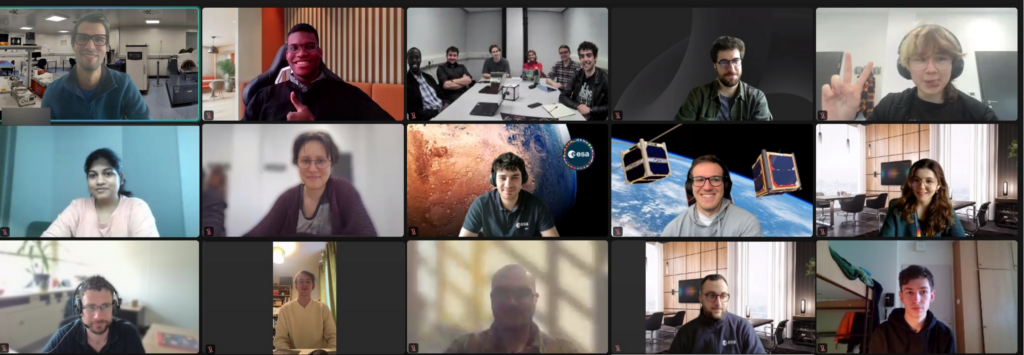
Following the selection process, the GraviTE team from AGH University of Kraków and the Project EXCALIBUR team from Queen Mary University of London were invited to present their test proposal at the programme kick-off meeting held in March 2026. During the same event, the students were offered a webinar on environmental testing by CSF operators.
The selected teams did an outstanding job in presenting their test proposals and responding to the questions raised by the Fly Your Satellite! team. Following the kick-off meeting, the EXCALIBUR team and the GRAVITE team have been officially selected for a total of 2-week test campaign, one week each, at the CSF for the July 2026 test window of Fly Your Satellite! Test Opportunities.
EXCALIBUR, Queen Mary University of London, School of Engineering and Materials – United Kingdom
Project EXCALIBUR will develop and culture samples of L. aestuarii to be sent aboard a high-altitude balloon. Onboard sensors will measure incident and transmitted UV flux through biofilm-coated and uncoated surfaces, as well as atmospheric pressure and temperature. After retrieval, laboratory analyses will quantify pigment retention, EPS integrity, and functional recovery (photosynthetic performance, rehydration kinetics) to evaluate how well the live specimens attenuate UV under conditions of such stratospheric extremes.
By leveraging naturally evolved adaptations for radiation resistance, this experiment will provide new insights into the feasibility of cyanobacteria-based biofilms as passive UV shields.
GraviTE, AGH University of Kraków, Faculty of Mechanical Engineering and Robotics – Poland
GraviTE is a 2U Experiment Cube designed as a compact bioreactor for cell culture applications aboard the ICE Cubes Facility on the International Space Station. The experiment – GraviTE (Gravity-free Tissue Engineering) – is developed by a team from AGH University of Kraków. The team comprises students on different levels and of various backgrounds, ranging from mechanics and electronics to biology.
The device integrates a sealed hydraulic system with pumps and valves, soft fluid reservoirs and cell culture chambers. The mechanical test campaign focuses on verifying compliance with launch vibration requirements through random vibration and associated pre- and post-test functional assessments.
What’s next?
Following the test preparation phase and upon securing the “green light” for execution, the teams will conduct environmental testing at the CubeSat Support Facility.
Stay tuned for the next test opportunities. More information about the Fly Your Satellite! Test Opportunities programme can be found here.
Like