
Eyes to the sky in the hours before sunrise, Wednesday morning, to spot tiny fragments of Halley’s Comet streaking by overhead!
Every year, from April 19 through May 28, our planet passes through a stream of dusty debris in space, left behind by Comet Halley, probably the most famous comet in the world. As we cross through this debris, the bits of dust and ice, collectively known as ‘micrometeoroids’, get swept up by Earth’s atmosphere. Since they are travelling at a relative speed of around 100,000 kilometres per second when they hit the top of the atmosphere, these micrometeoroids produce brief flashes of light in the sky. We call those flashes meteors.
Since each meteor from this particular stream of debris appears to originate from a point in the night sky near the constellation Aquarius, and more specifically the star eta Aquarii, astronomers named this annual event the eta Aquariid meteor shower.
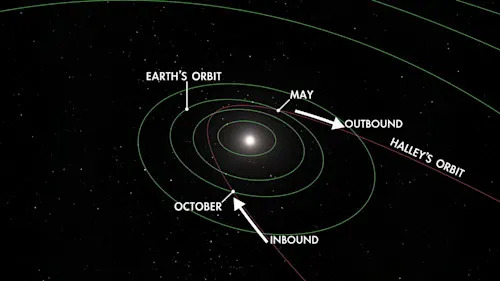
Halleys Comet Orbit inbound outbound meteors
The path of Halley’s Comet and its debris stream through the inner solar system, which Earth crosses twice each year — the outbound part of the stream producing the eta Aquariids in April and May, and the inbound part causing the Orionids in October. (NASA/JPL/Scott Sutherland)
What’s up in May night skies? Halley’s Comet meteors, clustered planets, and a rare Blue Moon
Now, Halley’s debris stream is somewhat unique, at least with respect to us, as it is the only comet debris stream that we cross twice, each year.
The first time, in April and May, we cross the ‘outbound’ portion. Since the bits of dust and ice in the stream fly at us from the direction of the Sun, this particular meteor shower is only seen in the hours prior to sunrise.
The radiant of the eta Aquariids only rises around 3 a.m., local time.
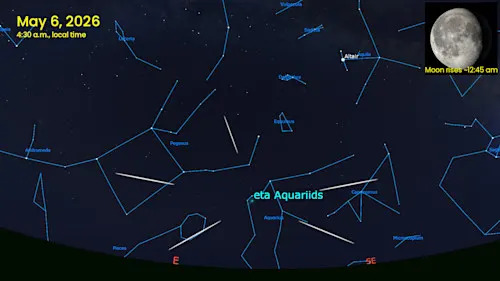
eta Aquariid meteor shower peak – 2026
The radiant of the eta Aquariid meteor shower — the location in the sky where the meteors appear to originate from — in the predawn hours of May 6, 2026. (Stellarium/Scott Sutherland)
READ MORE: How to get the most out of meteor showers and other night sky events
The second pass, which takes place in October through early November, has us crossing the ‘inbound’ portion, which produces the Orionid meteor shower. In that case, the meteoroids are streaming towards us from deep space, and thus the meteor shower is visible all night long.
During the peak of the eta Aquariids, on the morning of May 6, observers with a clear, dark sky could see anywhere from 20-40 meteors per hour.
Unfortunately, this year, a Waning Gibbous Moon will be shining in the sky at that time. Its light could limit the number of meteors we can spot, possibly cutting their numbers by as much as half.
Since the Moon will be off to the west as the meteor shower becomes visible, observers should try to keep their back to it, facing east and looking up, to minimize its impact.
Persistent trains!
If you spot an eta Aquariid meteor flashing by overhead, keep a close eye on that same location afterward. You might catch a glimpse of a mysterious phenomenon known as a persistent train!
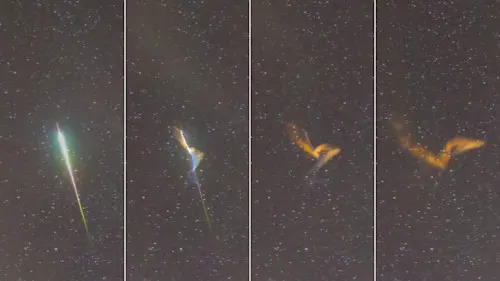
Persistent train Orionids 2022 10 21 – Brenda Tate Tim Doucette
This persistent train was captured during the Orionid meteor shower, on October 21, 2022. (Brenda Tate/Tim Doucette)
Copy, Moon Joy!: Keep the Moon Joy alive with over 12,000 new photos from Artemis 2
These wispy glowing trails are sometimes left behind after a particularly fast meteor winks out. Some last for minutes, while others can remain visible for hours!
Comet Halley meteors, from both the eta Aquariids and the Orionids, are well known for producing this phenomenon. Even so, they are only rarely captured in images and videos, so they are still poorly understood.
One hypothesis states that they could be caused by ionization. The fast-moving meteoroid produces so much energy as it plunges through the atmosphere that it strips electrons off of the air molecules in its path. The ionized molecules then float along in the wake of the meteor, and each emits a small flash of light when it picks up a free electron and cancel out the ionization. With billions of ionized molecules along the path, millions of them emitting these flashes at each moment causes a luminous ‘train’ to appear, and it finally fades away as the last ionizations are cancelled.
Another hypothesis involves a process known as chemoluminescence, which is the production of light through chemical reaction. In this case, when the micrometeoroid is vapourized, the minerals contained within it chemically react with the air, resulting in the glowing train.
More study is needed to tell which of these is the more likely explanation, or if they both play a part in producing this fascinating phenomenon.
Watch below: Fireball captured streaking across B.C. sky on April 29
Click here to view the video