
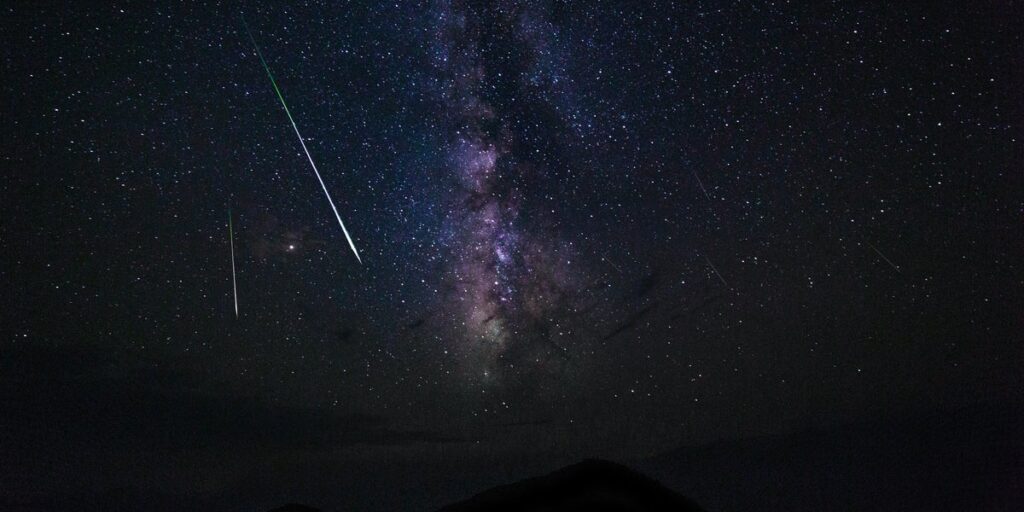
In April, stargazers got to enjoy the Lyrid meteor shower.
But if you missed it, don’t worry: since April 18, the Eta Aquariid meteor shower has also been falling, and it’s set to peak this week.
Here’s why it happens, when it’ll be at its brightest in the UK, and how to catch it:
What is the Eta Aquariid meteor shower?
As with the Lyrid meteor shower, it’s not that the comets are “shooting” towards us.
They’re part of the debris following a comet (in this case, comet Halley); in our journey around the sun, we pass through this space rubble, some of which then enters our atmosphere.
When they do that, they move so quickly that they compress and superheat the air surrounding them.
That leads to a glowing “head” and, sometimes, a streaking “tail” that stargazers will recognise as part of a meteor shower.
Royal Museums Greenwich (RMG) said on its site, “the beautiful streaks we see in the night sky can actually be caused by particles as small as a grain of sand.”
The debris of Halley’s comet is associated with two meteor showers. The other one, Orionid, is due in October 2026.
When will the Eta Aquariid meteor shower peak in the UK?
In the UK, your best odds are on Wednesday, 6 May, from midnight to dawn. But don’t despair if you miss it.
One of the things that makes the Eta Aquariid meteor shower distinct is that it doesn’t have a “sharp peak”, RMG said.
Instead, brilliant shows tend to cluster around a particular week. In 2026, that’s this week (May 4-10).
How can I see the 2025 Eta Aquariid meteor shower?
Look towards the Eastern horizon in the wee hours of Wednesday.
Steer clear of sources of light pollution, like street lamps, and wait. (Unfortunately, the peak of this meteor shower occurs alongside quite a bright moon, which might make the display less obvious).
The meteors should be visible to the naked eye, so you won’t need any special tools like binoculars.
Related…