
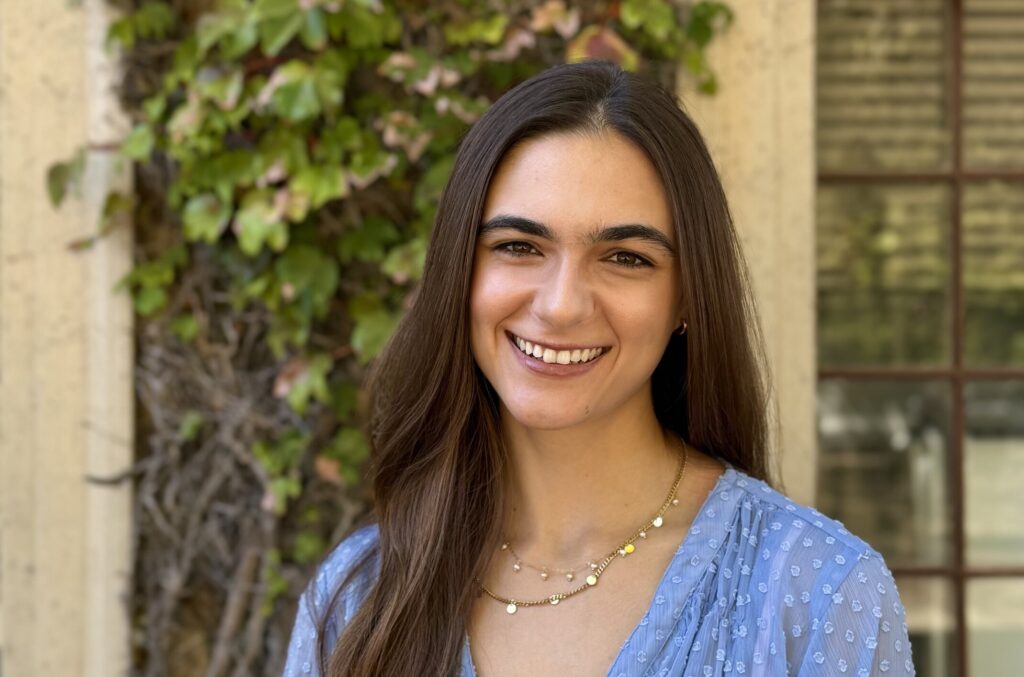
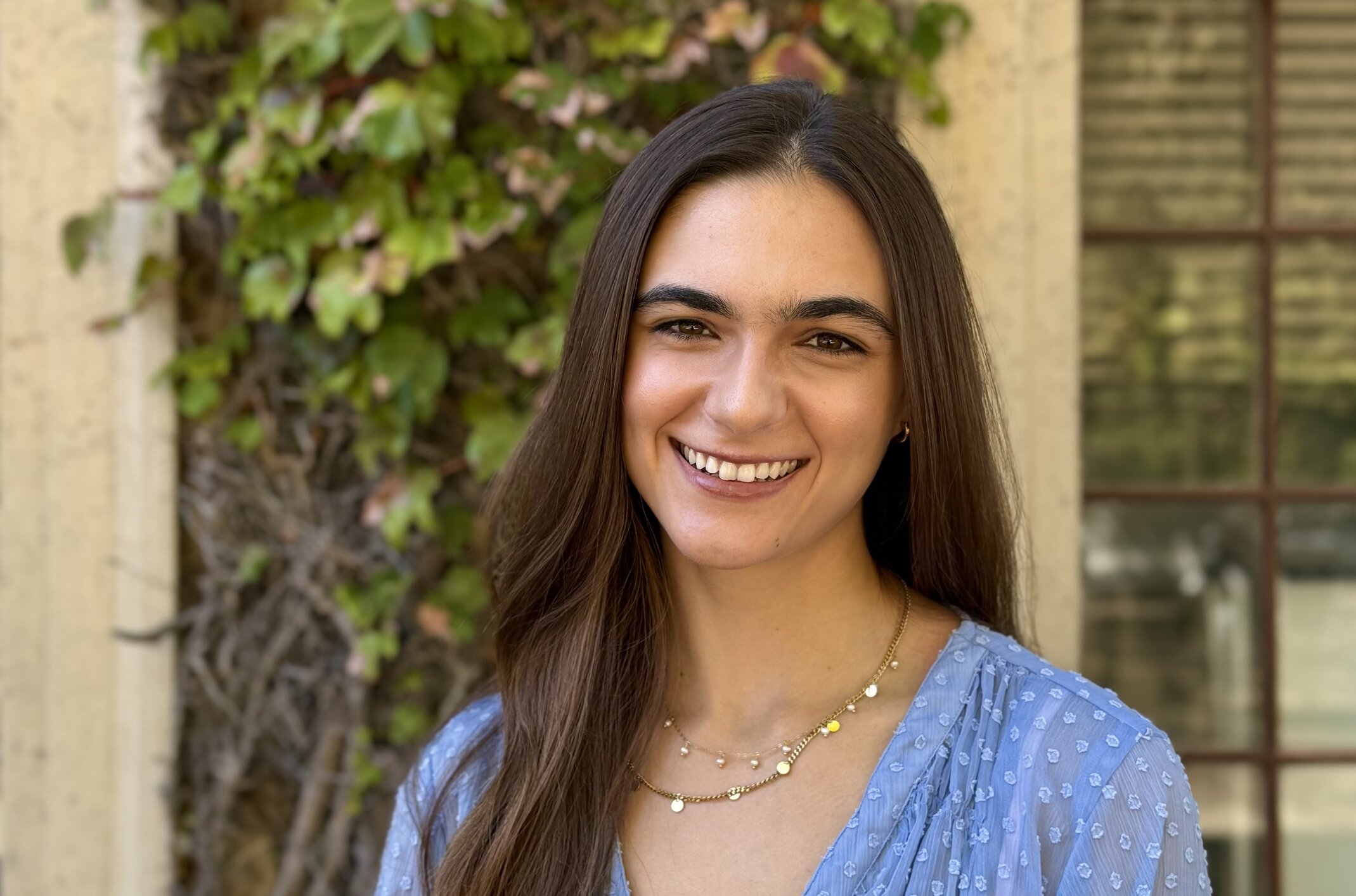
Scholar-Elect Charlotte Louw will be studying primordial gravitational waves, which are thought to carry crucial information about our early universe
Primordial gravitational waves provide a unique window into the very early universe, far beyond what electromagnetic radiation can reveal and thus may be used to answer fundamental questions about the universe. There is still so much we don’t know.
Charlotte Louw
Charlotte Louw became fascinated by theoretical physics and the evolution of the early universe while she was an undergraduate. Her master’s focused on primordial gravitational waves – slight ripples in the fabric of spacetime generated by quantum fluctuations during the early universe’s inflationary period, which carry crucial information about the early universe. She will continue that work for her PhD, which she begins in the autumn.
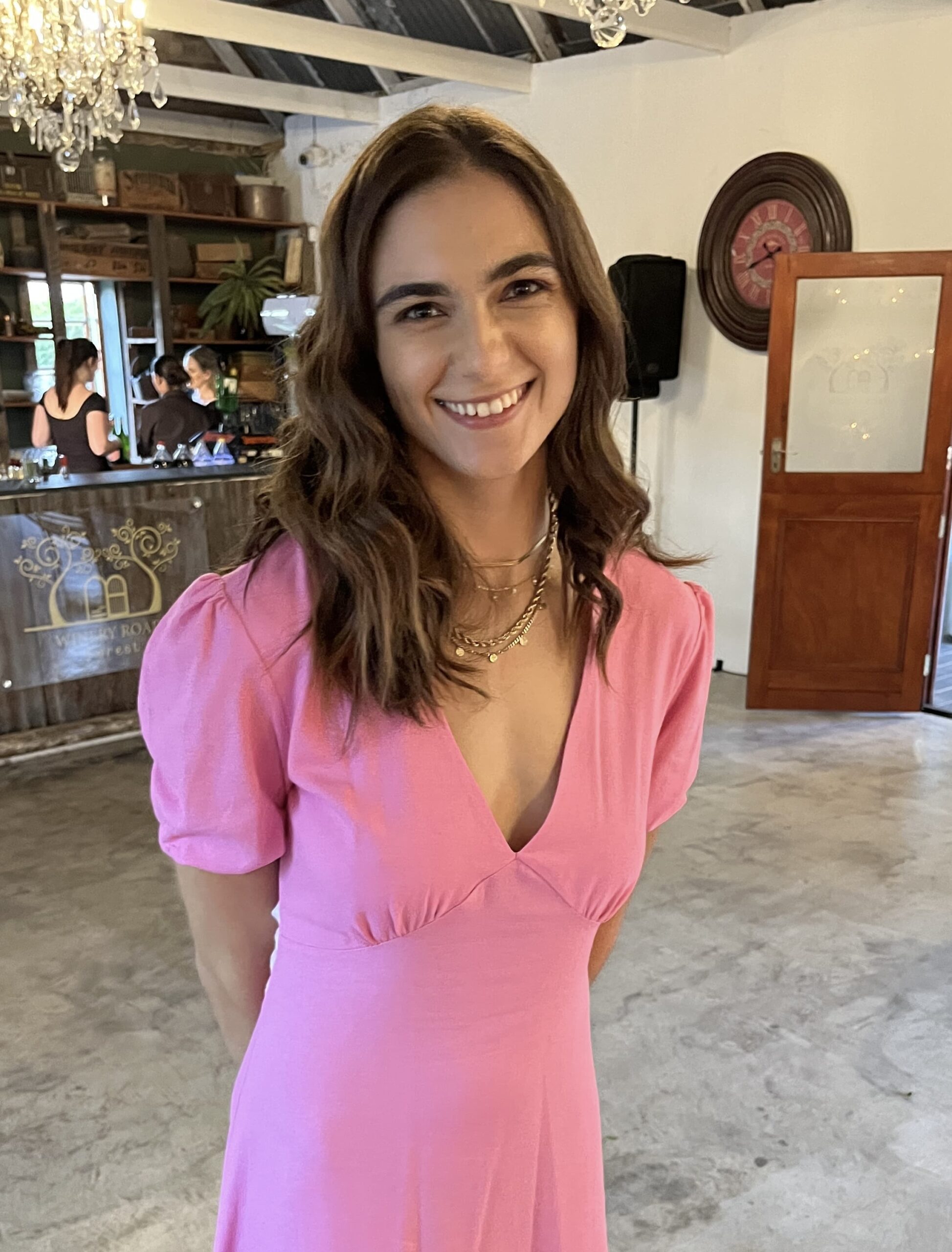 She believes we are in a golden age of gravitational wave observation. New developments – including the Laser Interferometer Gravitational-Wave Observatory (LIGO) and Laser Interferometer Space Antenna (LISA), a planned European space mission to detect and measure gravitational waves from astronomical sources – are revealing more and more information on the early universe and how it interacts with matter because they can carry information about the universe nanoseconds after the Big Bang.
Charlotte lists different types of gravitational waves, including induced gravitational waves sourced from perturbations from the rapid expansion of the Universe. She is also interested in the role of cosmic strings – topological defects created from phase transitions during the early Universe – and how the evolution and decay of cosmic string networks generates a gravitational wave background. “We need to understand how these different processes create gravitational waves and how they imprint on the spectrum,” she says.
Her PhD will seek to develop accurate and quantitative predictions for primordial gravitational waves. She says: “These gravitational waves provide a unique window into the very early universe, far beyond what electromagnetic radiation can reveal and thus may be used to answer fundamental questions about the universe. There is still so much we don’t know.”
Early years
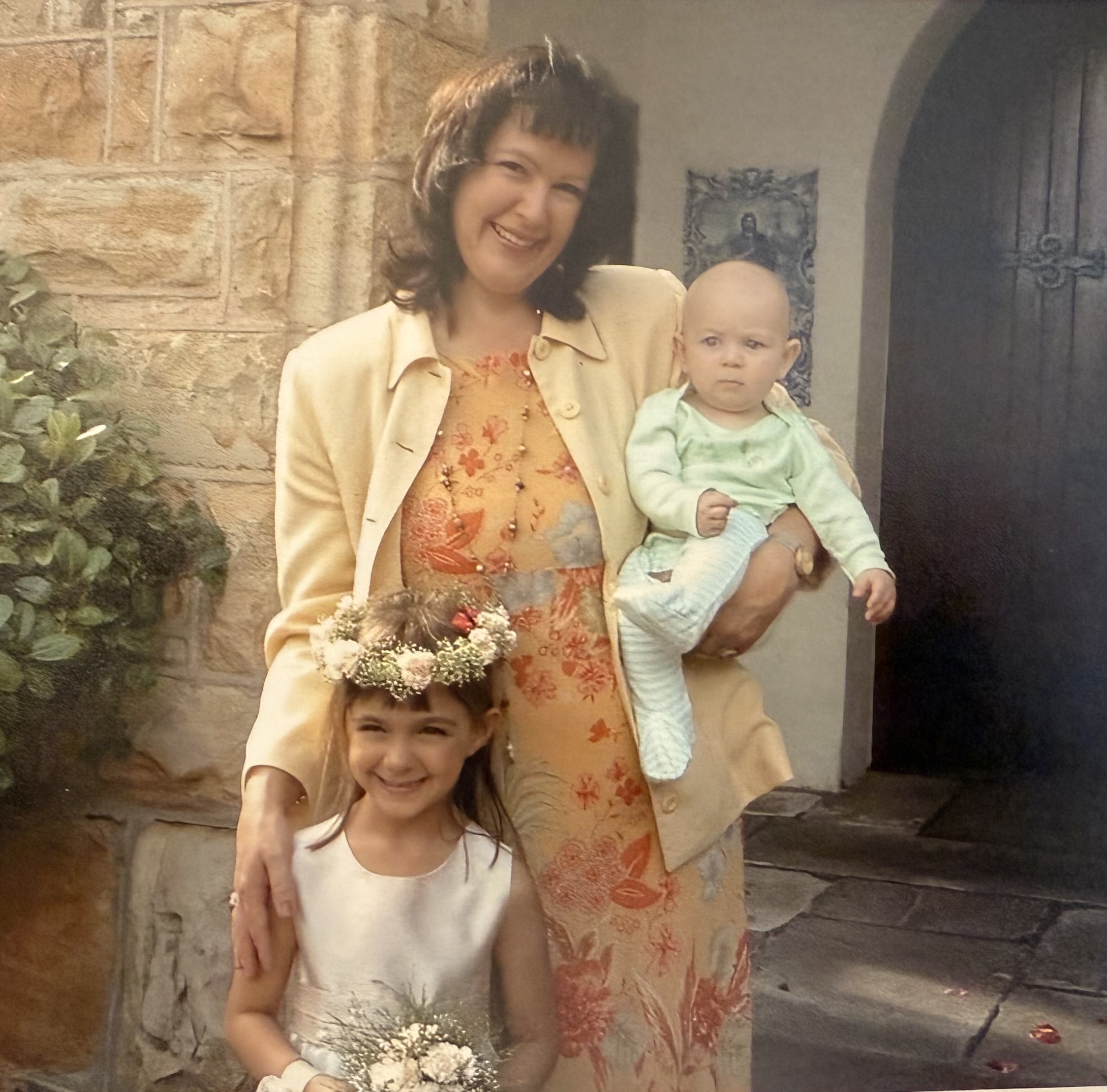 Charlotte [2026] was born and raised in Cape Town. Charlotte describes herself as a nerd as a child. “When all my friends were watching Disney Channel I used to wake up early to watch National Geographic,” she says. Her favourite programme was Carl Sagan’s mini-series, Cosmos: A Personal Voyage.
She benefited from excellent teachers at primary school who noticed that she was very advanced and gave her extra tasks to encourage her learning, particularly in maths and science. After primary school, she won a scholarship to a prestigious private high school, the top girls’ secondary school in the area. The school stretched its students and in grade 11 Charlotte had to write a mini dissertation on neuroscience and creative thought and learn how to do research reviews, getting her first taste of the research world. She loved it.
Her academic success in her final year – she was in the top five students in the province in her final year exams – came as a surprise to her as she had struggled with health issues throughout secondary school. Charlotte suffered from eating disorders and body dysmorphia from the age of 11 and was diagnosed with anorexia at age 15. She lost a lot of weight at high school because of a combination of academic pressure due to her scholarship and feeling, like many young girls, that her self-worth was based on how she looked.
She became so ill in her second last year that she had to study from home. When she returned she set up the first peer support group at her school to get girls talking to each other about anorexia. That same year her mother was diagnosed with breast cancer. However, she was given the all-clear when Charlotte started her first year at the University of Cape Town in early 2019.
Undergraduate studies
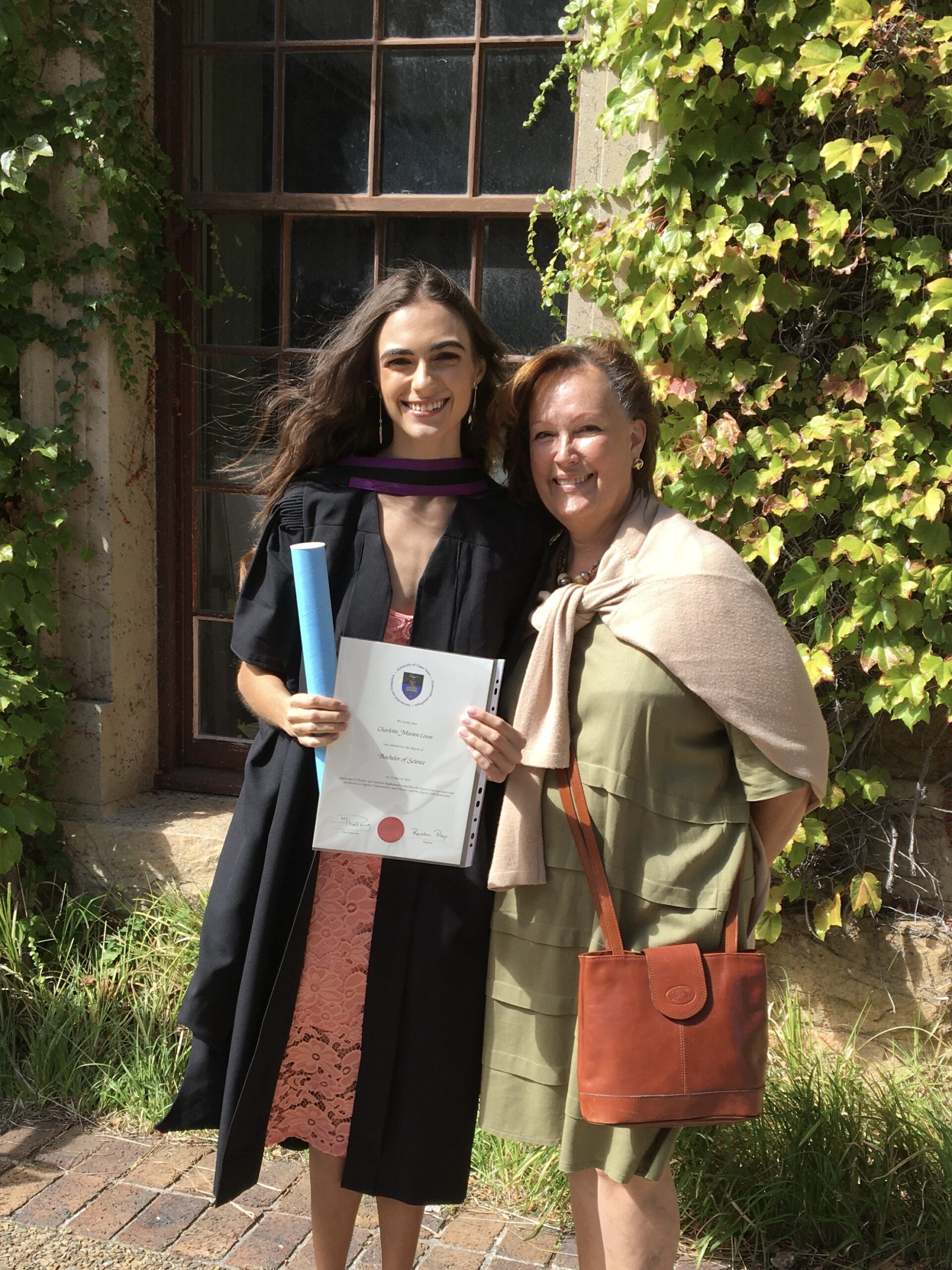
 Her degree, which she mostly studied for at home due to Covid, was in Physics & Applied Mathematics. The more she learned about theoretical physics the more inspired she became. She was inspired by the rich history of South African cosmology research including the likes of Professor George Ellis who had co-authored The Large Scale Structure of Space-Time with Stephen Hawking and served as president of the International Society on General Relativity and Gravitation. She also benefited from amazing professors including her supervisor, Professor Peter Dunsby who, she says, “believed in me even when I did not believe in myself”.
Because she couldn’t do in person exams due to Covid, Charlotte did a lot of research projects and in her third year she learned about differential geometry and general relativity. It was her first time working with Einstein’s theory and she says as soon as she started learning about cosmology and began thinking on such large scales she knew she wanted to do more. In her fourth year she did a project on modified gravity. The first paper she co-authored was based on that research.
 During that year Charlotte’s anorexia returned. She was burnt out and stressed and the fact that she was the only female on her course put extra pressure on her. She hid away and became more and more consumed by the illness, almost having to be hospitalised. She says that was “the biggest wake-up call”. “It was hard to believe that I was so smart in academic terms, but that my brain was trying to kill me,” she says.
She took a gap year between her undergraduate studies and her master’s and grew physically stronger. In that year her mother’s cancer came back and spread to her bones. “I realised that if I was not strong enough I would not be able to care for her,” says Charlotte. “I would not have been able to forgive myself if I could not look after her. She sat with me when I did not want to eat and when I was upset. She took care of me and in less than a year the roles were reversed and I was taking care of her.”
In the last years, Charlotte has focused on improving her physical strength and says she hopes “to inspire girls to become both physically and mentally strong in a world that tries to shrink us”.
Postgraduate studies
For the two years of her master’s course, Charlotte looked after her mother. She was becoming more and more fascinated by the early universe, in particular primordial gravitational waves, and also published on dynamical dark energy during this period.
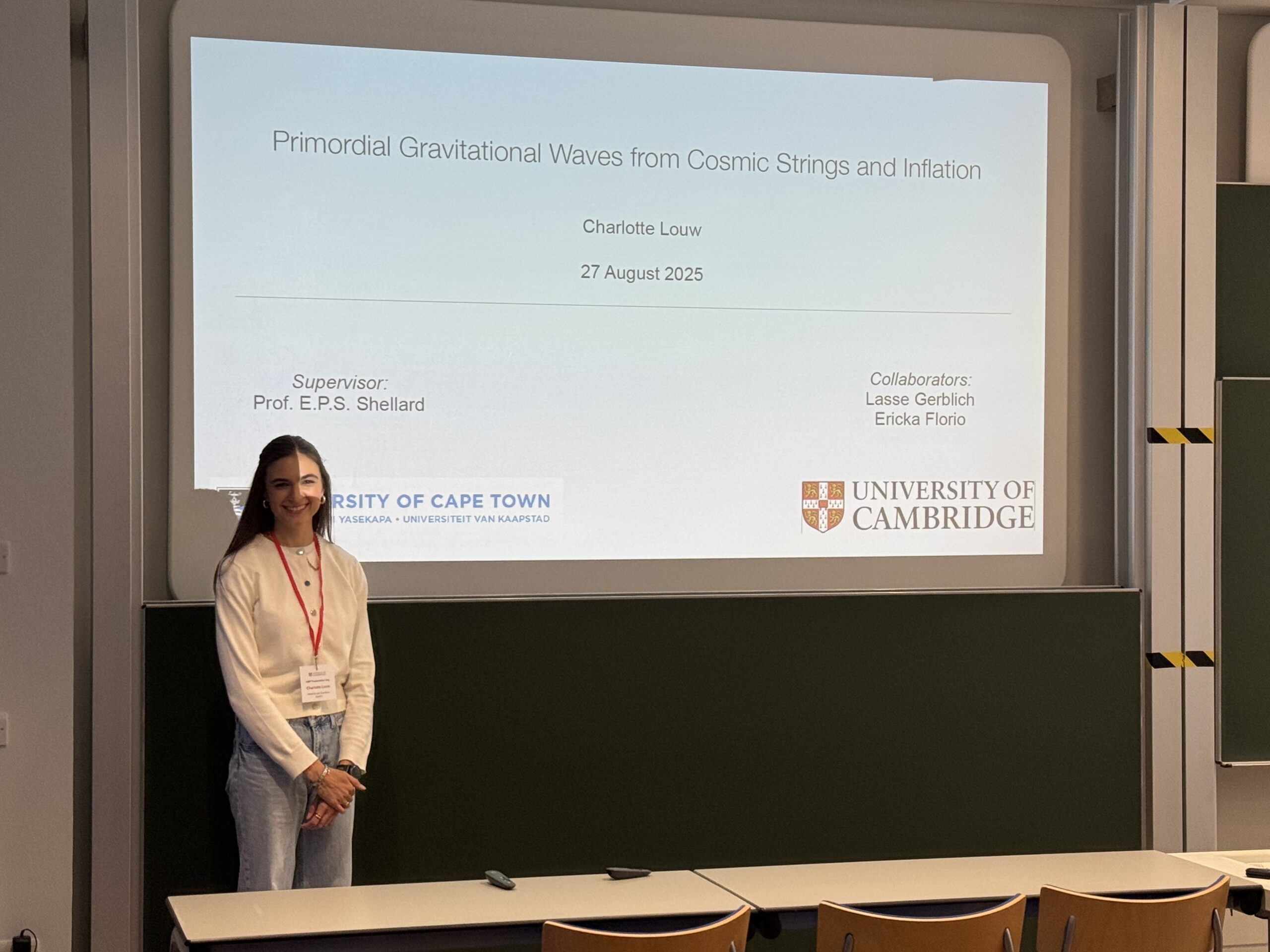 Early last year, Charlotte was accepted onto the Philippa Fawcett Internship Programme, a summer research internship programme at the University of Cambridge for women, trans women and non-binary students who are looking to gain first-hand experience as a researcher at the Centre for Mathematical Sciences. They had never selected a South African before. At the time, Charlotte’s mum seemed to be getting better, but soon after things deteriorated. Her mother begged her to go to Cambridge. “She knew it was an opportunity I had to go for,” says Charlotte. “She inspired me to go for my dreams, even though we came from a traditional family where women generally stay at home with the children.”
When Charlotte left for Cambridge she knew it was possible she might never see her mum again. Half way through her internship she got a phone call saying she had passed away. “She sacrificed those last months with me to see me succeed,” says Charlotte. It was during the internship that she met and worked with Professor Paul Shellard, who will be her PhD supervisor and who was himself supervised by Professor Hawking.
His research aims to advance knowledge about the confrontation between theories of the early universe and empirical cosmology, focusing especially on the primordial fluctuations involved in large-scale structure formation and he has a long-standing interest in phase transitions in the early universe which can form cosmic strings or other cosmological defects. He is also the coordinator of COSMOS, the UK National Cosmology Supercomputer, an essential tool for quantitative progress in theoretical cosmology.
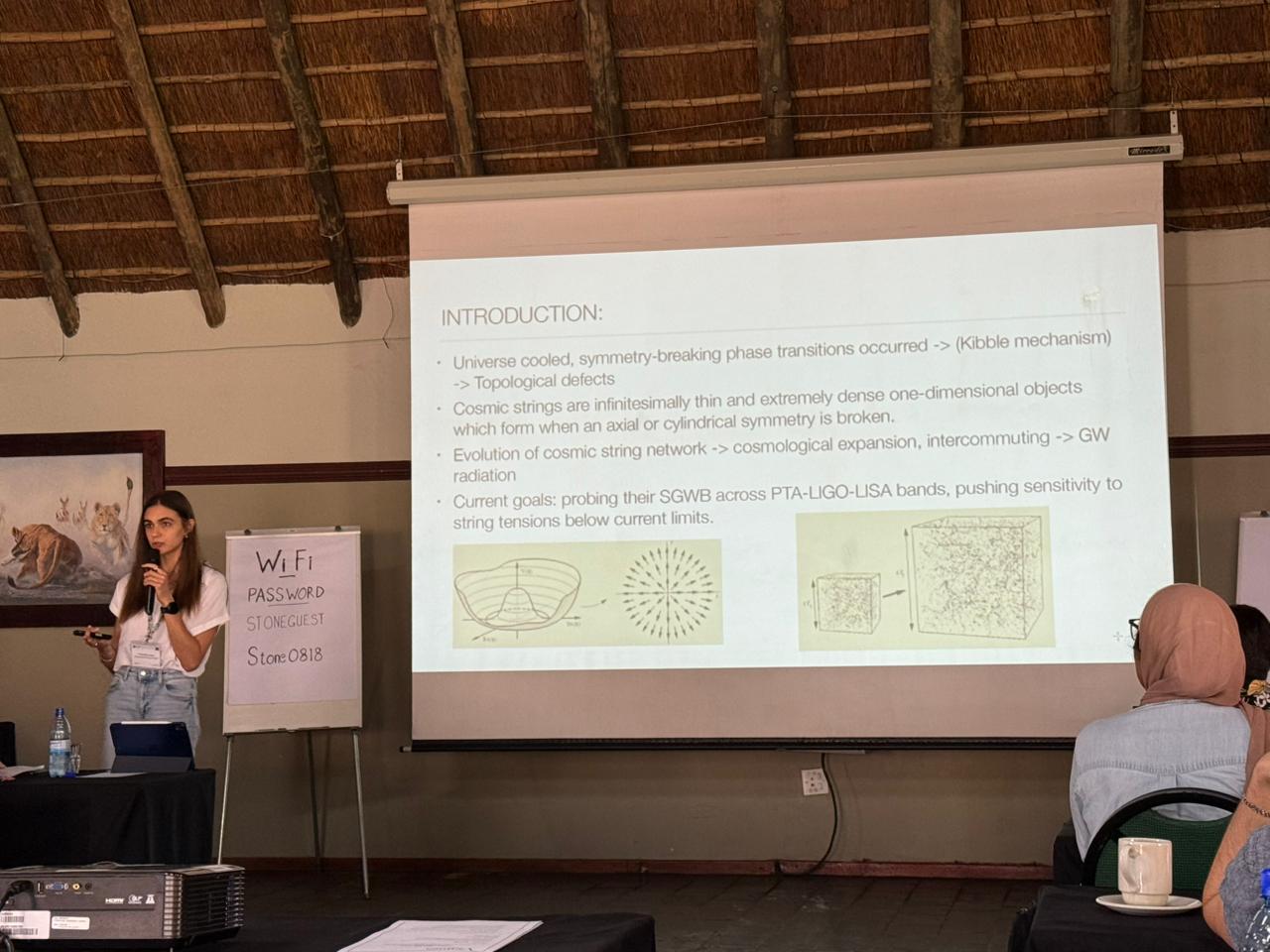
Charlotte is hoping to fly the flag for South African cosmology research at Cambridge, but she is also passionate about teaching, having been a tutor since high school. She speaks of how satisfying it has been to see her students discover a new excitement for maths once she found a way of teaching it to them that struck a chord. She hopes eventually to become a lecturer and carry those teaching skills forward. She also wants to encourage more women into her field having struggled herself and sometimes felt lost in a world where women are underrepresented. During her master’s course, Charlotte represented her research group on cosmology at a career day for young female scientists.
She is very excited to be joining the Gates Cambridge community, which she heard about when in Cambridge in 2025. She says: “I have achieved so much in the last months and the only person I want to tell is my mum, but I would like to think that she knows.”