
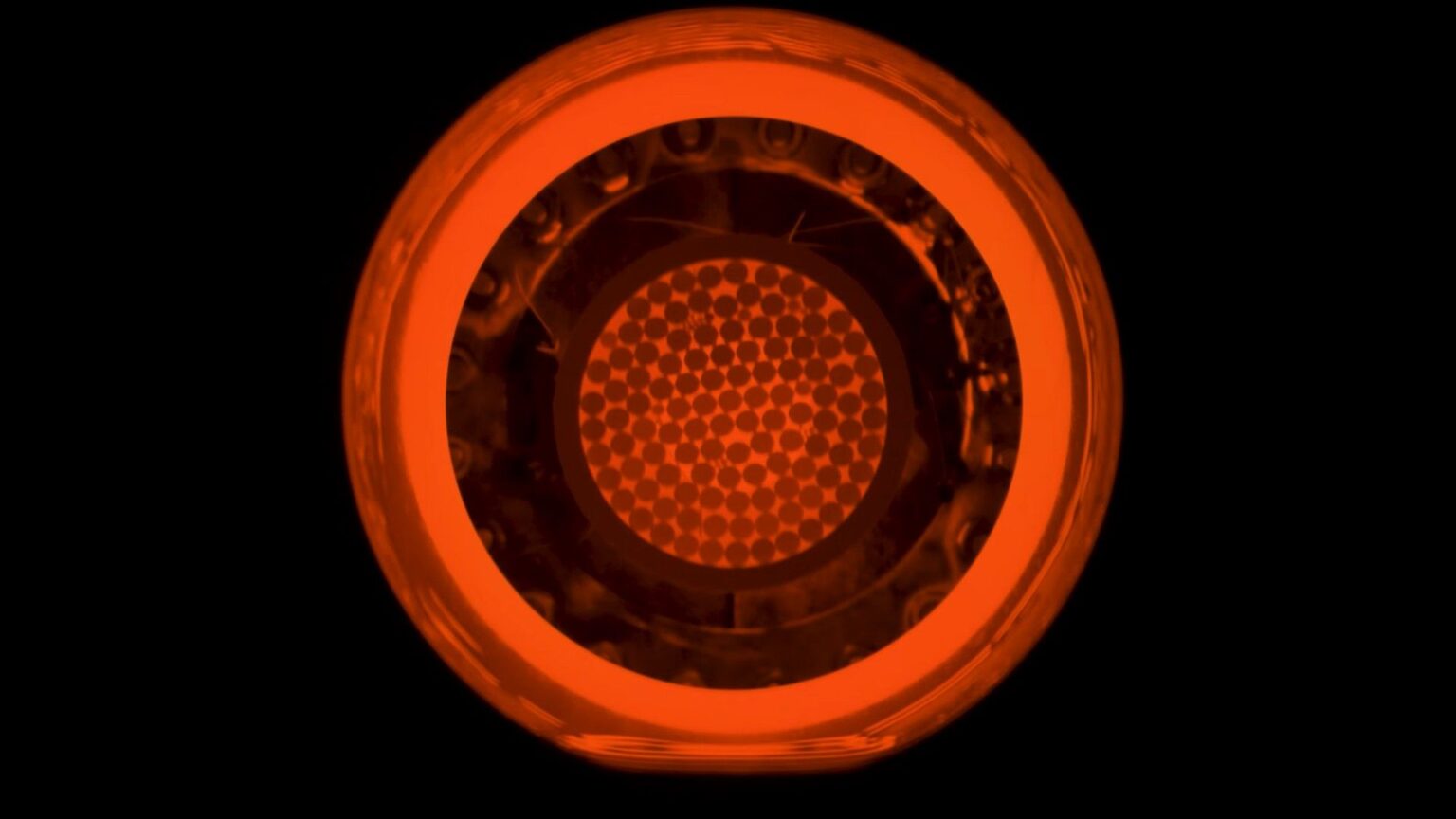
A new ion engine has been tested in a lab, proving itself to be 25 times more powerful than NASA’s current state-of-the-art one. This advanced technology could one day assist humans in reaching Mars.
Ion engines are very different to the usual sort of thrusters that burn chemical propellant. Using electromagnetic fields, they accelerate ions — charged atoms — out through a nozzle to provide thrust, hence they are often described as using “electric propulsion.” Though they are slow at first, these engines’ thrust can build up incrementally to achieve high velocities, and because they use 90% less propellant than chemical rockets, ion engines also reduce the mass of a spacecraft and make launch less expensive. Currently, the most powerful ion engine on a spacecraft belongs to NASA’s Psyche mission to the asteroid of the same name. Its engine has been able to ramp up to a velocity of 124,000 miles (200,000 kilometers) per hour.
You may like
In many cases, the ion propellant of these engines is xenon gas, but researchers have been experimenting with ion engines that operate using metallic plasmas. And now, a new prototype ion engine, called a lithium-fed magnetoplasmadynamic (MPD) thruster, has passed its first test with flying colors. The lithium-fed MPD generates powerful electrical currents that interact with a magnetic field to accelerate lithium ions. Operating inside a dedicated 26-foot-long (8-meter-long) vacuum chamber, called the Condensable Metal propellant (Comet) vacuum facility at NASA’s Jet Propulsion Laboratory (JPL), the prototype engine performed five test firings on Feb. 24, reaching up to 120 kilowatts of power, which is 25 times the power of Psyche’s ion engine.
“Designing and building these thrusters over the past couple of years has been a long lead-up to this first test,” said James Polk, who is a senior research scientist at JPL, in the statement. “It’s a huge moment for us because we not only showed that the thruster works, but we also hit the power levels that we were targeting. And we know we have a good testbed to begin addressing the challenges to scaling up.”
Polk has worked on ion engines since the 1990s, with the launch of Deep Space 1. Now, he’s eying a new target. The aim is to reach between 500 kilowatts and one megawatt in the next few years, and beyond that to produce ion engines that accelerate ions with an electrical power of up to four megawatts. A spacecraft carrying astronauts could then use multiple such ion engines to reach the Red Planet, Mars.
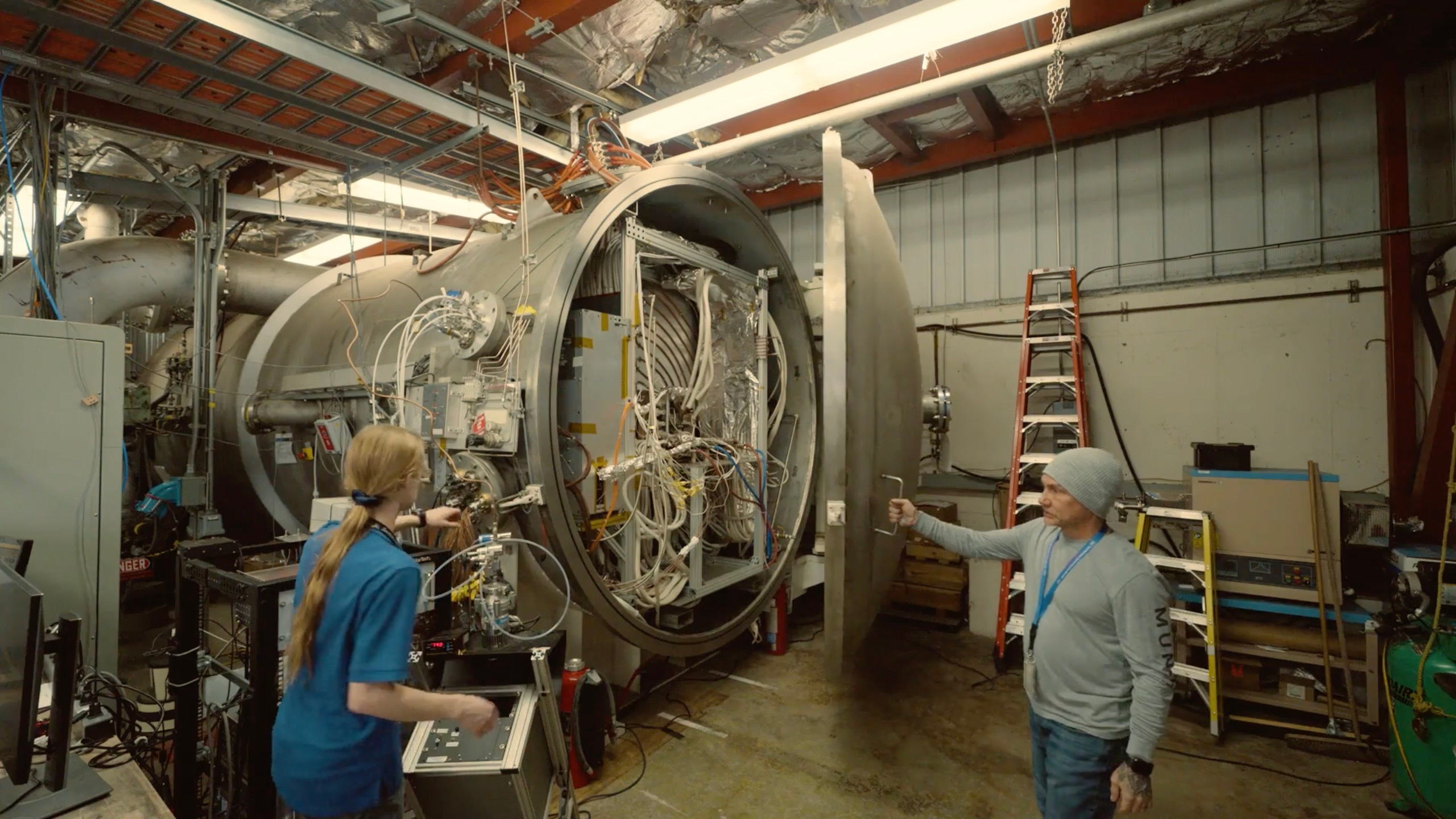
The Condensable Metal propellant (Comet) vacuum facility at NASA’s Jet Propulsion Laboratory, inside which the new ion engine was tested. (Image credit: NASA/JPL-Caltech)
Missions utilizing ion engines have so far obtained their power from the sun by unfurling solar arrays. However, this comes with two disadvantages. One is that these engines cannot be used far from the sun in the outer solar system, and the other is that without a truly enormous solar array, the power that can be generated is limited.

That’s why NASA are currently working on a space nuclear propulsion project called Space Reactor-1 Freedom, which will carry a small nuclear fission reactor on a space mission to produce more energy for an ion engine. It is hoped that Space Reactor-1 Freedom will launch by the end of 2028 and take a small armada of miniature rotor-craft, collectively referred to as “Skyfall,” to Mars. While Space Reactor-1 Freedom will utilize a regular xenon-fueled ion engine, the intention is that a convergence of nuclear power in space with the development of the Lithium-fed MPD thrusters will have what it takes to carry the first astronauts to Mars.
Ion engines have been in use on space missions since the 1960s, but it was only with the launch of NASA’s Deep Space 1 mission in 1998 that the technology was used beyond Earth orbit for the first time. Since then, missions powered by ion engines include NASA’s Dawn mission to Ceres and Vesta, Japan’s Hayabusa2 asteroid sample-return mission, NASA’s DART mission that collided with the asteroid Dimorphos and the European Space Agency’s SMART-1 mission to the moon and BepiColombo mission currently en route to Mercury. Now, with the development of nuclear propulsion and the new lithium-fed MPD, ion-engine technology might be about to take the next giant leap.