
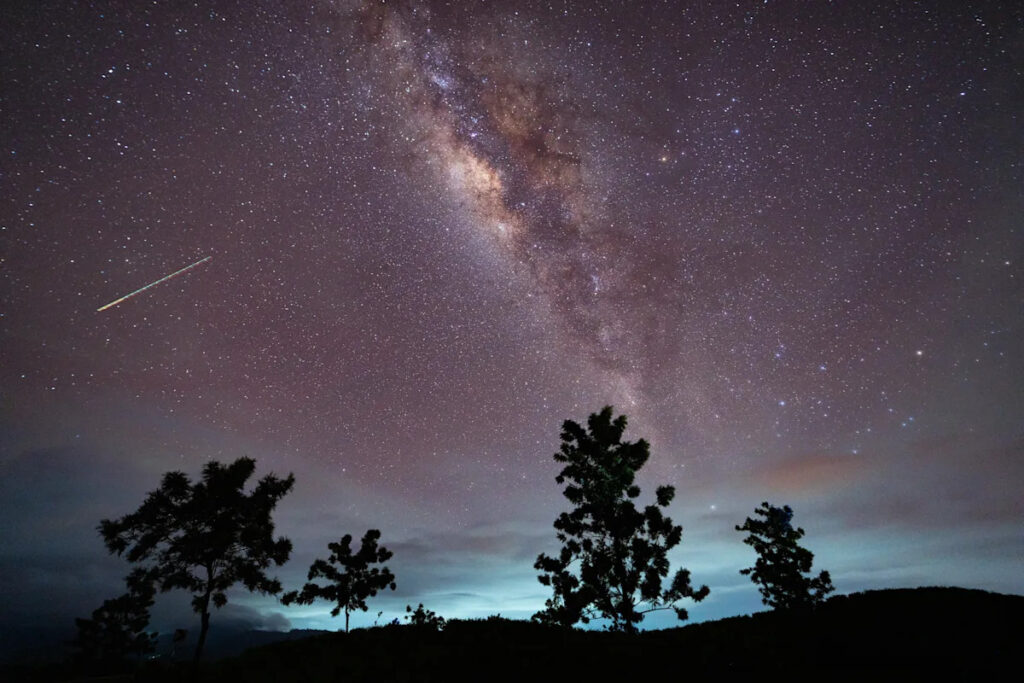
The skies above Australia will light up tomorrow night, giving Aussies the chance to witness one of the fastest meteor showers in the solar system.
The Eta Aquarids, also known as Eta Aquarii, is produced by debris left behind by Halley’s Comet.
Each year between late April and late May, the Earth collides with the comet’s trail of dust, sending debris into Earth’s atmosphere at a speed of 65km per second.
While the comet particles are only about the size of a grain of sand to a grain of rice, the speed at which they travel can produce streaks of light that stretch for kilometres in the night sky.
RELATED
The blaze will produce up to 50 shooting stars per hour at its peak, according to NASA. Source: Getty Images
(Roberto Michel via Getty Images)
The Eta Aquarids will produce up to 50 shooting stars per hour at its peak, according to NASA.
Unfortunately, a bright waning gibbous moon will make it hard to see some of the fainter meteors this year. However, the brighter streaks should still be visible.
The shower is set to reach its peak in the early hours of Thursday morning, with the best of the intense show to shine in the pre-dawn hours when the sky is at its darkest.
The Eta Aquarids don’t require a telescope or eye protection, so strap yourself in and find the darkest place, and look overhead rather than directly at the Moon.
You should give yourself 30 minutes to adjust your eyes, making sure to stay away from light pollution.
If you get great pics of the Eta Aquarids, let us know! Contact newsroomau@yahoonews.com
What time should I be awake for Eta Aquarids?
For the best chance to see the Eta Aquarids meteor shower, look towards the east or northeast during the hours before dawn.
The best viewing times begin at 2am for each state and territory, while finishing windows vary:
Queensland 6.15am (all local times), NSW 6.30am, ACT 6.40am, Western Australia 6.50am, South Australia and NT 6.55am, Victoria 7amam, and Tasmania 7.05am.
Where does the name Eta Aquarids come from?
Meteor showers are typically named after the constellation that sits close to the point in the sky where they appear to originate.
This point is called the radiant.
The radiant of the meteor shower caused by Halley’s comet appears to sit in the direction of the constellation Aquarius, and the meteor shower is named after a star in this constellation, therefore called Eta Aquarii.
You can also follow us on Facebook, Instagram, TikTok, X and YouTube.