
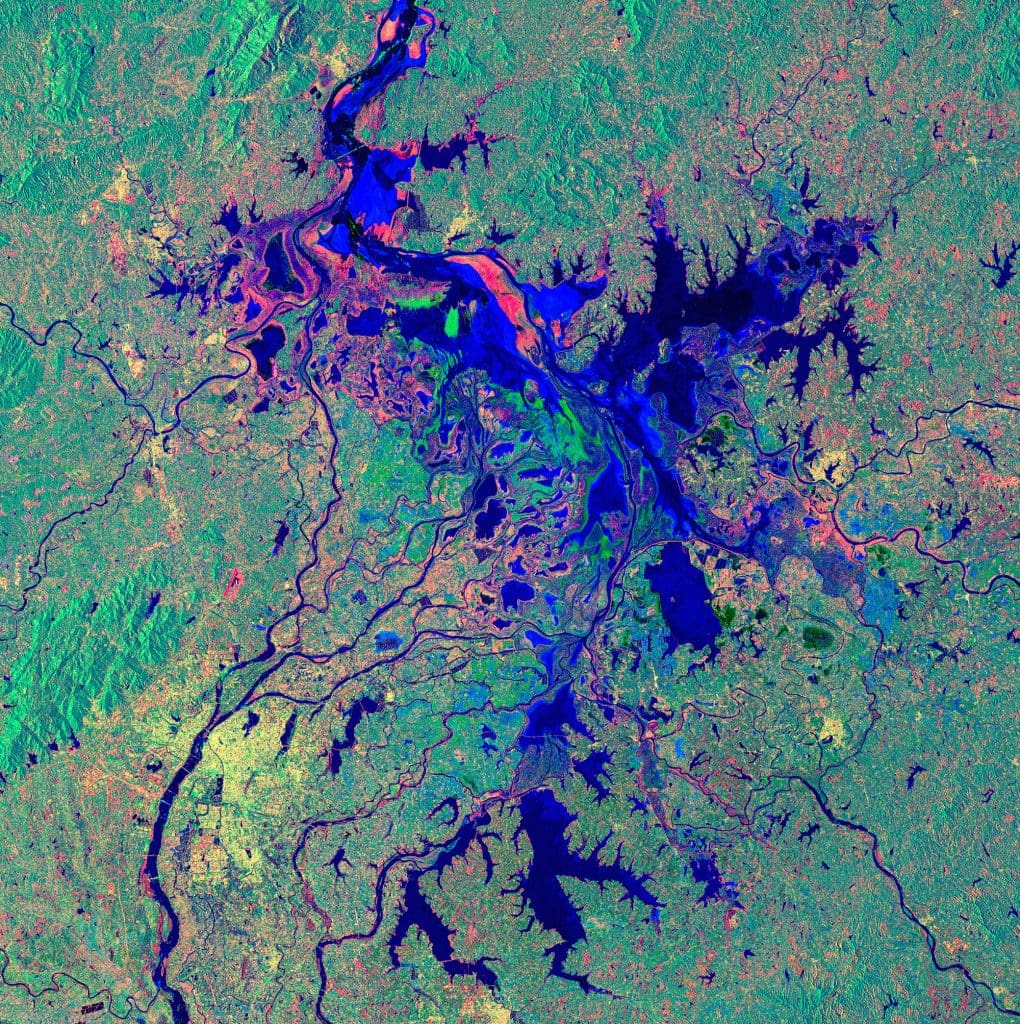
Launched last November, the Copernicus Sentinel-1D satellite has completed the critical in-orbit commissioning phase and marks a milestone in Europe’s flagship radar mission.
The first generation satellite of the Copernicus programme, Sentinel-1A was launched in 2014. The Sentinel-1 mission aimed to provide consistent, high-quality Earth Observation data for the Copernicus Services, helping inform analysis of meteorological events, natural disasters and climate change.
The programme consists of two identical satellites orbiting our planet with 180 degrees of separation to optimise coverage. Sentinel-1B was launched in 2016 to pair with Sentinel-1A, but was its mission was ended prematurely by a technical anomaly in 2022.
Sentinel-1C was launched in 2024 to fulfil the constellation, with Sentinel-1D launched as an additional satellite in late 2025.
Day and night radar coverage of the Earth’s surface
The mission delivers critical data for scientists, emergency responders and policymakers through high-resolution synthetic aperture radar imaging.
Upon completion, the satellites will have provided twenty years of continuous observations, in all weathers and day and night, offering an unparalleled retrospective in a time of rapid climate change and environmental shifts.
Reducing space debris
Sentinel-1C and Sentinel-1D also carry a new separation mechanism which will help avoid space debris, underscoring the European Space Agency’s and the European Commission’s commitment to clean space principles.
The European Space Agency estimates there is over 15,800 tonnes of material in Earth’s orbit, with well over 140 million items being considered space debris.
Whilst the majority of this debris measures between 1 millimetre and 1 centimetre, it orbits the Earth at approximately seven times the speed of a bullet, meaning it can do considerable damage to satellites and spacecraft.
The Sentinel-1 satellites will last for at least seven years
ESA’s Sentinel-1 Mission Manger, Nuno Miranda, said, “Sentinel-1 began as a trailblazer. With the successful commissioning of Sentinel-1D, it now stands as a cornerstone – reflecting Europe’s achievements while serving as a launchpad for what comes next.
“For several years, we have been advancing a follow-on mission: Sentinel-1 Next Generation, designed to ensure continuity of measurements well into the mid-2030s and beyond.
“These future satellites are expected to deliver enhanced performance and new capabilities, building on the legacy of their predecessors while addressing emerging scientific and societal needs.”