
The Expedition 74 crew kicked off the week setting up advanced radio frequency technology, configuring quantum physics hardware, and conducting ultrasound vein scans aboard the International Space Station. The crewmates also prepared for the arrival of the next U.S. cargo mission, unpacked the latest Roscosmos resupply ship, and checked out a spacesuit.
NASA engineers are demonstrating a new technology to help astronauts keep track of the wide variety of inventory aboard the orbital outpost. Flight engineers Jack Hathaway of NASA and Sophie Adenot of ESA (European Space Agency) installed antennas that detect tagged items nearby and reader boxes that collect data from the antennas and update the space station’s inventory system. The Hyperdistributed Radio Frequency Identification Antennas demonstrate new technology that autonomously keeps track of the constantly shifting hardware and supplies on the space station. Results may inform advanced logistics systems for future space exploration missions and help astronauts focus on more important duties such as scientific research.
Afterward, Hathaway and Adenot joined each other again and trained for the upcoming SpaceX CRS-34 mission to resupply the Expedition 74 crew. The duo reviewed procedures on a computer for monitoring the automated approach and docking of the SpaceX Dragon spacecraft planned to deliver several tons of new science experiments and lab hardware later this month.
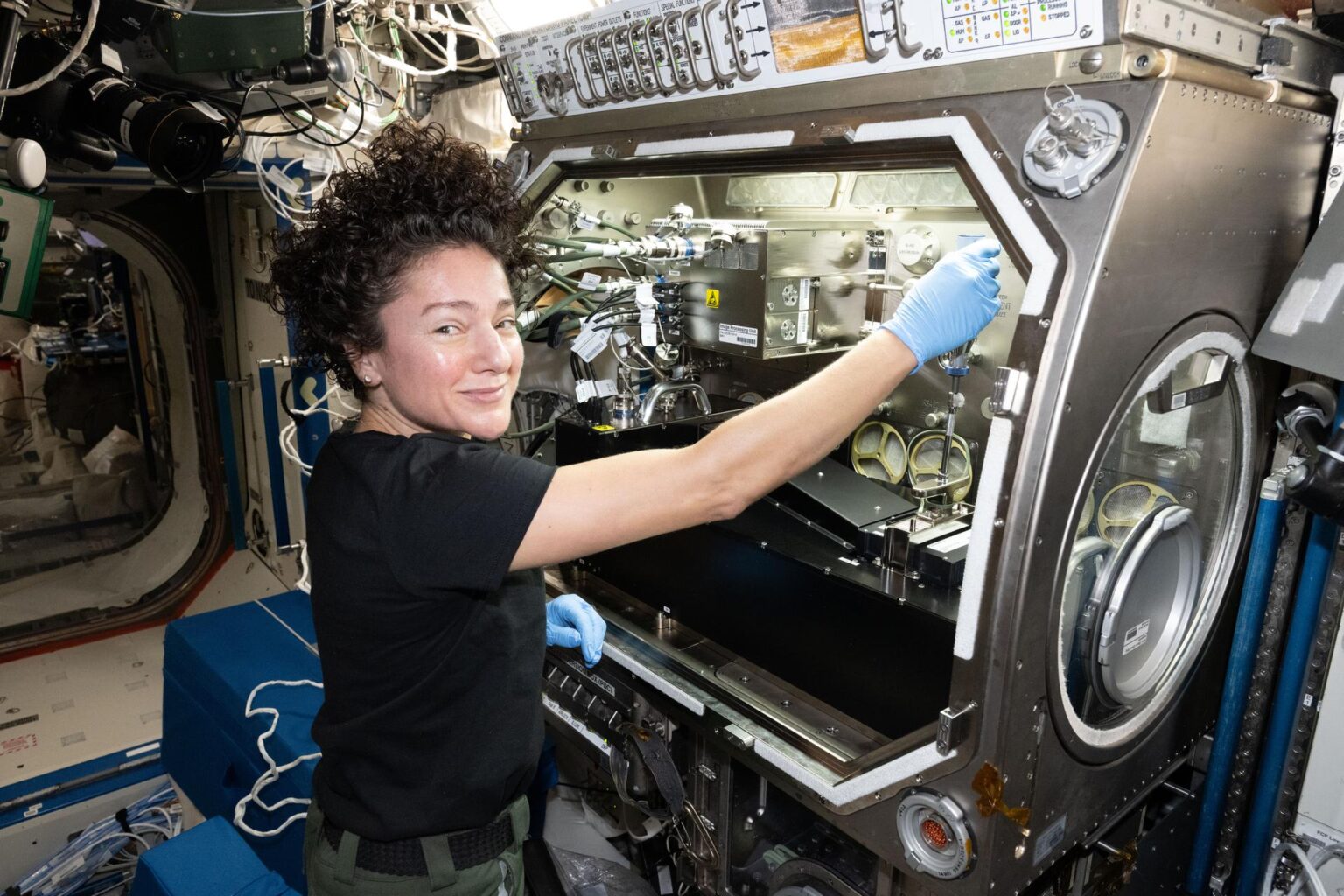
NASA flight engineer Jessica Meir inspected sensitive fiber cables that emit light helping cool, trap, and study atoms with high accuracy inside the Cold Atom Lab (CAL). Next, she carefully reconnected the cables inside the CAL, a quantum research device, that chills atoms to near absolute zero providing insights into atomic wave functions, general relativity, and dark matter.
At the beginning of his shift, NASA flight engineer Chris Williams attached electrodes to his chest then rested as doctors on the ground scanned his veins using the tele-operated Ultrasound Echo device. Next, Williams measured his blood pressure using portable biomedical hardware and arm cuffs. His health data was collected for a pair of cardiovascular studies including CIPHER, a suite of 14 continuous human research investigations, and Vascular Echo both seeking to understand and prevent space-caused heart changes. He wrapped up his shift cleaning fans inside the Tranquility module’s ventilation system.
Roscosmos cosmonauts Sergey Kud-Sverchkov and Andrey Fedyaev, station commander and flight engineer, continued unpacking some of the several tons of food, fuel, and supplies the Progress 95 cargo spacecraft delivered on April 27. The duo also took turns photographing the condition of windows inside the Zvezda, Nauka, and Rassvet modules for analysis on the ground.
Flight engineer Sergey Mikaev spent his shift checking out an Orlan spacesuit ahead of an upcoming Roscosmos spacewalk. Mikaev activated the spacesuit, checked it for leaks, and installed its support equipment making sure all of its systems functioned properly.
Learn more about station activities by following the space station blog, @space_stationon X, as well as the ISS Facebookand ISS Instagram accounts.
Get the latest from NASA delivered every week. Subscribe here.

May 4, 2026 3:08PM
More from International Space Station