
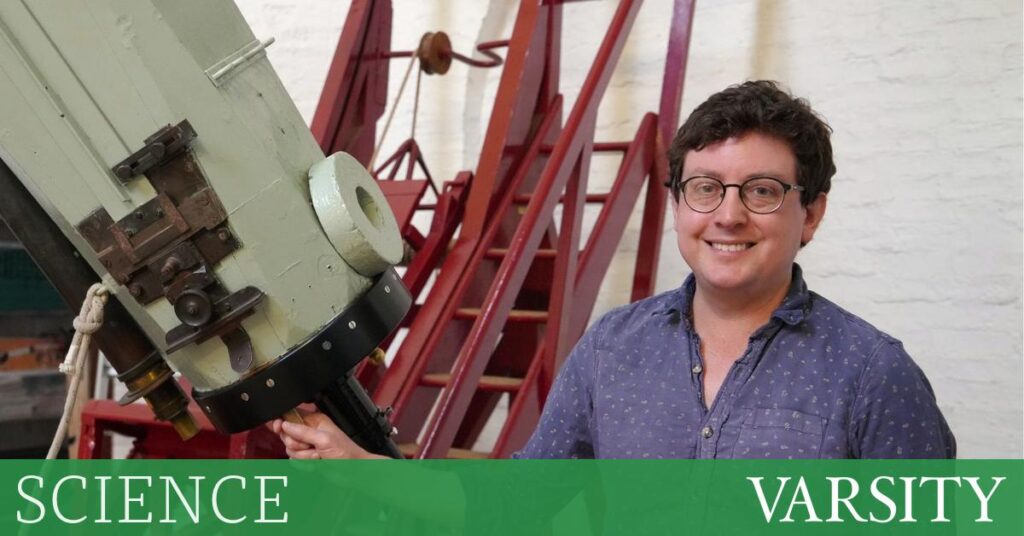
Bothwell finds children books are a ‘natural extension’ to his years of astronomy outreachGORDON CHUNG FOR VARSITY
Matt Bothwell is used to speaking to big audiences. As Public Astronomer at the Institute of Astronomy, Cambridge, he has run hundreds of outreach events in schools and given talks at the Royal Institution and New Scientist. But now, he has taken on an even tougher medium: children’s books.
Since the start of the Covid-19 pandemic, Matt has written three children’s books exploring the wonder of the universe, from the infinities of black holes to the mystery of dark matter. His latest, Mastering the Multiverse, comes out in May. How does writing for children fit into a career in science outreach – and how do you even make a start?
“The elevator pitch was to do Horrible Histories but for astronomy”
“It’s almost like a natural extension of the work I was already doing in schools,” Matt explains over Teams. After 14 years as a science communicator, he has spent a lot of time working out what makes children listen. “It’s not like one day I just decided I’m going to be a children’s author. I spent years talking to thousands of kids a year.”
This process sparked a love for outreach that outshone his research activities. “I just realised I was looking forward to giving a talk to kids about black holes and aliens a lot more than wrestling with my telescope data.” And that brings us to his book on astronomy. It’s already a fascinating subject, but how does that excitement translate into effective science communication?
“I sometimes think being an outreach astronomer is the easiest job in the world because people intrinsically think space is cool,” Matt jokes. And, as he points out, astronomy is entering something of a golden age. Recently, the Vera C. Rubin telescope in Chile captured its first images of the southern sky. With the world’s most powerful camera ever built, it will scan the universe in extraordinary detail, helping researchers investigate everything from black holes and exoplanets to dark matter and dark energy.
“I sometimes think being an outreach astronomer is the easiest job in the world because people intrinsically think space is cool”
“It can find ten million new interesting things a night. It’s honestly just staggering,” comments Matt. “No matter what astronomical question you’re asking, whether it’s small-scale stuff like life or big stuff like what is dark matter and dark energy doing on the biggest scales, we will have a super cool telescope that’s designed to answer that.”
For Matt, this sense of possibility is key. In his talks, outreach work, and books, he is not only explaining what we already know about space, but inviting his audiences to get excited about what is still waiting to be discovered.
When he finally sat down to write, the idea was clear: “The elevator pitch was to do Horrible Histories but for astronomy.” His first book, Astrophysics for Supervillains, takes readers on a tour of the universe, through gruesome, strange, and funny questions – from what would happen to your body in a black hole to how a supervillain might misuse the laws of physics.
“It only takes one little engagement with someone to spark a lifetime fascination”
“Kids want a dopamine spike every once in a while,” Matt says, laughing. “I try not to write more than a couple of sentences without putting something at least a bit silly to lead them through the book.”
The result is science that does not feel like schoolwork. “It’s teaching so it doesn’t feel like eating vegetables. We call it learning by stealth.” Matt describes the book as a personal success; he fondly describes the fan mail he receives and the impact it’s had on his readers.
Now, with Mastering the Multiverse, the latest instalment in the trilogy, Matt is proud to create a series that can make a real difference. For him, children’s books are not just another form of outreach, but a way of giving young readers a positive first encounter with astronomy.
That mission also underpins his work on Astro East, an outreach programme run by the Institute of Astronomy to support communities across East Anglia. “We do a lot of our work in communities across Norfolk, across Suffolk, that maybe don’t have access to a lot of traditional science content,” Matt says. “I think it’s super important.”
Astro East works with schools that traditionally don’t have access to such science programs. For Matt, the value of that work is simple: “It only takes one little engagement with someone to spark a lifetime fascination.”
So, with Matt’s book set to release soon, he’s hoping to continue his work of bringing that fascination to the next generation. “My advice for anyone that wants to write a children’s book: just do it and see how it goes. You don’t necessarily need the experience or formal backing. If you’ve got a computer, phone, or pen and paper, give it a try and see if you enjoy it.”
Varsity is the independent newspaper for the University of Cambridge, established in its current form in 1947. In order to maintain our editorial independence, our print newspaper and news website receives no funding from the University of Cambridge or its constituent Colleges.
We are therefore almost entirely reliant on advertising for funding and we expect to have a tough few months and years ahead.
In spite of this situation, we are going to look at inventive ways to look at serving our readership with digital content and of course in print too!
Therefore we are asking our readers, if they wish, to make a donation from as little as £1, to help with our running costs. Many thanks, we hope you can help!