
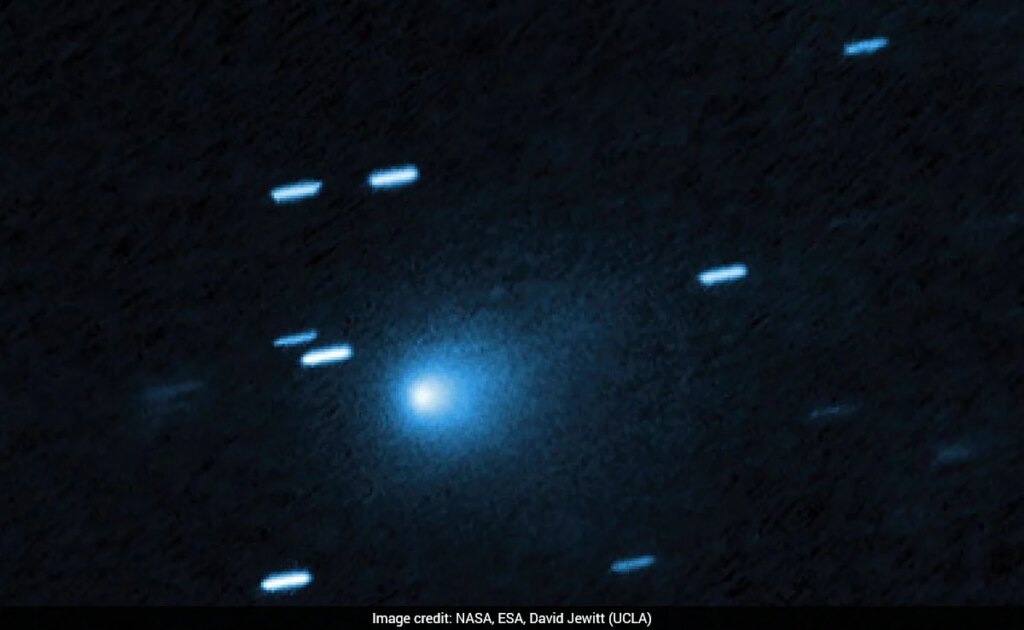
Astronomers used radio telescope observations to get fresh details about the origins of the interstellar comet 3I/ATLAS. New research shows that the comet was formed in conditions far colder and more ancient than anything in our solar system. 3I/ATLAS, the third known interstellar object to enter our solar system, after ‘Oumuamua (discovered in 2017) and 2I/Borisov (discovered in 2019), continue to intrigue space enthusiasts. It was discovered in July 2025.
As per the authors of the study published in the journal Nature Astronomy, the research about the comet’s composition indicated that it originated somewhere very different from our own solar system.
Also read | From Meteor Showers To Blue Moon: Rare Celestial Events This May
The astronomer used the Atacama Large Millimeter/submillimeter Array (ALMA) in Chile to make the observations last year in November.
The researchers were able to measure deuterium within the comet for the first time. The results reveal water and carbon signatures unlike any comet born around our sun.
Deuterium is a “heavy” isotope of hydrogen that forms in frigid interstellar clouds. Regular water, H2O, has hydrogen atoms with one proton. Deuterated water, HDO, adds a neutron, making it heavier.
“Deuterium is generally found in the water of Solar System comets and in Earth’s oceans in the form of deuterated water, HDO, also called semi-heavy water,” lead study author Luis Eduardo Salazar Manzano, a doctoral candidate in the department of astronomy at the University of Michigan, told CNN in an email.
“Our observations with ALMA indicate that the abundance of deuterium in the water of 3I/ATLAS is more than 40 times the value in Earth’s oceans and more than 30 times the value in Solar System comets.”
Also read | Hyderabad Amazon employee shares ‘10 things never to share’ at work: ‘Oversharing can derail your career’
After the comet was spotted, its mysterious nature prompted some scientists to say that it might not be naturally occurring. Although NASA refuted all the claims and referred to it as a “comet”, nothing else.
For astronomers, 3I/ATLAS is more than a comet. It’s a 7-to-11-billion-year-old message from a time when the galaxy was still assembling, and our sun didn’t exist.
“The enrichment in deuterium generally happens when water forms in cold molecular clouds in interstellar space, which is generally around the same time that solar systems around other stars form,” Salazar Manzano said as quoted.
As per the researchers, 3I/ATLAS was formed in a planetary system that was incredibly cold and much colder than our own solar system.
“The temperature in the formation environment of 3I/ATLAS was less than 30 Kelvin, which corresponds to -243.14 Celsius, or -405.67 Fahrenheit,” he said as quoted.
“Interstellar objects are time capsules that bring material from the environments where other planetary systems formed, and our measurements are finally allowing us to open those time capsules and peek at the physical conditions where these objects originated,” Salazar Manzano said as quoted.
When exactly was the comet formed?
Age estimates for 3I/ATLAS are staggering. While our sun and solar system formed 4.5 billion years ago, models of Galactic chemical evolution put this comet at 10-12 billion years old. Other trajectory studies suggest around 7 billion years.