
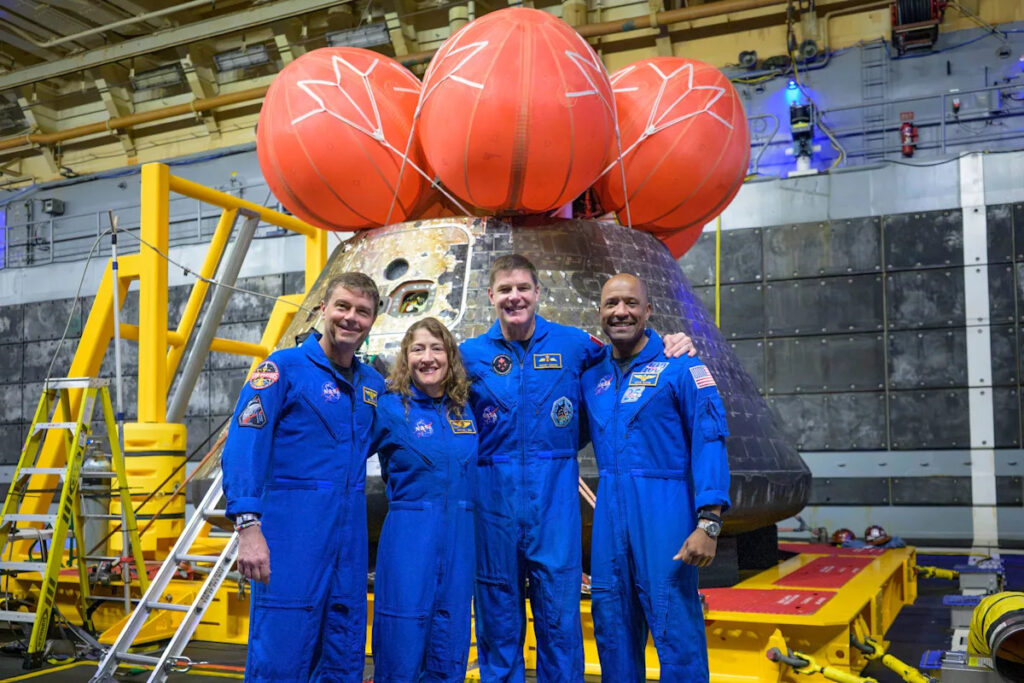
The crew of NASA’s Artemis II moon mission revealed on Friday morning the first thing they ate when they returned to Earth after their historic spaceflight last month: peanut M&M’s.
Astronauts Reid Wiseman, Christina Koch, Victor Glover and Jeremy Hansen made history during their 10-day mission, traveling over a quarter-million miles from Earth.
The quartet joined CBS Mornings for a live town hall special, Artemis II: A Celebration of Heroes, during which Wiseman revealed the crew’s first snack as they waited to be picked up after splashdown.
“When we landed, we splashed down into the Pacific Ocean, we’re waiting for the rescue forces to come open the hatch, and Christina, out of her spacesuit pocket, goes, ‘I got some peanut M&Ms, anybody want some?’” Wiseman said. “And so we’re leaning back against the side of the spacecraft, we’ve just come back from the moon, we’re just eating peanut M&Ms. We were happy.”
The astronauts’ food choices during the flight were the source of some interest. According to NASA, some of the most common foods available to them included tortillas, nuts, barbecue beef brisket, cauliflower, macaroni and cheese, butternut squash, cookies and chocolate.
Wiseman told CBS about one moment on the seventh day when they spoke to the crew of the International Space Station and realized they were eating the same foods: spicy green beans, broccoli au gratin and beef fajitas.
“It was one of our favorite days and the best part about that whole call was we were all eating the same food,” he told CBS.
‘Tiny Earth’
The four astronauts also discussed their “emotional” flight on The Tonight Show Starring Jimmy Fallon on Thursday night.
Wiseman described how the Earth looked so small from hundreds of millions of miles away that it inspired the nickname “Tiny Earth.”
“Around day three, we started to call it Tiny Earth because it’s this big out the window,” Wiseman said, making a small gesture with his hand. “So we’d say, ‘Oh, that’s Tiny Earth!’”
The trip left a deep emotional impression on the astronauts.
“The thing that is hard to understand is we’re constantly going away from or back to the planet, so it’s changing the whole mission and the view,” Wiseman told Fallon.
“That is really what gets you. We would be eating or washing up, getting ready for bed or something, and you look out the window, and you just see that Earth out there,” he said. “It was so amazing to see.”
The crew, who spent three years training for the mission, said they coped with living in close quarters by “giving each other a lot of grace.”
The crew demonstrated how cramped the Orion capsule was by holding hands and forming a circle around the talk show host, showing just how difficult grabbing a glass of water from the other side of the capsule could be.
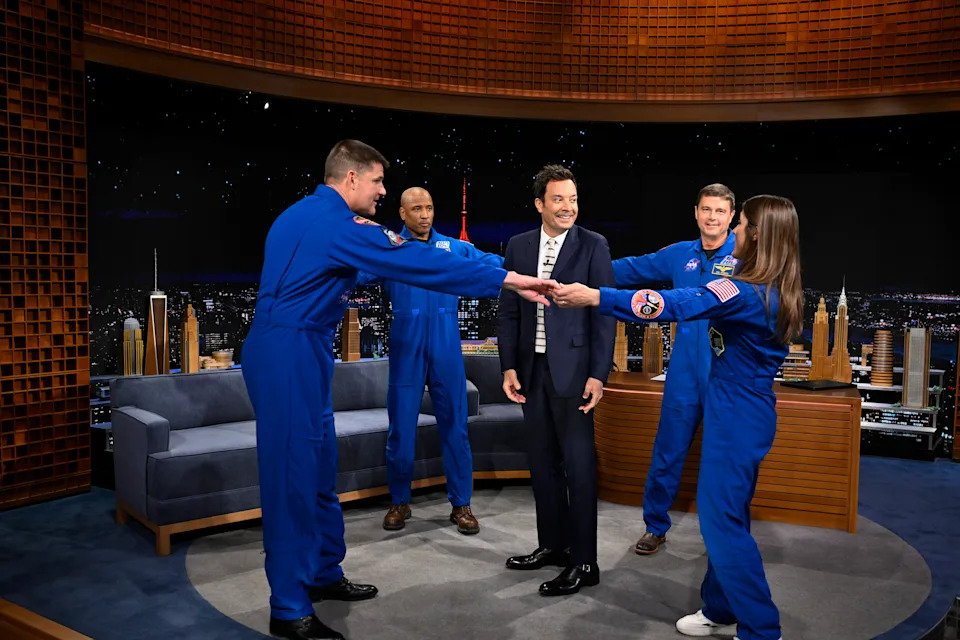
The Artemis II crew members form a circle around host Jimmy Fallon to demonstrate how much space the four of them had to share in the Orion capsule.
(NBC via Getty Images)
“I think we surprised ourselves,” Koch said. “But these are three of the greatest humans you could ever fly in space with.”
Wiseman said that despite the cramped conditions, he shared a moving moment with the crew that “bonded them forever.”
Naming a moon crater after his late wife, Carroll, was “a crew decision.”
“Jeremy gave one of the most moving speeches, and that moment was a great honor for my kids,” Wiseman said.
“My kids were in mission control, Ellie and Katie, when that happened, and they didn’t know anything about it. It’s deeply moving for them, but also for the four of us. That kind of solidified us as a crew,” he added.
What happened on the Artemis II mission?
The Artemis II crew splashed down off the coast of San Diego on April 10 after spending more than a week in space.
At Orion’s farthest point, the astronauts traveled 252,756 miles from Earth — a record-breaking distance.
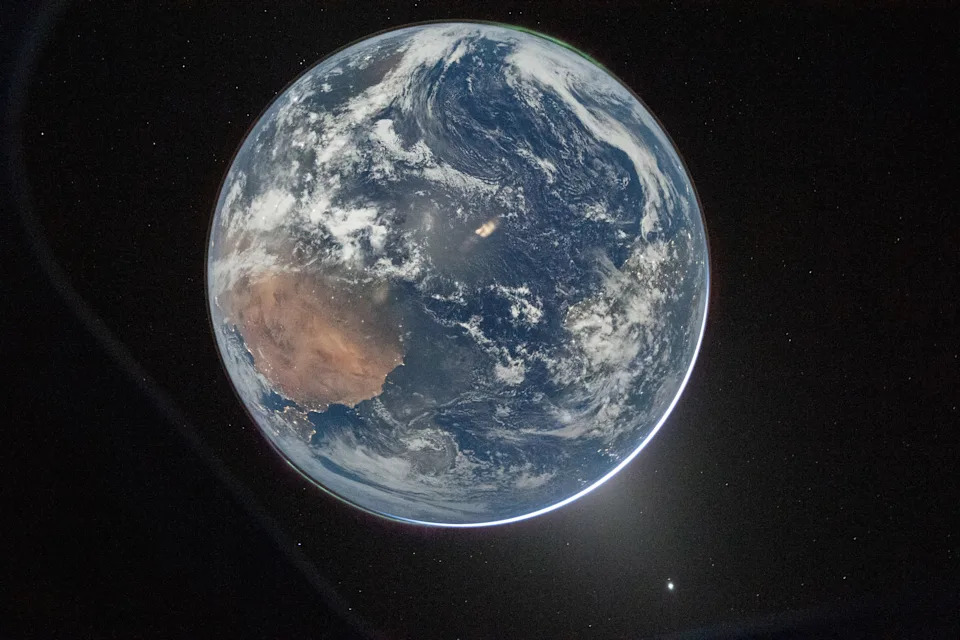
A nighttime picture of Earth taken by an Artemis II crewmember.
((NASA))
The moon mission tested NASA’s deep-space system, with the crew circling the moon and capturing photos of its far side.
The images have not only given scientists and the public rare views of the moon’s far side but also provided exceptional views of Earth from that distance.
The trip has been heralded as a major step toward sending humans back to the moon, including future landings and longer-term moon exploration.
On Wednesday, NASA Administrator Jared Isaacman told President Trump that the U.S. has “an achievable plan” to go back to the moon.