
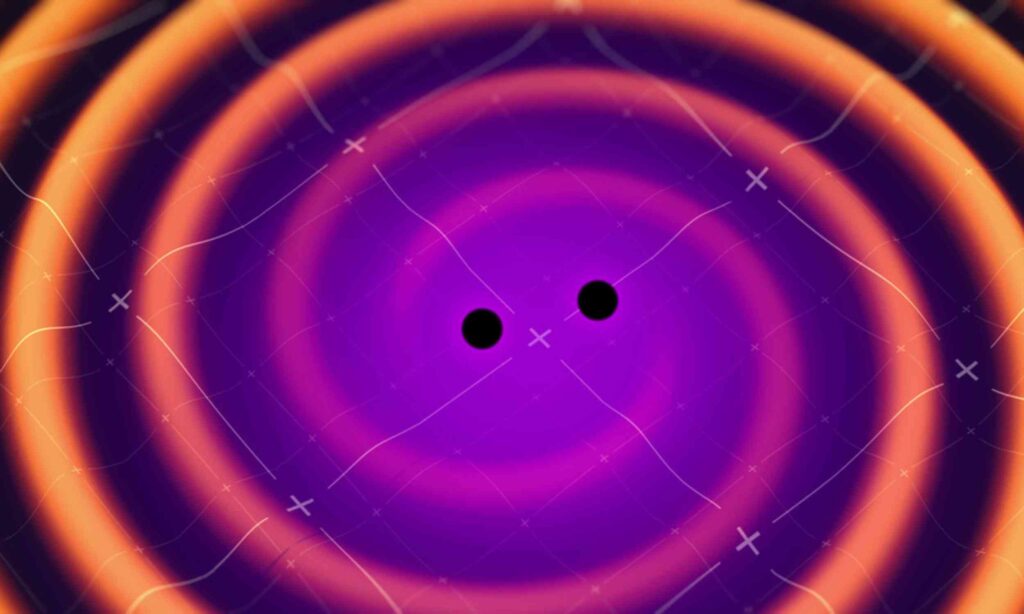
Researchers have found that faint gravitational waves in the early Universe could have produced particles that later became dark matter.
The result reframes dark matter as a byproduct of the Universe’s earliest motion, linking its origin to ripples that once filled all of space.
Traces in cosmic ripples

Across the early Universe, a persistent background of weak gravitational waves provided the setting in which this conversion could occur.
Working within this framework, Joachim Kopp at Johannes Gutenberg University Mainz (JGU) showed that these waves can be directly tied to the appearance of new particles.
Those particles would have emerged in small amounts at first, remaining nearly invisible while the Universe continued to expand.
Their formation depends on conditions that only exist in that early wave-filled environment, setting clear limits on when and how the process could unfold.
Importance of dark matter
Dark matter makes galaxies behave as if far more mass exists than telescopes can directly see.
Its pull keeps stars moving in patterns around galactic centers that visible gas, dust, and planets cannot explain.
Visible matter accounts for about four percent of the Universe, while dark matter represents roughly 23 percent.
Measurements from Planck, a European satellite that mapped ancient light, show dark matter outweighs ordinary matter by several times.
Ripples that lingered
The first direct detection captured gravitational waves from merging black holes, but the new idea relies on quieter waves.
These ancient waves form a stochastic gravitational wave background, a faint mix of many ripples, spread through space.
They may have arisen when the young Universe cooled, changed state, or built powerful magnetic fields before atoms existed.
Such waves are hard to isolate today, yet their early effects could have lasted within the particles they made.
Particles from motion
In the calculation, wave-filled space changed how some nearly massless particles responded to gravity during the first moments.
Those particles were fermions, matter particles that include electrons, protons, and neutrons in everyday matter.
Normally, massless fermions in a smooth expanding Universe keep their number because expansion provides no scale for creation.
Gravitational waves broke that balance by adding new scales, so some wave energy could become particles in rare amounts.
Freeze-in through gravity
Particle physicists call gradual buildup through extremely weak interactions freeze-in, a slow way to stock a hidden population.
Earlier versions usually relied on rare contacts between dark particles and hot ordinary particles over time.
Kopp’s version used gravity and wave motion instead, so the source did not need strong particle interactions.
“This leads to a new mechanism of dark matter production that has not been researched before,” said Kopp.
Mass came later
The particles in the model began with little or no mass, so they first behaved as radiation rather than settled matter.
Later, a Higgs mechanism – a process that gives particles mass – could have made them heavy enough to act as dark matter.
Once massive, they would slow down and clump through gravity rather than stream freely forever, helping build cosmic structure.
That timing matters because the proposed process works only while the particles are effectively massless in the early wave background.
Signals still hidden
This theory does not predict an easy signal in today’s ground-based gravitational wave observatories.
The paper points to present-day wave frequencies from thousands to billions of cycles per second after cosmic expansion stretched them.
Future detectors such as the Einstein Telescope and Cosmic Explorer, proposed observatories for faint waves, may reach part of the lower range.
Above 10,000 cycles per second, known astrophysical sources become scarce, which helps interpretation but challenges detector design.
What remains uncertain
Analytical estimates give researchers a starting point, not a final account of the early Universe with every assumption tested.
Numerical simulations would track the waves and particles step by step, reducing shortcuts in the calculation for particular wave sources.
“The next step in developing this line of research is to go beyond our analytical estimates and conduct numerical calculations to improve the accuracy of our predictions,” Kopp said.
Until that happens, the idea remains a serious route for testing, not a settled origin story.
A wider possibility
The same process might also make right-handed neutrinos, hypothetical partners of known neutrinos, if they exist.
Such particles are important because they could help explain why ordinary matter outnumbers antimatter, its opposite form.
That link is speculative, but it shows why early gravitational waves may affect more than dark matter.
A single wave background could leave several traces, each pointing to physics too faint for ordinary particle searches across the Universe.
A path forward
By joining gravity, particle physics, and cosmic history, the calculation turns an invisible substance into a consequence of early motion.
Better simulations and future high-frequency detectors will decide whether that path describes all dark matter, part of it, or none.
The study is published in Physical Review Letters.
—–
Like what you read? Subscribe to our newsletter for engaging articles, exclusive content, and the latest updates.
Check us out on EarthSnap, a free app brought to you by Eric Ralls and Earth.com.
—–