
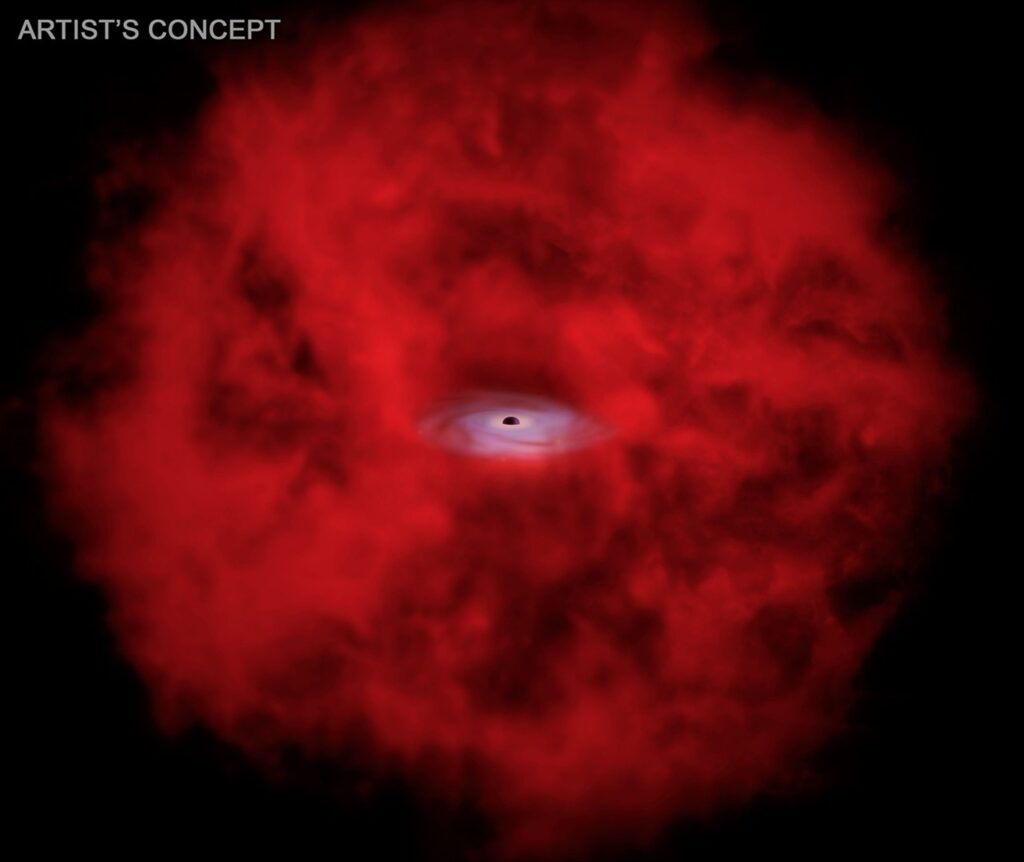
Astronomers studying the early universe may have uncovered a potential clue to how the first supermassive black holes were born, after detecting an unusual X-ray signal from one of the mysterious objects known as “little red dots.”
The discovery combines observations from the James Webb Space Telescope and archival data from the Chandra X-ray Observatory, suggesting that at least some of these distant objects could be massive clouds of gas hiding rapidly growing black holes at their centres.
Little red dots were first identified by Webb during deep surveys of the distant universe. They appear as small, reddish objects only a few hundred light-years across. This makes them extremely small on a galactic scale, yet they are remarkably bright. Astronomers believe they existed more than 11 to 12 billion years ago, meaning they formed when the universe was still in its infancy.
The new breakthrough came when researchers noticed that one particular object, catalogued as 3DHST-AEGIS-12014, matched the position of a previously unexplained X-ray source detected years earlier by Chandra. The connection suggests intense activity occurring deep inside the object.
“The X-ray dot has been sitting in our Chandra survey data for over ten years, but we had no idea how remarkable it was before Webb came along to observe the field,” said astronomer Andy Goulding of Princeton University.
Scientists have long debated how supermassive black holes (the enormous objects found at the centres of galaxies) formed so quickly in the early universe. One theory suggests they grew gradually from smaller black holes created in stellar explosions. Another proposes a more dramatic origin, in which vast clouds of gas collapsed directly into massive black holes.
Little red dots may support the second idea.
Researchers believe these objects could be dense gas clouds heated from within as a black hole consumes surrounding material. As the gas falls inward, it releases enormous energy. This could be what has caused the cloud to glow while partially hiding the black hole inside.
Temperatures within these objects are estimated to range between 1,700 and 3,700 degrees Celsius, cooler than most stars (including our own Sun) but still hot enough to produce detectable radiation. In this case, the presence of X-rays indicates that the cloud may be developing gaps or “windows,” allowing energy from the growing black hole to escape.
“This single X-ray object may be — to use a phrase — what lets us connect all the dots,” said Raphael Hviding of the Max Planck Institute for Astronomy, lead author of the new study.
A Rare Glimpse Into the Birth of Galaxies?
The finding could help explain one of astronomy’s biggest unsolved questions. How did galaxies and their central black holes evolve together in the early universe?
Although scientists caution that the object’s exact nature is not yet confirmed, the detection does provide one of the strongest pieces of evidence so far that some supermassive black holes may form rapidly from enormous gas clouds rather than slowly building up over time.
These little red dots could become a key discovery. Astronomers have their clearest view yet into the moment when the first giant black holes began shaping the galaxies we see today.