
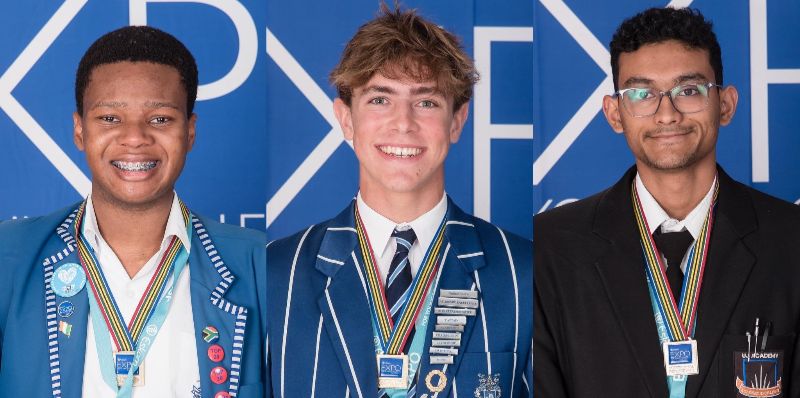
Three young science trailblazers are gearing up to represent South Africa at the Regeneron International Science and Engineering Fair (ISEF).
The ISEF, which provides a platform for young innovators to compete for prizes while advocating for scientific research, will be held at the Phoenix Convention Center in Arizona, US, from May 9 to 15.
The aspiring scientists, Rudra Patel (16), Tiro Moyo (19), and Gerhard Vosloo (17), will showcase their inventive research projects that tackle global challenges spanning environmental sustainability, space science, and biomedical advancements.
Meet the young innovators
The trio are no strangers to accolades, having garnered gold and silver medals at the 2025 Eskom Expo International Science Fair.
Rudra, a Grade 11 pupil at the UJ Academy Maths, Science and ICT School of Specialisation in Johannesburg, created a project titled Predictive AI-Based Genomic Optimisation of Donor Pig Livers for Human Xenotransplant Compatibility.
His research proposes an AI-driven model that adeptly prioritises gene-editing strategies for pig-to-human liver transplantation, pinpointing critical immunogenic genes.
Rudra’s findings suggest a scalable pathway for enhancing xenotransplant compatibility, which could revolutionise organ transplantation approaches globally.
Tiro Moyo, a Grade 12 pupil at Bryanston High School in Johannesburg, will present his project, Predicting Urban Expansion and Green Space Loss in Gauteng Province Using Sentinel-2 MSI Satellite Imagery and Machine Learning.
His work indicates a significant increase in urban land cover, utilising an integrated Random Forest model and Artificial Neural Network to ensure accuracy in future projections.
Tiro’s findings support essential evidence-based policies for urban planning and green space conservation amidst rapid urbanisation.
Gerhard Vosloo, a Grade 11 pupil at Parklands College in Cape Town, will present his project, A machine-learning driven approach to detecting gravitational wave signals from LIGO
His research leverages machine learning to detect gravitational wave signals embedded in noise, significantly reducing computational demands compared to traditional methods.
Gerhard’s project highlights the transformative role of AI in astrophysical research, setting the stage for future advancements in data analysis frameworks.
Mologadi Motshele, the acting chief executive officer of the Eskom Development Foundation, said Eskom, through its continued support of the Eskom Expo for Young Scientists, played a vital role in preparing South African pupils to compete on leading international platforms such as the Regeneron ISEF.
“The participation of local pupils at this level reflects the strength of the country’s growing research and innovation ecosystem. Eskom remains committed to developing future scientists, engineers and innovators by providing opportunities that extend beyond the classroom and onto the global stage. We extend our best wishes to the participants as they represent our country among the world’s top young scientific talent.”
Parthy Chetty, executive director of Eskom Expo, said: “We proudly commend these three young scientists, Tiro, Gerhard and Rudra, for representing our country at the Regeneron ISEF, the world’s largest pre‑college science competition. Their curiosity, rigorous research, and collaborative spirit exemplify academic excellence and inspire other young South Africans.
“We thank the mentors, families, and schools for nurturing talent and providing support. Their achievement demonstrates that bold questions and disciplined inquiry can open global opportunities. We encourage other students to pursue STEM, seek mentorship, and enter competitions that challenge and elevate ideas. Together we celebrate innovation, resilience, and the next generation of scientific leaders.”