

Find winning stocks in any market cycle. Join 7 million investors using Simply Wall St’s investing ideas for FREE.
Meta’s interest in space-based solar power signals a potential major new market for Rocket Lab’s launch and satellite subsystem capabilities.
The shift toward orbital energy collection highlights emerging commercial uses for space infrastructure that go far beyond traditional imaging and communications.
Rocket Lab’s new High-Performance Star Tracker is specifically engineered for the long-duration, high-radiation missions required by these types of power-intensive orbital projects.
These advancements reinforce Rocket Lab’s strategy of vertical integration, transforming the company from a “launch-only” provider into a comprehensive hardware partner for the entire space industry.
Rocket Lab (NasdaqCM:RKLB) is drawing fresh attention as it moves deeper into commercial orbital infrastructure, with its share price recently trading at $78.59. While Meta Platforms has recently signaled a major move into space-based solar power to fuel its data centers, the development highlights a growing market where Rocket Lab is strategically positioned to provide critical hardware and launch services. These moves into components and power applications broaden the story for Rocket Lab beyond pure launch services, reflecting its massive gains over the past year.
Rocket Lab has introduced a new High-Performance Star Tracker specifically aimed at long-duration missions in high-radiation orbits – the exact environments required for orbital power and data-center-focused satellites. This development points to broader vertical integration for the company, moving into key satellite subsystems that are essential for the ambitious orbital projects currently being explored by Big Tech.
Stay updated on the most important news stories for Rocket Lab by adding it to your watchlist or portfolio . Alternatively, explore our Community to discover new perspectives on Rocket Lab.
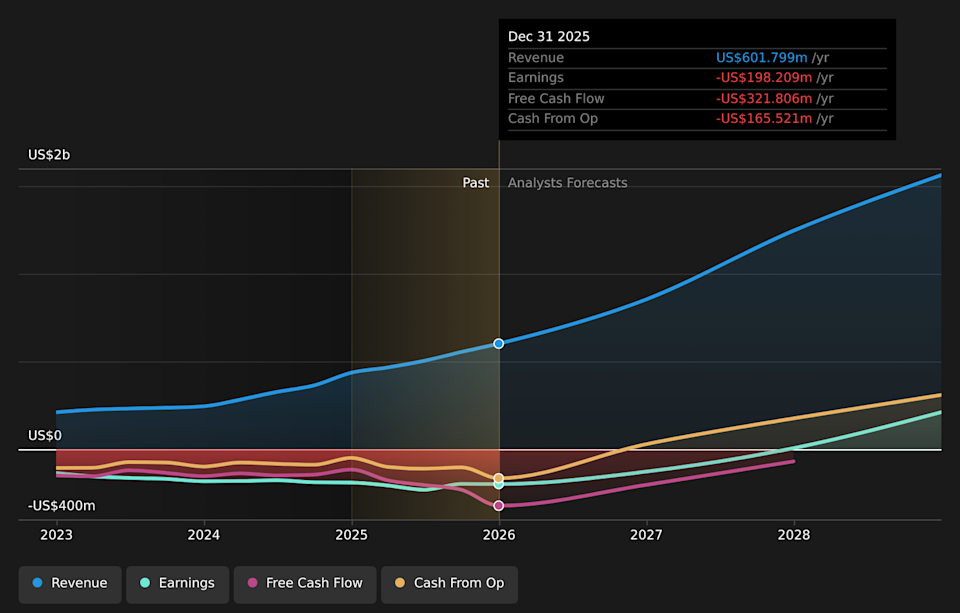 NasdaqCM:RKLB Earnings & Revenue Growth as at Apr 2026
1 thing going right for Rocket Lab that this headline doesn’t cover.
For Rocket Lab, the growing industry interest in orbital solar power fits into its effort to be an end-to-end space solutions provider. Because these missions require immense power and extreme durability, Rocket Lab can supply both the ride to orbit and the satellite subsystems, such as its newly unveiled silicon solar arrays that keep those assets operating reliably over time.
How This Fits Into The Rocket Lab Narrative
Vertical Integration: The launch of the new Star Tracker aligns with the existing narrative that end-to-end space solutions can support multi-year revenue growth by widening Rocket Lab’s role on each mission.
Market Expansion: While the current narrative leans on defense and “Neutron” launch vehicle work, the specific theme of space-based solar power-fueled by Meta’s interest represents a significant “unpriced” tailwind for the company’s space systems division.
Execution Demands: A broader product footprint increases operational complexity. This remains a key risk if R&D and product lines stretch the organization while it is still investing heavily in its larger rocket programs.
Story Continues
Knowing what a company is worth starts with understanding its story. Check out one of the top narratives in the Simply Wall St Community for Rocket Lab to help decide what it’s worth to you.
Risks and Rewards for Investors
⚠️ Sector Uncertainty: Space-based solar power is still in the early stages. There is uncertainty around the timing of commercial adoption and exactly how much revenue such industry trends will contribute to Rocket Lab compared to its established government contracts.
⚠️ Operational Complexity: Deeper integration into components like star trackers and solar arrays raises execution risk if manufacturing and quality control do not scale smoothly with demand.
🎁 Market Leadership: If orbital power and long-life satellites gain traction, Rocket Lab’s in-house suite, including reaction wheels, radios, and solar hardware could position it to capture a larger share of mission value than pure launch peers like Astra.
🎁 Validation by Association: Meta’s recent exploration of the sector, alongside Rocket Lab’s work with agencies like JAXA, adds credibility to the commercial space-systems market, potentially helping Rocket Lab compete for future high-stakes missions.
What To Watch Going Forward
Investors should monitor how often Rocket Lab’s Star Tracker and subsystems are selected for third-party spacecraft, including any future contracts that may arise from Meta’s orbital power efforts. It is also worth tracking the upcoming earnings release on May 7, 2026, for details on space-systems demand and whether the company is securing more “bundle” contracts that include both launch and hardware.
To stay informed on how the latest news affects the investment narrative for Rocket Lab, visit the community page for Rocket Lab to keep up with the top community narratives.
This article by Simply Wall St is general in nature. We provide commentary based on historical data and analyst forecasts only using an unbiased methodology and our articles are not intended to be financial advice. It does not constitute a recommendation to buy or sell any stock, and does not take account of your objectives, or your financial situation. We aim to bring you long-term focused analysis driven by fundamental data. Note that our analysis may not factor in the latest price-sensitive company announcements or qualitative material. Simply Wall St has no position in any stocks mentioned.
Companies discussed in this article include RKLB .
Have feedback on this article? Concerned about the content? Get in touch with us directly. Alternatively, email editorial-team@simplywallst.com