
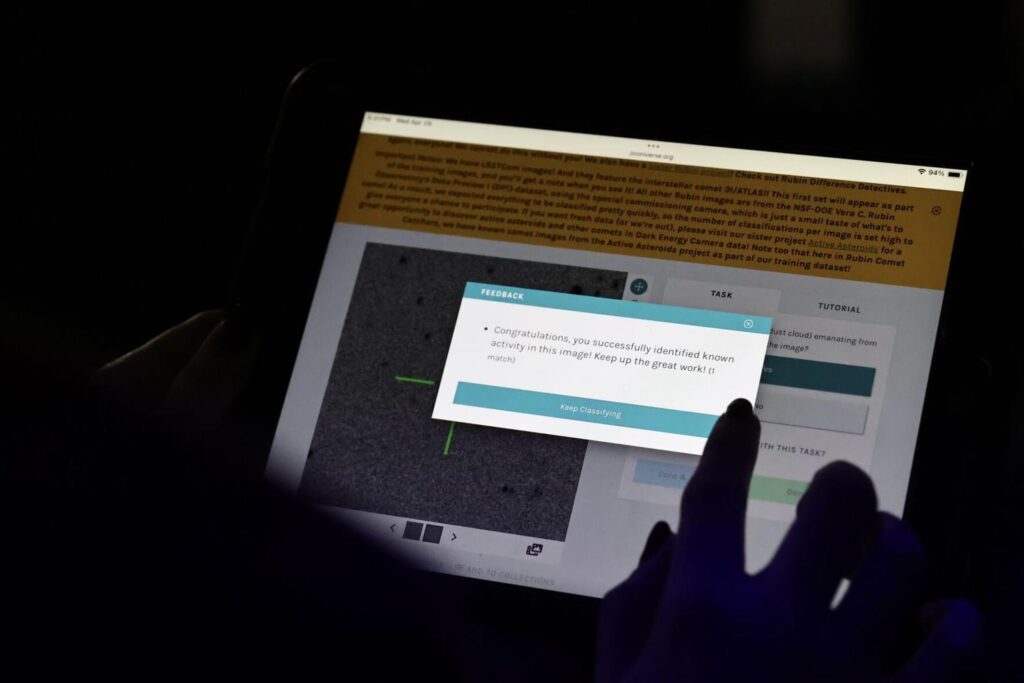
The Mallory Kountze Planetarium inside the Durham science building brought comet classification to campus with a Do NASA Science Live livestream with scientists Wednesday.
Students heard from scientist Colin Chandler P.H.D. who is behind the Rubin Comet Catchers program. The program scans images from the Vera C. Rubin Observatory in Chile and works with Citizen Science to have the public be involved in sorting the data and identifying possible comet activity in space.

Participants across the globe tuned into the livestream and created an account on Zooniverse, a data project platform for the scientific study. On the platform, they learned how to determine if objects in the sky had a tail or coma around them indicating a possible comet which the Rubin Conservatory team will investigate.
“As our algorithm says, a lot of people said, you know, yes, this thing has activities. So, we look at those candidates. […] We’re able to do an archival investigation. So, we look at online repositories of existing astronomy data to try to find other images of that same object and see if we can’t show that it was active some other time or some other camera,” Chandler said.
The discoveries of public volunteers can catch things that the conservatory scientists might miss or didn’t notice.
Some discoveries “go towards a campaign that we have where we actually observe [and] use a number of different telescopes to follow up with these objects that the volunteers find,” Chandler said.
Chandler said that the slight differences in the appearance of comet tails and comas are such small changes that AI cannot distinguish them as humans can.
“There aren’t any current AIs that have successfully been able to classify comets even remotely on a decent scale. We have an AI that’s job is to try to filter out the junk from the project, and it’s done a decent job at identifying stuff that are much more likely for us to find things in as a project. But you know, I can count on three fingers how many schemes have been attempted for finding things with AI that have been successful,” he said.
The data from volunteers like the UNO students who attended the event and learned how to identify comets will be further studied and could even get published, with data volunteers being cited.
Luther Gutekunst, a junior education major with a social studies specialization, found out about the event from passing the flyers for it in Durham going to class.
“I have a class right over there, and so I would always walk past this, and I looked at this sign […] and I went, Yeah, sure,” Gutekunst said.
While he knew about the planetarium at UNO and had heard it was in the Durham building, he didn’t realize where it was, and the event was his first time in the space. Even though it was Gutekunst’s first time in the planetarium it wasn’t his first Citizen Science study.
“You have to sort 15,000 images or something, and you can’t get the computer to do it because it won’t do it right? So, yeah, you make a bunch of people sit on the website, and they do it themselves, because people are good at image recognition. It’s one of the things that our brains are set up for,” Gutekunst said.
After sorting through over 700 images of objects in the sky, Gutekunst felt he accomplished his Citizen Science participation. The Rubin Comet Catchers program for identifying comets will remain available to the public and can be accessed at https://scistarter.org/rubin-comet-catchers.