
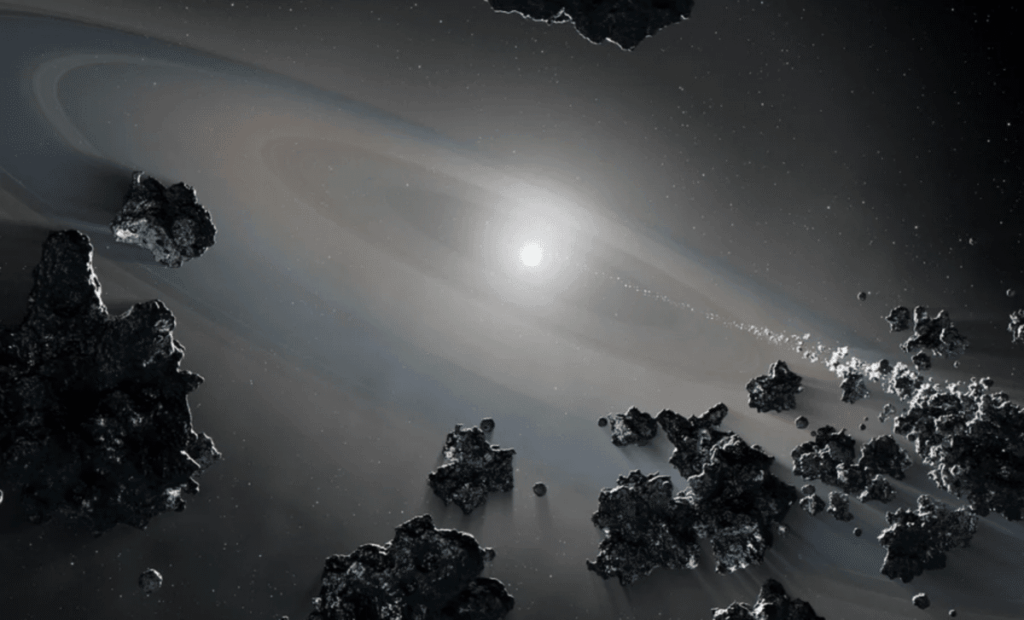
A new cosmological study published in arXiv suggests the universe may have a dramatically shorter lifespan than previously believed, potentially collapsing in just 33.3 billion years. This finding challenges the long-standing assumption of endless cosmic expansion and reintroduces the once-dismissed idea of a Big Crunch, where the universe reverses course and collapses back into an ultra-dense state.
A Radical Shift In How Scientists View Cosmic Expansion
For decades, the dominant model of cosmology has pointed toward a universe that expands forever, driven by a mysterious force known as dark energy. Observations consistently showed that this expansion is accelerating, leading many researchers to conclude that galaxies would drift apart indefinitely, leaving a cold and empty cosmos.
This new research, published in arXiv, challenges that narrative by suggesting that dark energy may not be constant. Instead of behaving like a fixed property of space-time, its influence could evolve over time. That single shift changes everything. If dark energy weakens or reverses its effect, the expansion of the universe could slow, stop, and ultimately reverse.
The implications are profound. Rather than a universe that fades into isolation, this model predicts a dynamic lifecycle that ends in collapse, echoing conditions similar to the Big Bang.
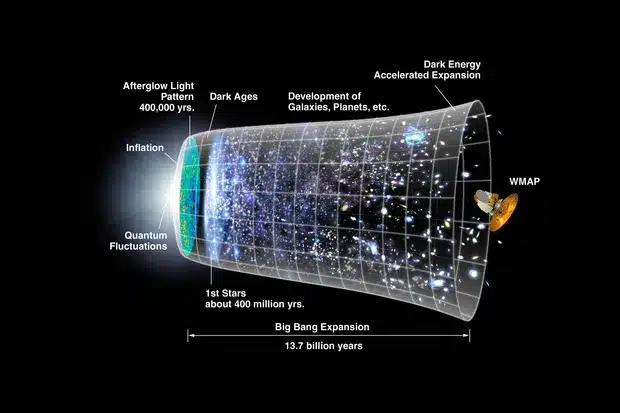 This graphic shows a timeline of the universe based on the Big Bang theory and inflation models.
Image credit: NASA/WMAP
The Axion Dark Energy Model And What It Changes
At the center of this discovery is the axion dark energy (aDE) model, a hybrid theory combining two components: a cosmological constant and an ultra-light particle field known as the axion. Axions are hypothetical particles often associated with dark matter, and in this framework, they play a crucial role in shaping cosmic evolution.
Using data from large-scale surveys like the Dark Energy Survey (DES) and the Dark Energy Spectroscopic Instrument (DESI), researchers tested how this hybrid model fits real observations. These surveys mapped hundreds of millions of galaxies, offering one of the most detailed pictures of cosmic expansion ever assembled.
The results suggest that the aDE model aligns closely with observed data. More importantly, it introduces a future phase where the combined effects of the axion field and cosmic background energy begin to pull the universe inward, rather than push it outward.
This marks a turning point in cosmology. A force once thought to guarantee eternal expansion may instead set the stage for cosmic collapse.
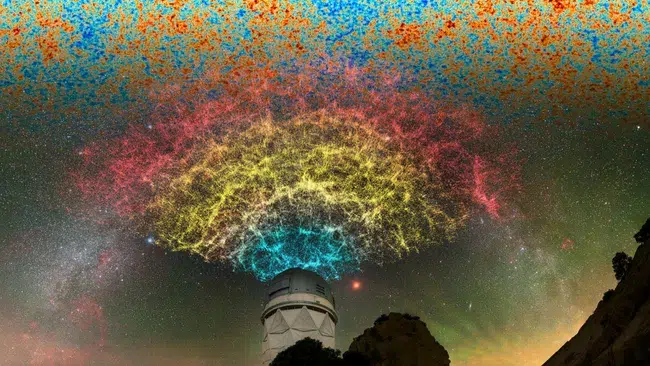 An artistic celebration of the Dark Energy Spectroscopic Instrument (DESI) year-one data, showing a slice of the larger 3D map that DESI is constructing during its five-year survey.
Image credit: DESI Collaboration/KPNO/NOIRLab/NSF/AURA/P. Horálek/R. Proctor
A Universe Headed Toward A Big Crunch
If this model is correct, the universe will not expand forever. Instead, it will reach a maximum size before reversing into a contraction phase. Over billions of years, galaxies would begin moving closer together, cosmic structures would compress, and temperatures would rise.
This process would culminate in a Big Crunch, where all matter and space-time collapse into an extremely dense state. It mirrors the Big Bang in reverse, raising new questions about whether such a collapse could trigger another cosmic cycle.
The predicted timeline, 33.3 billion years from now, is strikingly shorter than previous estimates that extended into the trillions of years. In cosmic terms, this represents a significant revision.
Why This Discovery Matters Now
This research reshapes one of the most fundamental questions in science: how the universe will end. It also highlights how much remains unknown about dark energy, which still accounts for roughly 70% of the universe’s total energy content.
The study demonstrates that even small changes in how dark energy behaves can lead to dramatically different outcomes. It underscores the importance of ongoing observations and future missions designed to probe the expansion of the universe with even greater precision.
As new data arrives, scientists will test whether this model holds or if further refinements are needed. What remains clear is that the fate of the universe is far from settled, and may be far more dynamic than once believed.