

A few years ago, I attempted to make an origami (paper folded) animal. Armed with a square of paper and what I can only describe as misplaced confidence, I managed to produce something that looked vaguely threatening rather than like a flapping crane. If I struggled that much with a single sheet of paper on a kitchen table, I can’t begin to imagine what it takes to apply the same principle to a satellite antenna destined for space. But that is exactly what a team of engineers in Japan has just pulled off and the results are really quite extraordinary.
Engineers at the Institute of Science Tokyo have unveiled an antenna for small satellites that borrows directly from the art of origami and their design could solve one of the most frustrating bottlenecks in modern space science, the fact that our smallest satellites simply can’t talk loudly enough!
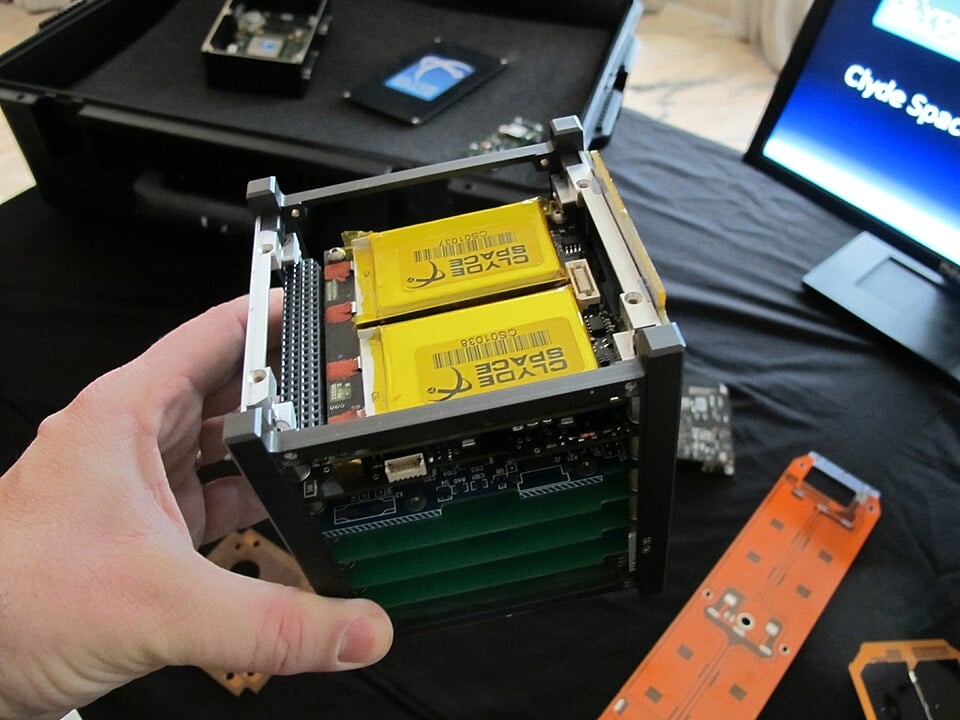 An example of a cube sat. It’s easy to see that size and weight of the antenna is critical decision in their design (Credit : Svobodat)
CubeSats are the workhorses of the modern space age. Cheap, standardised, and small enough to hold in your hands, these little spacecraft have democratised access to orbit. Universities build them, startups launch them, and space agencies use them to test ideas that would be far too risky to try on a full size mission. But there has always been a catch. The smaller the satellite, the smaller the antenna and the smaller the antenna, the weaker the signal. For a CubeSat trying to beam data back from deep space, or even just maintain a reliable link from low Earth orbit, that’s a serious problem.
The team’s solution is elegant in the extreme. They took the “flasher” pattern which is a classic origami fold that allows a flat sheet to collapse into a remarkably compact stack and applied it to a deployable antenna. Stowed for launch, the entire system fits inside a box just ten centimetres square and six centimetres deep, weighing only 64 grams. To put that into context, it’s roughly the same as a small chocolate bar. Once in orbit, a set of booms manufactured from materials that are engineered to spring back to a pre set shape when released, pop the antenna open to around two and a half times its packed size.
The antenna itself is built from a flexible two layer membrane of conductive and dielectric textiles, with tiny U-shaped circuit elements sewn directly into the fabric to control exactly how radio waves bounce off the surface. That reflect array design means the antenna can focus and steer a signal without physically moving, something that is critical on a spacecraft where every gram of mechanical complexity is a potential point of failure. In laboratory testing, it achieved a gain of 18 dBic, a measure of how powerfully and precisely it can direct a signal. For a device you could slip into your jacket pocket, that is seriously impressive performance.
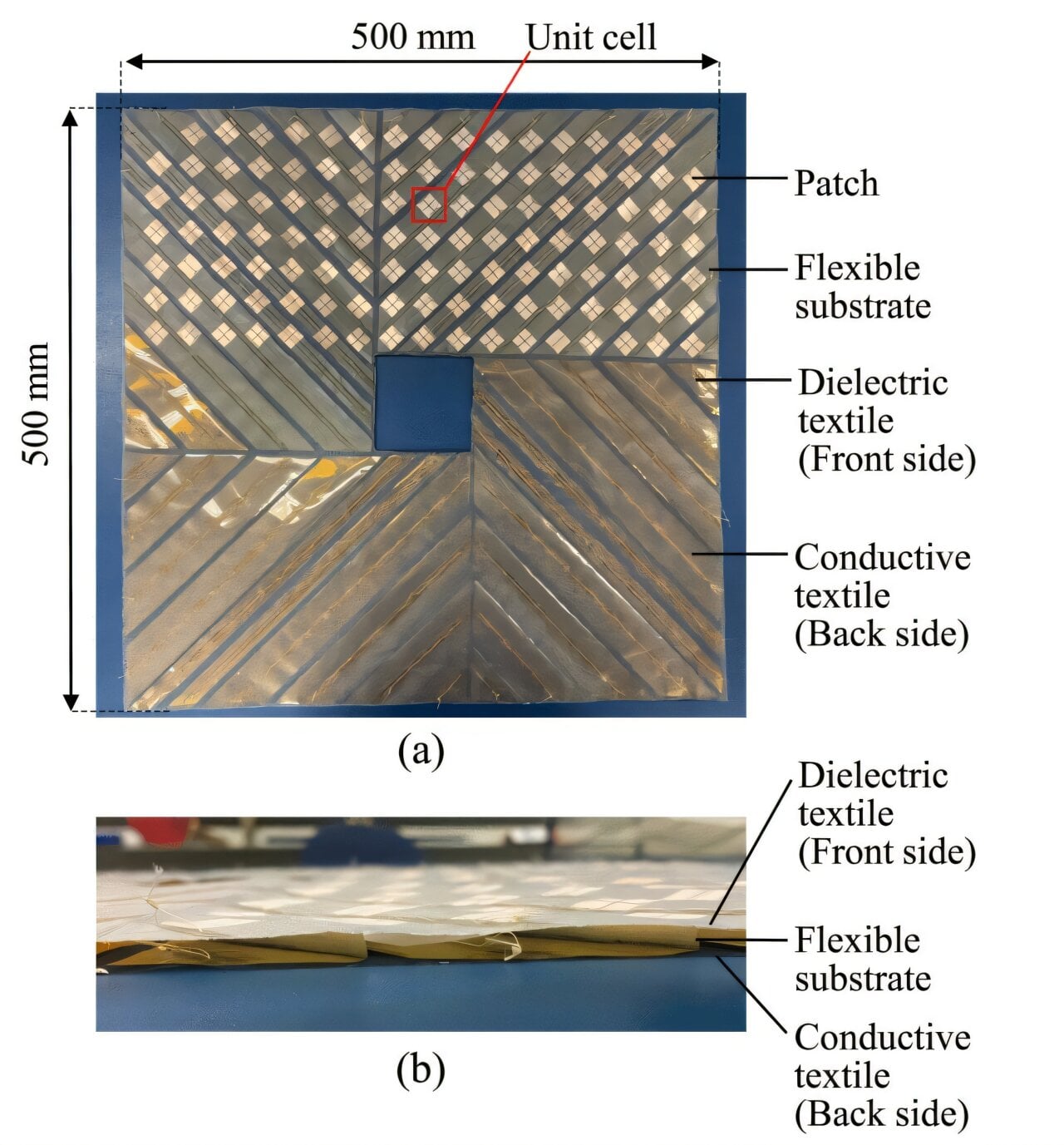 Example of the structure of a folded antenna (a) Top view and (b) side view (Credit: IEEE Transactions on Antennas and Propagation)
The antenna is destined for OrigamiSat-2, a CubeSat which is roughly the size of a large Thermos flask, scheduled for launch later this year. Applications range from space based internet services and disaster monitoring all the way to future lunar communications, where small satellites will need to punch well above their weight.
Space engineering has always demanded ingenuity in the face of constraint, and this team found their answer not in some cutting edge laboratory material, but in a fold of paper. The idea is as simple as it is beautiful but it seems that sometimes the most powerful solutions have been hiding in plain sight for centuries.
Source : Foldable origami-inspired antennas for CubeSat satellites