
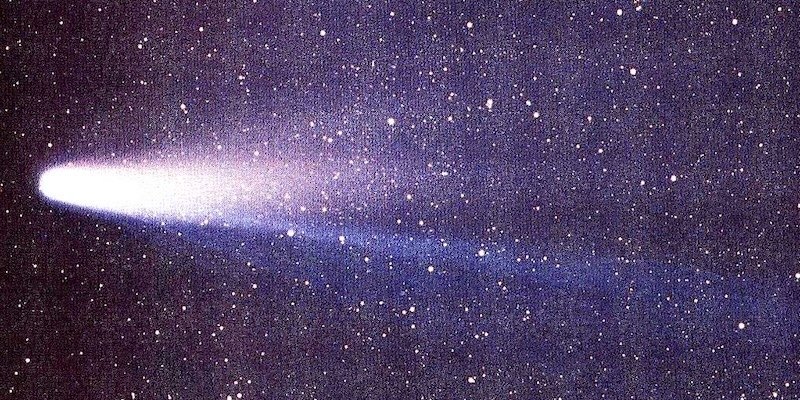
In the spring of March 1997 the earth received a celestial visitor. Silvery and long-tailed, the comet Hale Bopp had travelled from the edges of the solar system to make a dramatic appearance in the night sky. Hale Bopp was visible for eighteen months, but on the night of March 22nd, when it had its closest approach to Earth, I was up on the dark cliffs of North Cornwall. The comet appeared to my naked eye like a star which had been slightly smudged, bright and fuzzy and icy-blue.
Article continues after advertisement
As I sat and watched it in the cold night air, looking upward so long I got a crick in my neck, over on the other side of the world thirty-nine members of the Heaven’s Gate cult were preparing to commit mass suicide. Their leader, Marshall Applewhite, had revealed to his followers that behind the comet Hale Bopp was a UFO which would provide them with an evacuation from this earth. The members were all found deceased just two days later, dressed in black Nikes and carrying a five dollar bill and three quarters in their pockets. They believed this was “the cost to ride the tail of a comet to heaven.”
While I was writing Dark Is When the Devil Comes I dreamed of comets. My head was full of cosmic visions, and night after night I poured them into a story about a dark and tangled wood that lay beneath shifting, unmapped stars. I read about the Black Death, the plague which ravaged Europe, finding strange comfort in John Kelly’s The Great Mortality and Rebecca Rideal’s 1666, an intimate study of an epidemic which had begun with a vision of a comet in the sky.
Comets have long been seen as cosmic harbingers of ill fortune. Recorded as early as 240 B.C., Halley’s Comet is woven into the fabric of history, with Chinese astrologers referring to it as a “broom star” because of the distinctive long tail. It features in the Bayeux Tapestry, a thousand-year-old embroidery that reaches seventy meters long and depicts the events leading up to the Battle of Hastings and the Norman Conquest.
The comet was considered a portent of disaster for King Harold II who was killed during the battle, and was described in the Carmen de Hastingae Proelio thus: “blazing from heaven, the streaming hair of a comet proclaimed to the English foreordained destruction.”
Article continues after advertisement
The day after I’d gone stargazing up on the cliffs I visited the local woodland near my home for a brief circuitous walk. The forests here are small and well-managed, ancient but not wild, not in the truest sense, so it’s difficult to get lost and find yourself in any real danger.
On my walk I came across something jarring. Just off the path, near a copse of young growth pine trees, I discovered a man’s clothing, neatly folded and set down amongst the pine needles and moss. There was nothing special about the clothes themselves—a pair of beige slacks with a flannel shirt folded on top, brown lace-up shoes beside the pile with the socks stuffed inside as though to keep them safe—they were orderly, conventional.
The thing which struck me as most strange was the hearing aid on top of the shirt, placed there very deliberately. It made me think of endings. It made me think of the Rapture.
In the winters of 1664 of 1665 a comet was spotted in the skies in Europe. This “fiery star” heralded a major outbreak of bubonic plague that killed 100,000 people in London. On August 30 2019, a comet from outside our solar system was observed by an amateur astronomer in Crimea. On December 8 2019 it made its closest approach to the sun, roughly coinciding with the first recorded human cases of COVID-19.
I walked around the tree in the woods, and looked up into the branches. The clothes hadn’t been there long. They weren’t damp, and there was no leaf litter blown across them, no scattering of dirt. There was a stream nearby, running through the bottom of the valley, but it was shallow, knee-high at its deepest point, and no good for swimming in.
Article continues after advertisement
Although the weather was bright and sunny there was still a chill in the air. Besides, the shade of these woods weren’t conducive to undressing, not even at the height of summer. The trees threw long shadows which seemed to bleed into each other to create a thick, gloomy canopy above.
Oh boy, that hearing aid was bothering me. Flesh-colored, clunky looking. Irrefutably a medical object. What was it doing there? I stood and waited awhile but there was no-one around, and no-one came back to claim the clothes. It was as if they’d vanished into thin air. Abducted, maybe. Sucked upward so fast they shed their outfit like a skin.
Before we understood comets as balls of frozen gases, rocks and dust, our ancestors saw them as predictors of calamity for humankind, a message from the Heavens. Even the word “disaster” even comes from an old word for comets, dus aster, meaning bad star.
When we talk of “reading the stars” we think of astrology, but ancient cultures read symbols in the likenesses of comets – sometimes it would appear like the head of a woman with flowing hair, or a blazing sword slicing through the heavens. Sometimes they would see the death mask of their enemies or a divine bird with a luminous tail. Some—like the doomed members of Heaven’s Gate—saw messengers from space, come to take them home.
In Edgar Allen Poe’s short story “The Conversation of Eiros and Charmion,” the two title characters discuss the ending of the world, revealed to have been caused by a comet hitting earth. It is thought to have accelerated the “comet panic” of that era and leans heavily on the idea that these objects were prophecies of doom. In Ruby Todd’s debut novel Bright Objects we find a widowed woman struggling with the arrival of a once-in-a-lifetime comet and the increasing fervor of the small town over its impending approach.
Article continues after advertisement
I didn’t go back to the woods for a long time after I found that pile of clothes. There was nothing in the local news about the discovery of a body and no MISSING posters on the corkboard at the back of the supermarket that told me someone was looking for a lost loved one. Over time I began to forget about it, and of course when I went back to the woods over a year later there was no sign of the clothes at all.
Like the ancients, I’m probably reading too much into it. It’s easy to look for the fantastical explanation over the logical one, isn’t it? These days we know that a comet can no more predict disaster than can a handful of runes or the entrails of a sacrificial goat. We are scientifically minded, rational. We know too much.
But that hearing aid is what I always come back to. It was just such a strange thing to see there, almost as if the person leaving it behind knew they wouldn’t need it anymore. As if they were vanishing on the tail of a passing comet.
***

Article continues after advertisement