
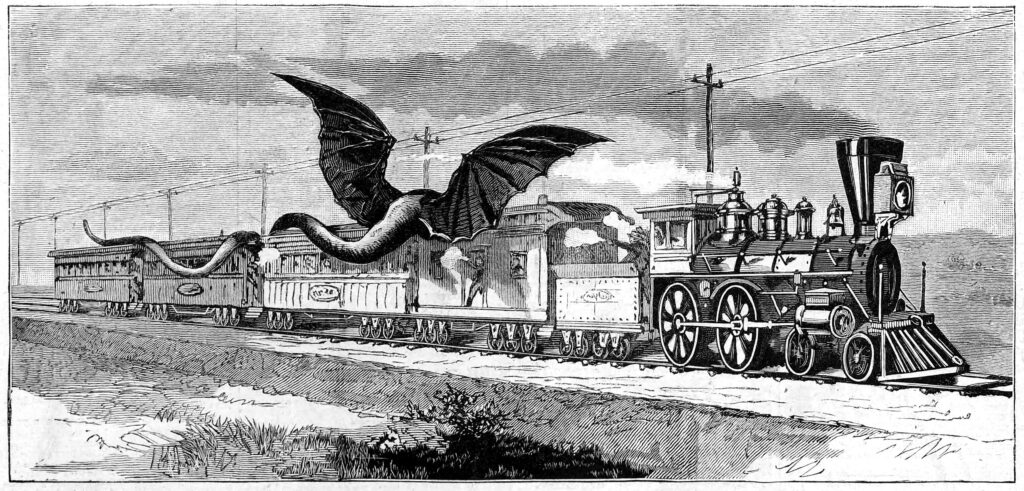
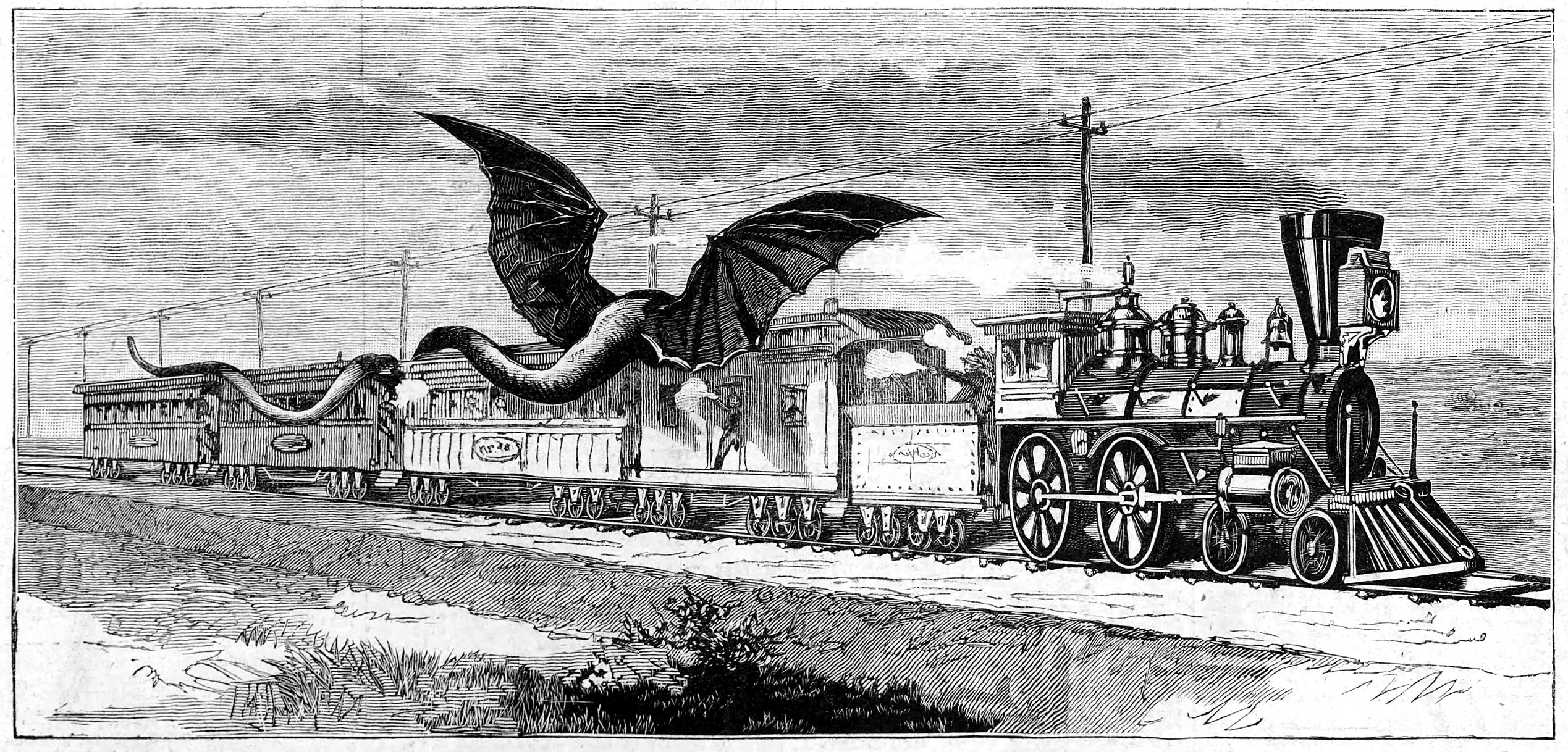
 Memories of his grandfather’s tall tales about flying snakes, lifted from Victorian scandal sheets, kept Cincinnati reporter Frank Y. Grayson shivering in bed as a child. Here, the “Illustrated Police News” imagines such a serpent attacking a train.
From “Illustrated Police News”, March 18, 1882
They don’t call them UFOs anymore. Those mysterious things zipping around up there are now known as Unidentified Aerial Phenomena, no longer Unidentified Flying Objects. That’s okay. Back in the 1940s and early 1950s, before we settled on UFO as the official acronym, we called them flying saucers, even though many sightings involved shapes not commonly found in the china closet.
The really big year for flying saucers was 1947. The Enquirer printed a banner headline—“Flying Saucers Over Cincinnati”—on July 7, 1947 to report the observations of a Terrace Park housewife. For the next two decades it was “Katie Bar the Door” as dozens of Cincinnati UFO sightings found their way into the files of Project Blue Book, headquartered just up the road at Wright-Patterson Air Force Base outside Dayton.
Those first flying saucer incidents were viewed with some amusement by Frank Y. Grayson from his perch at the old Cincinnati Times-Star. Good old Frank Grayson. He had a long career at several Queen City newspapers and, although he was primarily a baseball reporter, the papers kept him on as a dependable raconteur, one of those old duffers who remembers everything and has a good story to go with it. On July 8, 1947, Grayson’s column in the Times-Star was headlined “Flying Saucers Are Nothing To Flying Snake of Eighties.” The eighties in question were, of course, the 1880s, and Grayson had the goods.
“The writer was a small boy then and he can well remember the thrill that he experienced when told by his granddad, who was a great almanac reader, that a ‘flying snake’ was on the loose. Excitement attained its peak when the Police Gazette, that salmon-colored barber-shop bible of the period, published a fantastic drawing of the aerial serpent. It was 100 feet long, equipped with 14 wings, six legs and a head that was hideous to look upon.”
Though rarely as huge or hideous as Grayson recalled, flying snakes were regularly reported by Cincinnati newspapers at the time. The Cincinnati Gazette [June 7, 1882], for example, printed a squib about a farmer in nearby Connersville, Indiana:
“Jonathan Hittle, a well known and perfectly reliable citizen of this county, relates an extraordinary story about a flying serpent, twelve feet long, which he positively declares he has frequently seen of late in one of his wheat fields. He tried to kill it a few days ago with a rail, but it escaped into a den.”
The Cincinnati Commercial Tribune [July 26, 1899], by special dispatch, printed the discovery of a less imposing but still curious flying snake from a nearby Kentucky hamlet:
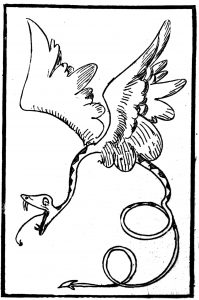 Cincinnati newspapers regularly warned readers from the 1880s well into the 1900s whenever a report of a flying snake came over the wires.
From “Cincinnati Weekly Enquirer”, July 6, 1905
“John Greenert, a prominent farmer whose veracity has never been doubted, tells of a wonderful species of winged snake seen by him and a farm hand on his place. He described the snake, which they first discovered lying on the ground, as about three feet long and about ten inches in circumference at the center. It had four pairs of legs, two near the head and two just back of the wings, which grew just forward of the middle of the body. The wings consisted of a membranous substance, remained folded up under the body and were not noticed by them until on their approach. With a spring it raised from the ground and sailed through the air at a terrific speed. The snake is as black as charcoal and has a very repulsive appearance, especially when flying through the air.”
The Enquirer [June 28, 1905] described a flying snake killed around Berry Plain, Virginia: “The curious reptile was first noticed flying about in the air with several feet of its horrid snakeship dangling around, presenting the appearance of an ordinary snake attached to a strange-looking bird. It was finally killed and measured and proved to be five feet long and about one inch in diameter of body. It had perfect wings of good size, and these were covered with feathers.”
The really big and scary flying snakes seemed to be located some distance away from Cincinnati. If, in fact, the National Police Gazette did publish the horrific illustration described by Mr. Grayson, that issue has not been located. However, a competing salmon-tinted scandal sheet, The Illustrated Police News, did delight its readers in the March 18, 1882 issue with a drawing of an immense flying snake attacking a railroad train in the Nevada desert near the California border. The details, provided by the Los Angeles Times, describe a winged serpent some 30 feet long and a foot or more in diameter, flying at a pace equal to the locomotive and so close that the train’s wheels clipped the tip of the monster’s tail, which infuriated the beast:
“The angry animal kept over the train and gave the train a lively thrashing, roaring like a cow in distress all the time. After breaking several windows and frightening the women and children almost to death, the monster sailed off, followed by a shower of lead from pistols of the passengers, which seemed to have no effect at all, if any of the bullets hit him.”
A large flying snake was reported around South Carolina in 1897, estimated at twenty-five to forty feet in length and eight to ten inches through the widest part. This beast appeared to float leisurely just above the treetops, which its head reared back as if to strike.
A dreadful aerial lizard was reported from the Great Salt Lake in Utah in 1903, estimated at sixty-five feet in length, with a head like an alligator and a body covered in scales thoroughly encrusted by salt from the lake. The veracity of the report was undercut the next day when an illustration of the alleged beast was printed in the Salt Lake Telegram bearing on its wings the insignia of a local department store then promoting excursions around the lake.
Commercial interests were not the only motivations suggested for apparitions of flying snakes. Alcohol, it was suggested, might play a part as well. The Cincinnati Commercial [August 24, 1906] implied just this, assuming its readers were familiar with the famous Monongahela Rye whiskey:
“Pittsburgh papers record, with details and all evidence of truth, that a frightful winged snake has been frequently seen of late flying up and down the Allegheny. Taking the story for true, from start to finish, the wonder of it is that the monster wasn’t seen flying up old Monongahela. It would be just as convenient and far more appropriate.”
Even Mr. Grayson believed there was a bit of hokum to these reptilian visitations. Although he recalled how, after hearing his grandfather’s description, he slept all night with his blankets pulled over his head, he now looked back with a heavy dose of skepticism:
“Maybe there may be some old-timers who can recall how as small boys they took to the woods so fast that their ankles jelled when some weisenheimers told them that the ‘flying snake’ was headed their way. P.T. Barnum was right when he said there was a sucker born every minute. The ‘flying snake’ increased it to one every fifth of a second and we were one of them.”