
In a definitive move to cement its position as a global space powerhouse, India is transitioning its space ambitions from the launchpad directly into the classroom. Union Minister Jitendra Singh recently reviewed a strategic roadmap to establish the country’s first batch of seven specialized space laboratories within various universities and colleges.
This initiative marks a shift toward decentralized, hands-on aerospace education, ensuring that the next generation of “rocket scientists” is born not just in ISRO facilities, but on university campuses.
Bridging the Gap: Hands-on Space Tech
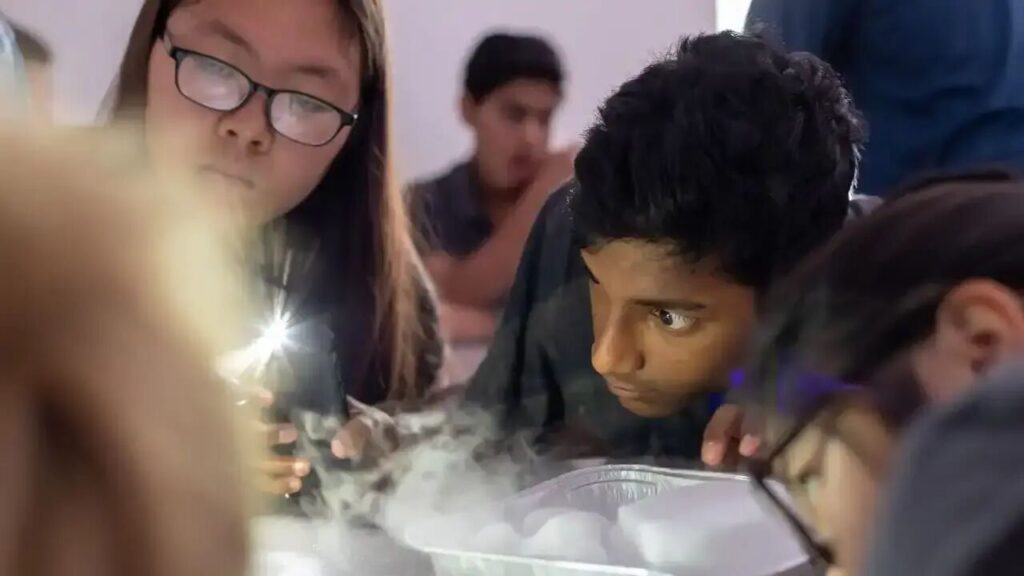
The primary goal of these laboratories is to provide students with practical, real-world exposure to the complexities of the cosmos. Rather than relying solely on theoretical textbooks, students will engage directly with:
* Satellite Systems: Learning the architecture and communication protocols of orbital hardware.
* Rocketry: Understanding propulsion, structural design, and launch dynamics.
* Mission Design: Simulating deep-space trajectories and mission planning.
The Economic Context: A $600 Million Boom
The timing of this educational push is no coincidence. Over the last five years, India’s space sector has undergone a radical transformation, pivoting from a government-exclusive domain to a thriving open market.
* Private Investment: The sector has attracted over USD 600 million in private investment.
* Startup Ecosystem: Hundreds of “spacetech” startups are now competing in satellite imagery, launch services, and orbital logistics.
* Economic Impact: By training mission designers and engineers locally, India aims to create a sustainable talent pipeline to support this influx of capital and innovation.
Why It Matters
For decades, the dream of working in space was often limited to a select few who entered the Indian Space Research Organisation (ISRO). By embedding these labs within the university ecosystem, the government is effectively democratizing space science.
The move is expected to:
1. Accelerate Innovation: Fresh perspectives from academia often lead to breakthroughs in cost-effective technology.
2. Global Competitiveness: Positioning India as a hub for affordable and reliable space engineering talent.
3. STEM Empowerment: Inspiring a new wave of students to pursue high-level Science, Technology, Engineering, and Mathematics (STEM) careers.
As these first seven labs roll out, they will serve as the blueprint for a nationwide expansion. With Union Minister Jitendra Singh signaling that “campus reality” is just around the corner, the barrier between a college lecture hall and the stars is officially beginning to dissolve.
India isn’t just reaching for the moon anymore—it’s building the tools to stay there, starting with the students of today.