
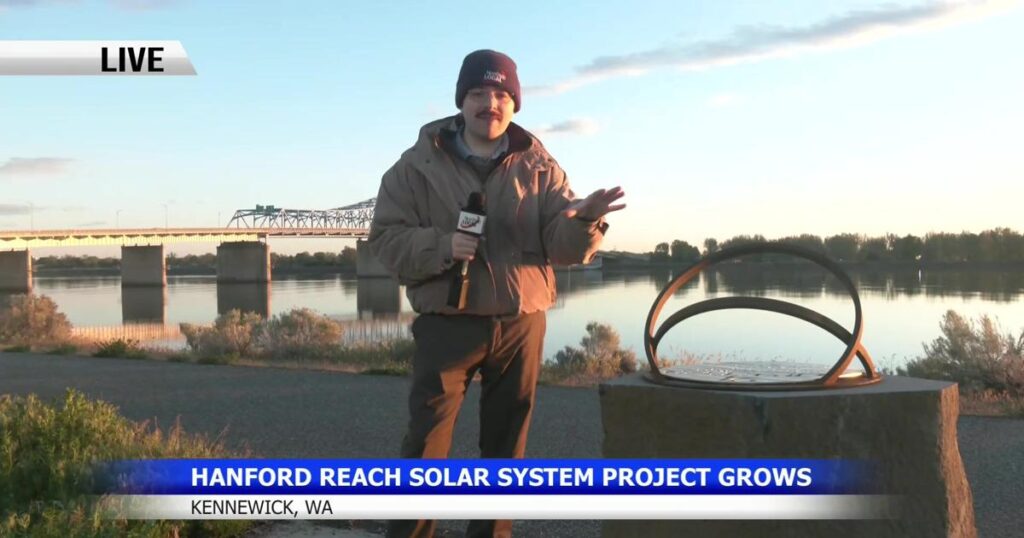
KENNEWICK, Wash.– A growing solar system model stretching from Oregon to Prosser gave visitors a new way to explore Tri-Cities trails and the scale of space.
Just over a year ago, the Hanford Reach Solar System Project from SILAS Education had five planetary markers scattered throughout Kennewick, centered at the REACH Museum’s Solar Arches. Since then, the model tripled, and programs for now-15 markers have been announced.
Trevor Macduff, a well-tenured and NASA-approved educator from Richland School District and creator of SILAS, explained the goal was to give families, groups and classrooms a hands-on way to learn.
“We have this opportunity for you, for your group, for your family, for your classroom– to go and explore this deliberately,” Macduff said.
Macduff said the project had been 15 years in the making. After the board at the museum approved the idea, the work started with the sun.
“I went to my students and I said, ‘Hey, we’ve got a partnership with The Reach [Museum]. They’ve approved a 40ft diameter sun. What can that look like?’” Macduff said. “And we came out with a whole bunch of ideas, and then we compiled them together into what we have now is the solar arches.”
An even larger concept was born soon after.
“We’re building a scale model of the solar system… I sat down with a map, and I started drawing orbits on the map with a 40ft diameter sun here at the Reach Museum. We end up with Pluto, our furthest planet, going through the boat launch at the White Bluffs for the Reach Monument,” Macduff said.
Once finished, the project aims to share the story of the planets in our nearest system and how people related to them.
“What do we know about each planet? How do we know it? What is the story of human engagement with each planet?” Macduff said.
Pauline Schafer, Education Manager for the REACH Museum, said, “Whether you’re walking the trail and seeing the planetary markers, or biking… seeing how far you can go, if you can bike all the way to Mars or Jupiter, Saturn. It just kind of helps cement in your consciousness, the scales and distances of the solar system and our place in it.”
“We’re on a planet, in a universe, in a solar system– that’s pretty unkind. For me, what the scale does is it shows how small we are, and that we should take care of each other,” Macduff said.