
The Moon has played a huge role in the development of Earth. It stabilizes the planet, tempered dramatic climate swings, and possibly even provided the tidal heating that might have led to the first life forms. So it’s natural we would want to find a similar Earth/Luna system somewhere else in the cosmos. But astronomers have been searching for one for years at this point to no avail. And a new paper, available in pre-print on arXiv, from Emily Pass and her colleagues at MIT, Harvard, and the University of Chicago describes using the James Webb Space Telescope to track some of the most promising exomoon candidates – only to be foiled by the star they were orbiting.
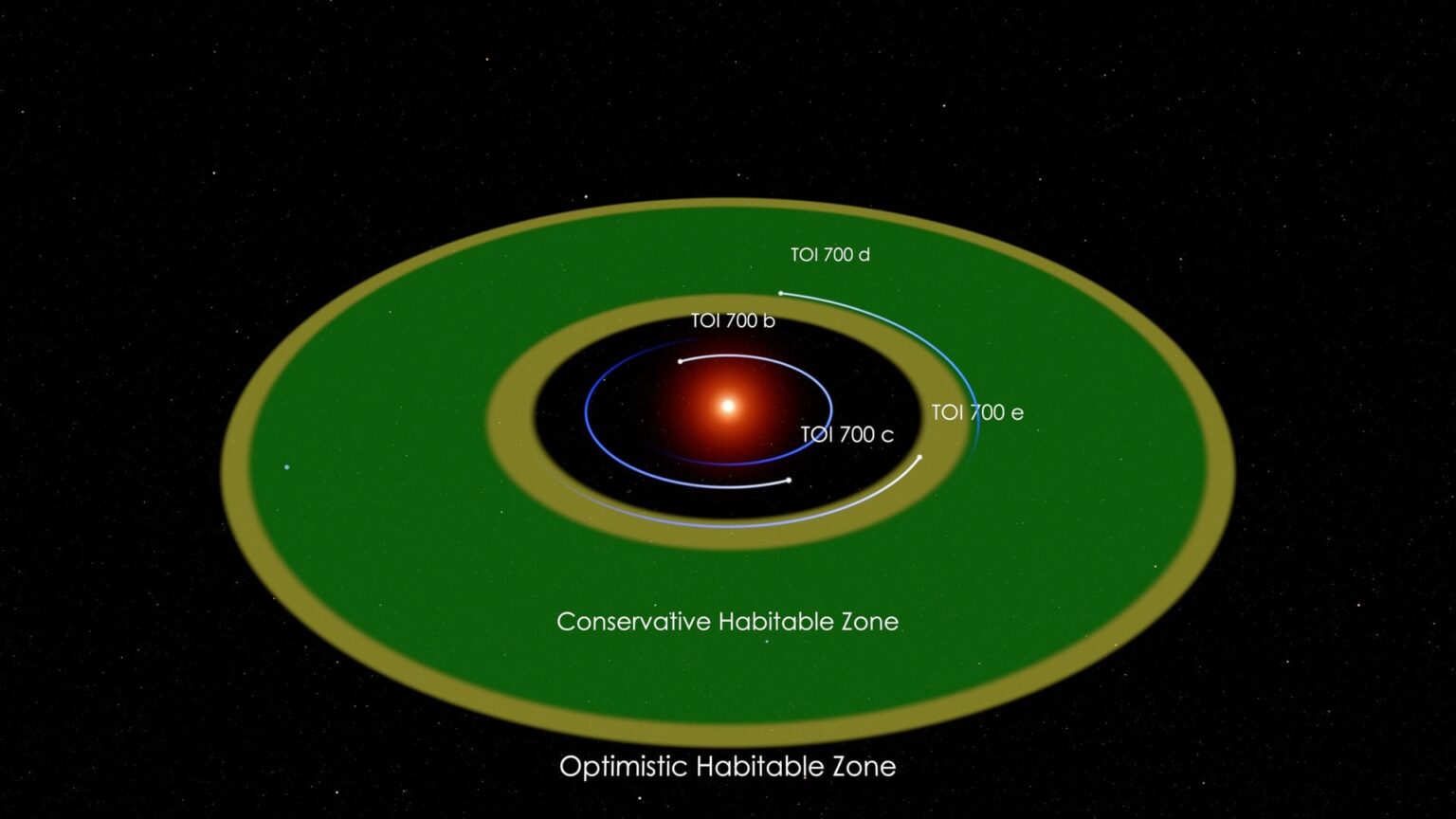
That star is TOI-700. Located about 100 light years away from Earth, TOI-700 is a small M-dwarf star that has a wide variety of known exoplanets, including two Earth-sized ones in the “habitable” zone, known as TOI-700 d and TOI-700 e. According to the paper, these planets are the best candidates we have for holding onto a stable moon, due to their proximity and gravitational pull.
Turning the world’s most powerful space telescope towards them offered our best chance to catch one in action. It was certainly more than capable of improving our knowledge of the planets themselves. Data described in the paper increased the accuracy of our orbital estimates of the planets by an order of magnitude, and improved our measure of their radius (1.145 times Earth for d and 0.919 times Earth for e) by a factor of 2 to 3.
Fraser talks Exomoon Hunting with Dr. Alex Teachey
But one thing it couldn’t do was find definitive evidence of a moon orbiting either planet. In theory, the telescope itself is more than capable of it. The researchers calculated that, in order to detect a Luna-analog, JWST would need to detect a 20 parts per million (ppm) dip in starlight. It is perfectly capable of doing so, but in fact, it might just be too good.
When analyzing the data, the research team realized there was a repeating noise pattern known as “red noise”. This signal is caused by stellar granulation – the boiling and bubbling that happens in the plasma on the surface of a star. The signal itself oscillated every 16 minutes, and had an amplitude of around 46 ppm – essentially washing out any 20 ppm signal a moon might give off.
The best conclusion the researchers could draw with that level of certainty was that their observations were only sensitive to moons larger than Ganymede (the largest moon in our own solar system) on orbits longer than 2 days.
Fraser discusses the challenges of finding an exomoon with Dr. David Kipping, a world expert on exomoon and also a YouTuber at CoolWorlds
That’s not much of a constraint, but there was a bit of silver lining. The researchers also determined that, if someone was able to develop a noise-reducing algorithm that can remove the “red noise”, and if there is actually a moon in the system, the dataset should show it. In other words, we might have already collected the data to prove the first discovery of an exomoon. But we just can’t parse the signal from the noise yet.
Exomoon hunting has faced similar problems throughout its history. Explanations for potential exomoon discoveries range from the planet passing over a sunspot to statistical variance that called the finding into question. Some astronomers have even turned to searching for moons around exoplanets, specifically to eliminate the noise from host stars that caused such a problem with the most recent paper.
But for now, definitive evidence of a moon orbiting an exoplanet remains elusive. Astronomers and software engineers are nothing if not inventive, though, so it might be only a matter of time before someone comes up with a mathematical framework to eliminate this stellar noise. And when they do, there might just be the evidence astronomers have so long sought hiding in the data behind that noise.
Learn More:
E.K. Pass et al. – The JWST Search for Earth-Luna Analogs: Upper Limits on Exomoons and Refined Ephemerides for TOI 700 d and e
UT – Finding Exomoons Using Their Host Planet’s Wobble
UT – The Search for Exomoons is On
UT – Are Rogue Exomoons the Newest Frontier in the Search for Habitability?