
A new study has identified 45 rocky exoplanets — planets orbiting other stars in the Milky Way — that may be capable of supporting life. The research, published in the Monthly Notices of the Royal Astronomical Society, narrows down the most promising candidates from more than 6,000 known exoplanets.
The international team, led by Professor Lisa Kaltenegger of Cornell University, analyzed data from the European Space Agency’s Gaia mission and NASA’s Exoplanet Archive to identify planets within the so-called habitable zone. This region is defined by conditions that allow liquid water to exist on a planet’s surface.
“Our paper reveals where you should travel to find life if we ever built a ‘Hail Mary’ spacecraft,” said Kaltenegger, referring to the Hollywood movie depicting an astronaut on a years-long mission to search for life beyond Earth. The planets featured in the movie, Tau Ceti and 40 Eridani A, are not on the shortlist.
Distant Worlds And ‘Project Hail Mary’
Among the shortlisted planets are well-known exoplanets such as Proxima Centauri b, just 4.2 light-years away, TRAPPIST-1f (41 light-years), and Kepler-186f (500 light-years), alongside less familiar candidates such as TOI-715 b (137 light-years). Particularly notable are the TRAPPIST-1 planets d, e, f and g, located about 40 light-years from Earth, as well as LHS 1140 b, which lies 48 light-years away.
“These planets could prove critical,” said Kaltenegger. “As Project Hail Mary so beautifully illustrates, life might be much more versatile than we currently imagine, so figuring out which of the 6,000 known exoplanets would be most likely to host extraterrestrials such as Astrophage and Taumoeba – or Rocky – could prove critical, and not just to Ryan Gosling.”
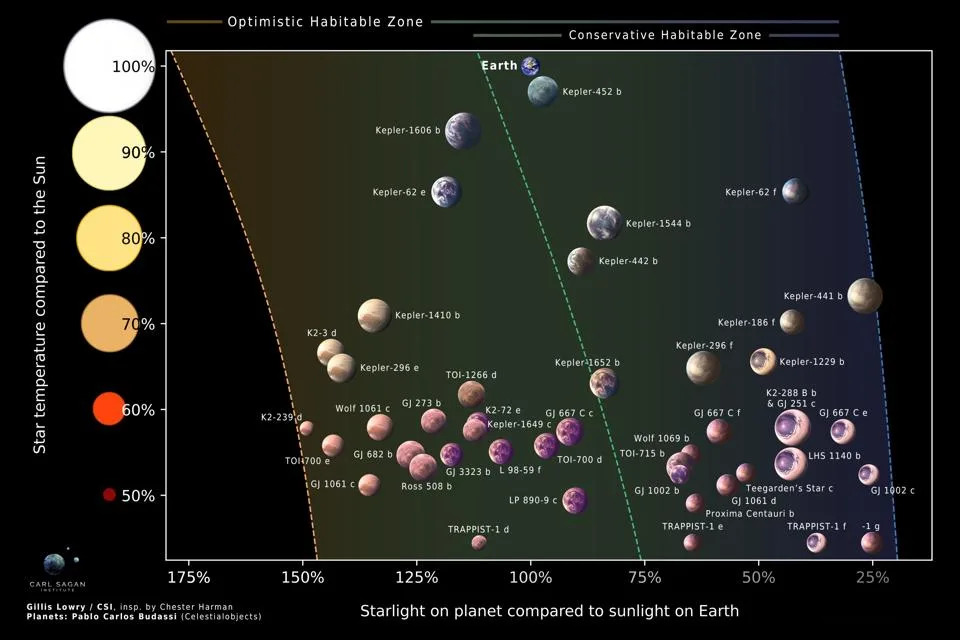
A diagram depicting habitable zone boundaries across star type with rocky exoplanets from Bohl et al. (2026). The boundaries of the habitable zone shift based on star colour, since different wavelengths of light will heat a planet’s atmosphere differently.
Gillis Lowry / Pablo Carlos BudassiThe Limits Of Habitability
The study also explored the boundaries of habitability by identifying planets at the inner and outer edges of the habitable zone, as well as those with unusual orbital patterns. These findings may help scientists refine their understanding of how much heat or cold a planet can tolerate while still supporting life.
“We know Earth is habitable, while Venus and Mars are not, said co-author Abigail Bohl. “We can use our Solar System as a reference to search for exoplanets that receive stellar energy between what Venus and Mars get.”
Target List For Webb Telescope
The researchers say their findings can act as a shortlist of targets for the James Webb Space Telescope and upcoming missions such as the Nancy Grace Roman Space Telescope.
“While it’s hard to say what makes something more likely to have life, identifying where to look is the first key step – so the goal of our project was to say ‘here are the best targets for observation,” said Gillis Lowry, a contributing researcher.
Wishing you clear skies and wide eyes.
This article was originally published on Forbes.com