
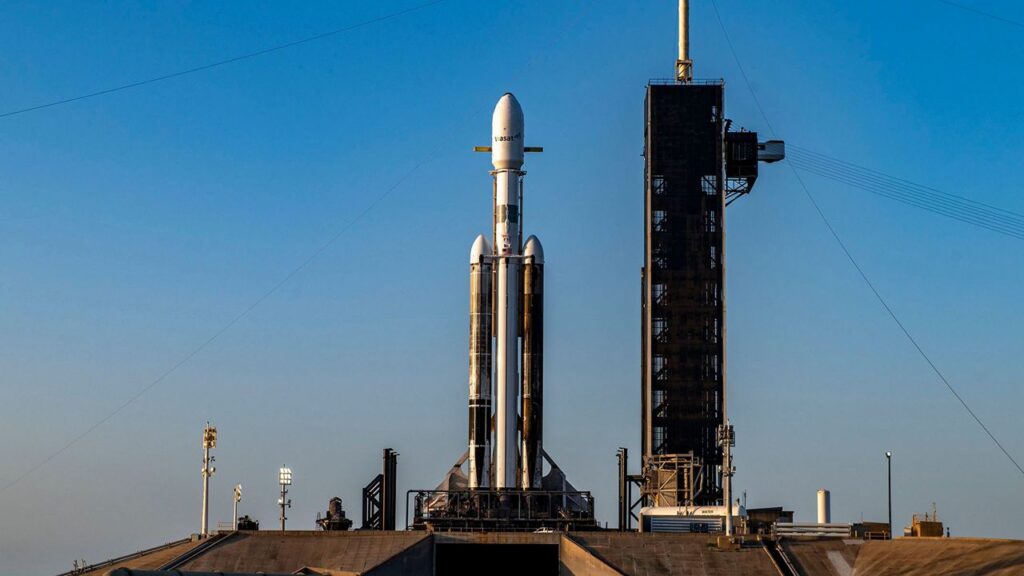
KENNEDY SPACE CENTER — SpaceX plans to use its Falcon Heavy rocket to launch the ViaSat company’s telecommunications satellite on Monday morning.
What You Need To Know
The rarely seen Falcon Heavy is expected to send up the ViaSat-3 F3 mission from the Kennedy Space Center’s Launch Complex 39A
The Falcon Heavy is made up of three Falcon 9 rocket boosters, with a total of 27 Merlin engines
Global communications company ViaSat’s broadband ViaSat-3 F3 satellite will be sent to a geostationary orbit
The rarely seen Falcon Heavy is expected to send up the ViaSat-3 F3 mission from the Kennedy Space Center’s Launch Complex 39A, stated SpaceX.
The last time the Falcon Heavy rocket took off was for NASA’s Europa Clipper mission in October 2024. The clipper spacecraft’s mission is to investigate Jupiter’s moon Europa, where there might be a chance of life under its icy surface.
The 85-minute launch window opens at 10:21 a.m. ET. That means SpaceX has during that time frame to send up the massive rocket.
If there is a scrub, the next launch attempt is Tuesday with another 85-minute launch window opening at 10:17 a.m. ET.
Taking off
The Falcon Heavy is made up of three Falcon 9 rocket boosters, with a total of 27 Merlin engines. (Each rocket booster has nine Merlin engines.)
For this mission, each of the side boosters will attempt to land in a landing zone but the center booster will not be recovered.
The side booster, B1072, has only conducted one launch: the GOES-U weather satellite in 2024.
The booster will land at Landing Zone 40.
For the booster B1075, this will be its 22nd mission. This is the first Florida launch for the booster, which will land at Landing Zone 2.
For the center booster, B1098, this will be its maiden launch. And it is its only launch since it will not be recovered.
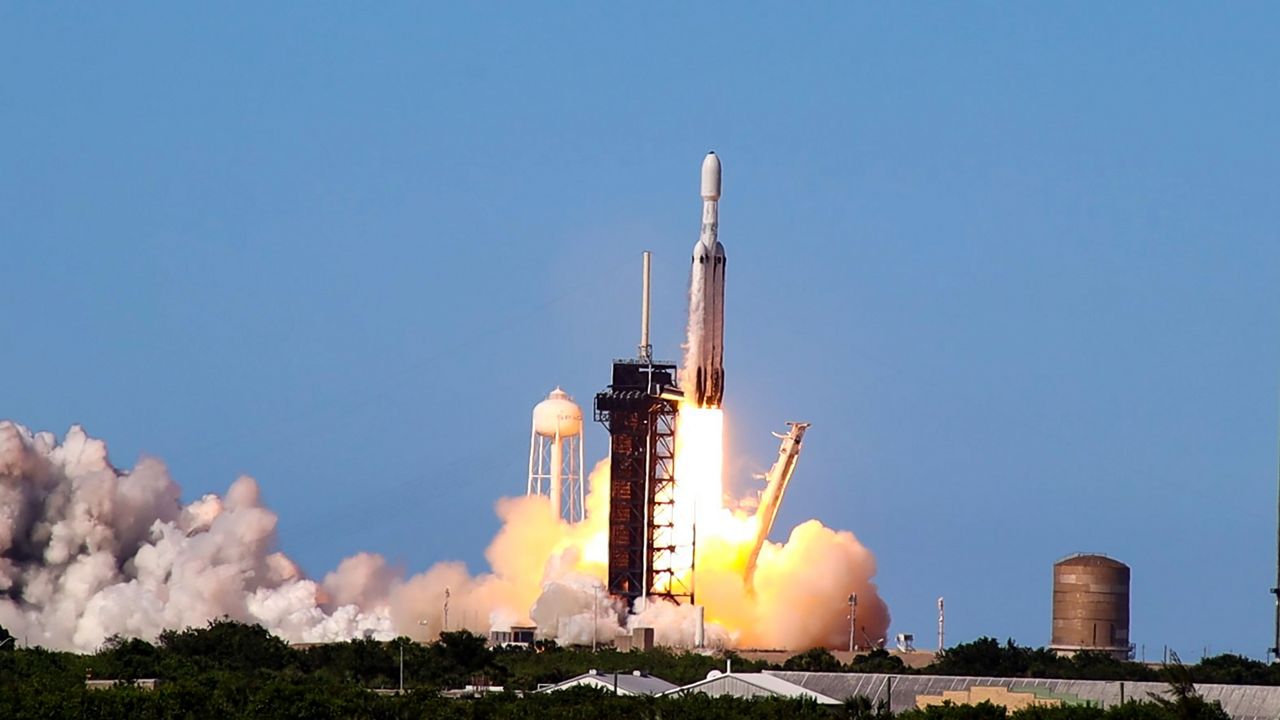
SpaceX’s Falcon Heavy rocket launched the GOES-U weather satellite on Tuesday, June 25, 2024. The GOES-U is the latest and final satellite in the GOES-R series. It will help to provide meteorologists with the latest data to give the most accurate predictions, stated officials. (Spectrum News/Anthony Leone)
About the mission
Global communications company ViaSat’s broadband communications ViaSat-3 F3 satellite will be sent to a geostationary orbit.
In fact, the California-based company stated that it will take a couple of months for it to travel to where it needs to be.
“Following launch, the ViaSat-3 F3 satellite will spend several months traveling to geostationary orbit before arriving at its reserved orbital slot. It will go through rigorous in-orbit testing of both the bus and payload before entering service, expected to occur by late summer 2026,” the company confirmed in a press release.
ViaSat shared the duties of its satellite once it is in service.
“The ViaSat-3 satellites are designed with state-of-the-art technology to maximize efficient, flexible bandwidth deployment and provide enhanced performance for commercial mobility, fixed services and defense customers,” stated the company.