
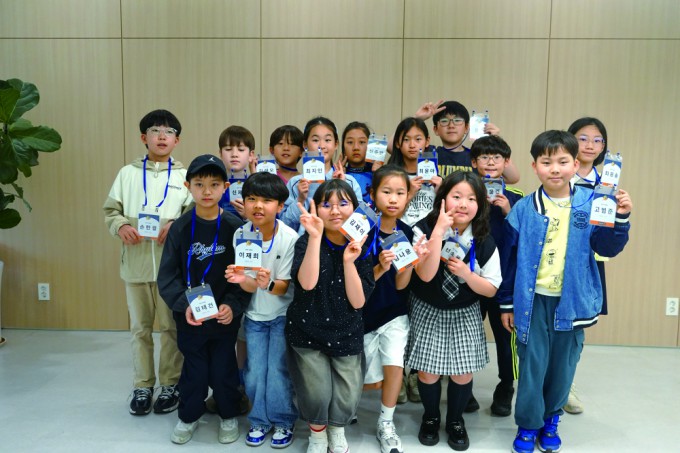
The Junior Space Reporter Corps visiting the Donga Science headquarters for a lecture and hands-on experience. Courtesy of Children’s Science Donga.
[Editor’s Note] Children’s Science Donga, a science magazine published by Donga Science, has been running the Junior Space Reporter Corps since 2024 to instill a sense of dream and challenge about space in elementary school students. In 2025, 1,832 elementary students carried out over 40 space missions as space reporters, and the two students selected as the final junior astronauts visited NASA. We introduce the reporting of the 3rd Junior Space Reporter Corps, who are growing into future space talents by visiting major domestic space agencies and companies, through the ‘Space Bud’ series.
“What would happen if satellites collided in space?”
The eyes of the Junior Space Reporter Corps turned to the screen as Dr. Huh Hyun-oh of SpaceMap posed the question, displaying an image of Earth surrounded by a dense field of satellites and space debris.
On April 15, the first field mission for the Junior Space Reporter Corps was held at the Donga Science headquarters in Seodaemun-gu, Seoul. The 15 junior reporters who participated in the mission attended a special lecture by Dr. Huh from the space traffic management company ‘SpaceMap’ and took part in a hands-on experience using ’42SAGA,’ a space education platform developed by SpaceMap.
This mission was designed to teach the importance of space traffic management, a key component of the future space industry, and to provide children with the opportunity to operate satellites in a virtual space environment.
SpaceMap is a company specializing in Space Situational Awareness (SSA) and Space Traffic Management (STM), founded in September 2021 by Professor Kim Deok-su of Hanyang University’s School of Mechanical Engineering. Even before founding the company, Professor Kim had been operating a ‘platform’ for space traffic management that calculates the real-time positions of objects in space, such as satellites and space debris, to help prevent in-space collisions with other satellites or launch vehicles.
The platform predicts the probability of a collision based on satellite data released by the U.S. Space Force, using a Voronoi diagram researched by Professor Kim. A Voronoi diagram is a structure that divides a space into regions by connecting perpendicular bisectors between various points, which allows for the identification of the spatial area occupied by each satellite.
SpaceMap applies this principle to objects moving at high speeds in three-dimensional space to predict the probability of satellite collisions faster than conventional methods.
At CES 2024 in January, SpaceMap also unveiled ’42SAGA,’ an educational platform based on real-time space simulation. In 42SAGA, users can learn by observing space in a digital twin, create their own avatar satellite, analyze its collision risks with real satellites, perform orbital adjustments, and even take satellite photos.
It also provides various space experiences to the general public and students, with content that includes diverse scenarios such as the Apollo 11 and Artemis missions.
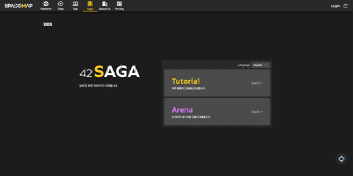
A screenshot of SpaceMap’s 42SAGA. Courtesy of SpaceMap.
“Just as we use various map apps on our smartphones, space also needs a map,” Dr. Huh Hyun-oh explained during his lecture. He added, “Space science may seem difficult at first, but it’s a field you gradually get used to as you try things one by one and understand the principles. I hope that through 42SAGA, the next generation can become closer to space by freely simulating various orbits.”
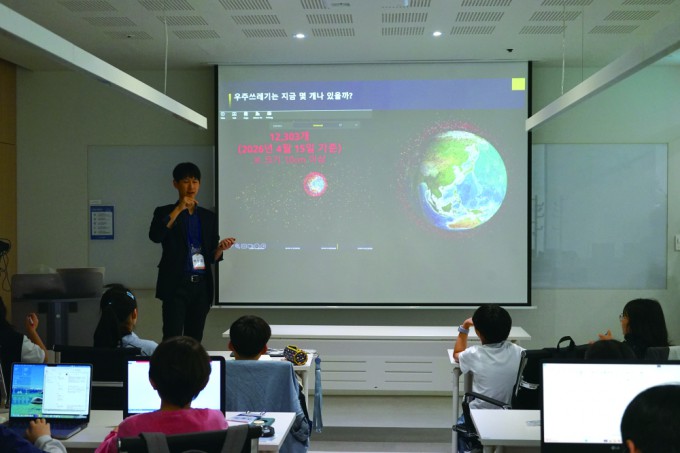
Dr. Huh Hyun-oh lectures on the necessity of space traffic management. Courtesy of Children’s Science Donga.
The Junior Space Reporter Corps first used the platform to observe the numerous satellites and space debris in orbit. The activity then proceeded with the Tutorial function of 42SAGA, where they learned about NASA’s manned lunar exploration plan, the ‘Artemis program.’
Through the tutorial, the junior reporters checked the orbit of the Orion spacecraft from the Artemis 1 mission, which was launched in 2022. Junior Reporter Choi Yun-sol, who participated in the experience, shared, “I learned how the Orion spacecraft orbited the Moon and returned to Earth.”
Next was a session using the free-roam program, the Arena function, where they had time to create their own satellites. The junior reporters set specific missions and orbits for their satellites and carried out the task of capturing images of Earth.
In the process of naming their satellites and assigning them roles such as transmitting/receiving radio waves or observing the Earth’s surface, each junior reporter created a satellite reflecting their own personality. The photos sent back by the simulated satellites orbiting the Earth showed blue oceans and snow-covered fields. “It was amazing and fun to create a satellite myself and take pictures,” said Junior Reporter Kim Jae-yi.
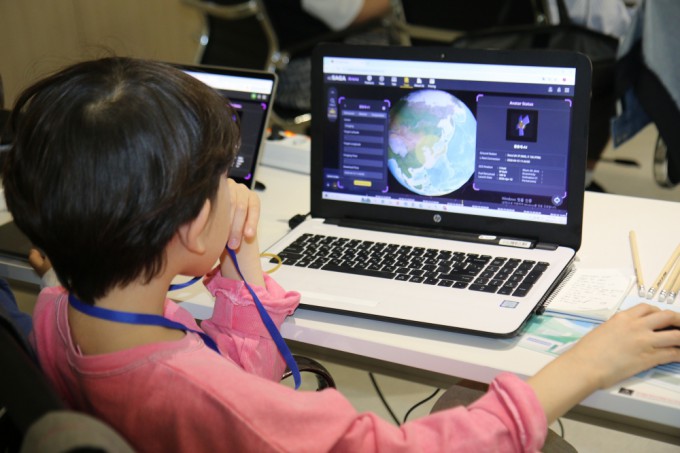
Creating a custom satellite using 42SAGA. Courtesy of Children’s Science Donga.
Junior Reporter Kim Rae-o remarked, “SpaceMap seemed like a space map that shows the location and movement of satellites and helps prevent collisions.” Junior Reporter Lee Jae-hee also shared her thoughts, saying, “It’s amazing to take pictures of the Earth with a satellite I made myself. I definitely want to participate in the next mission.”
Meanwhile, the 3rd Junior Astronaut Contest is sponsored by Kolon, the Korea AeroSpace Administration (KASA), the Korea Aerospace Research Institute (KARI), Korea Aerospace Industries (KAI), TelePIX, the Daegu National Science Museum, the Gwangju Institute of Science and Technology (GIST), the KAIST Space Research Institute, SpaceMap, INNOSPACE, and the Gwangju National Science Museum. The final junior astronauts who excel in their missions will have the opportunity to visit and report on NASA and other U.S. space companies this November.
Join ‘Children’s Science Donga’ to take on various space missions and challenge yourself to become a final junior astronaut!
▼Apply for the Junior Space Reporter Corps
https://www.popcornplanet.co.kr/astronaut
Copyright ⓒ DongA Science. All rights reserved.